Rocky Gerung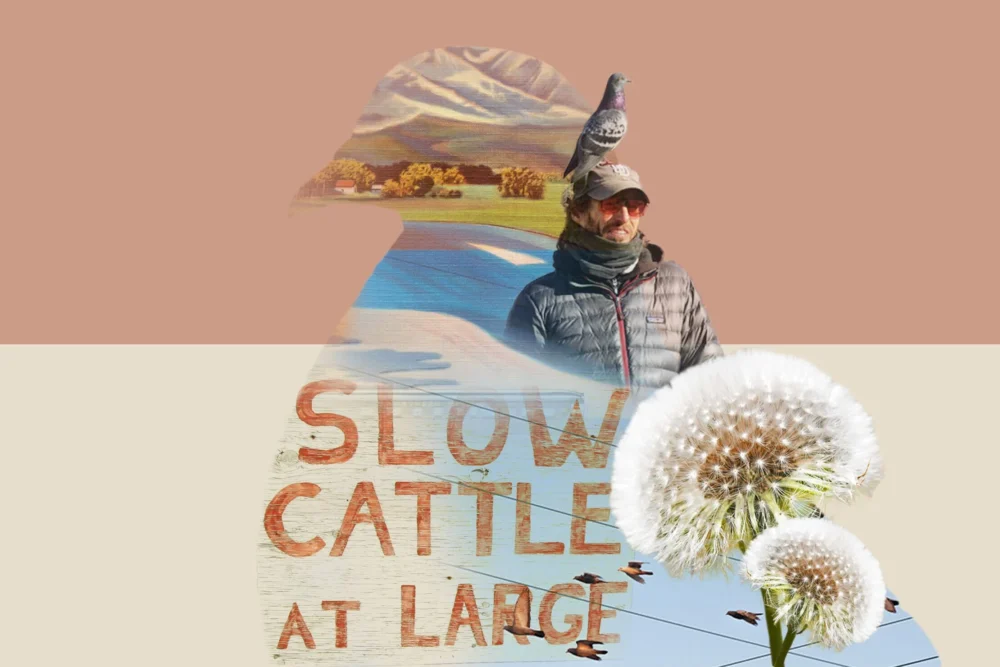
The notion of Montana first captured my imagination during high school, a vision of vast remoteness, untamed natural beauty, and boundless adventure. It represented an escape from the intense pressures of urban professional life, a place where I wouldn’t feel compelled to become a lawyer or banker, nor experience shame for not fitting that mold; a place where solitude wouldn’t equate to loneliness. This was in 1985, a time when such idyllic, uncrowded landscapes still seemed readily accessible within the continental United States.
My first actual encounter with Montana occurred in 1997 when I drove from Chicago to find a place to rent while pursuing graduate studies in Missoula. It was the heart of summer, and the clarity of the air, sky, and water was striking. Each time I passed a rolling hillside, an irresistible urge to stop the car and run up its slopes would overcome me. I soon discovered some of Montana’s unique characteristics. For instance, upon my arrival, there was no daytime speed limit on the state’s highways. Montana had only briefly adhered to a speed limit during the 1970s energy crisis, a mandate imposed by the federal government, and even then, the state managed to circumvent it almost entirely. While occasional speed limit signs were posted, drivers rarely heeded them, and police officers would sporadically issue citations. However, these tickets were not for "speeding" in the traditional sense; instead, they were for "wasting fuel." Regardless of the speed driven, unless it was deemed reckless, the fine for such an infraction was a mere five dollars.
One of the early sights that truly delighted me in Missoula was a "CATTLE AT LARGE" sign. Until that moment, the term "at large" had only conjured images of criminals and escaped convicts. This sign prompted a reevaluation of my perception of cows. Were they merely innocent grazers by the roadside, or were they harboring complex thoughts and clandestine plans? What lay behind those large, dark eyes? I vividly recall a drive on a secluded back road, traveling at approximately fifty miles per hour, when I rounded a bend and encountered a "CATTLE AT LARGE" sign. The warning to slow down proved providential, as a considerable shadow loomed ahead – a shadow that might have been directly in my path had I not seen the sign. This shadow resolved into a very large cow, lying languidly halfway across my lane.

The expression "at large" signifies "with great liberty," or, in essence, possessing an expansive territory for roaming. This sentiment resonates with the yearning for freedom often expressed by the young characters in Bruce Springsteen’s music. Montana features such signs because it is a state with expansive regions where cattle roam freely without the constraint of fences. It’s a place where one might drive for a hundred miles and suddenly encounter a herd of thousand-pound animals meandering across the road, showing no urgency to move. This mirrors the situation in my own home, which is currently populated by numerous pigeons "at large," creating an environment where the boundaries between my world and the natural world have blurred. Though I departed the metropolis long ago, I find myself situated in what I’ve come to call Pigeonopolis.
One of the young pigeons exhibits a distinct spraddle-legged gait. Even as a fledgling, it was evident that this bird struggled to maintain its balance. Its left leg would trail behind, causing the hip joint to twist backward. Initially, I attempted to bind its legs together, but this proved ineffective. My subsequent solution involved acquiring tags, which are plastic cuffs clipped onto the bird’s leg just below the knee. I then doubled up some yarn, knotting it to each cuff, thereby restricting the distance between its feet and ensuring the soft yarn wouldn’t chafe its underside.
After a few weeks, until the pigeon reached a juvenile stage, I removed the cuffs. The bird was then able to keep both feet mostly beneath it. However, within a few days, the affected leg reverted to its spraddled position, and the hip joint again turned in the wrong direction. Despite its disability, this bird demonstrates a remarkable effort to behave like a "normal" bird, making it one of my particular favorites. It currently occupies the floor of my living room, precisely in the middle of the wide doorway leading to the kitchen, and it consistently gazes at me. Each time I pass by, it becomes startled, yet this remains its preferred spot in the house, and it shows no inclination to move.
In the hearthside cabinet resides the juvenile pigeon that the neighbors brought to me, the one with the fractured wing. Additionally, another young pigeon is in my living room; it is the offspring of my caged female and the "bully" male pigeon who has established a nest in a box on the porch. I had installed this box last year for Two-Step, my initial pigeon, and V., his mate, though they never truly took to it. I am certain of the juvenile’s paternity because it bears no resemblance to its mother or her partner, but it is identical to the bully pigeon. It’s likely that a few months ago, I moved the cage onto the porch and opened the door, allowing the flightless couple some supervised time in the yard. During that period, the female apparently had a brief, yet consequential, liaison with the bully pigeon. Nevertheless, her partner remains devoted to her, and they engage in all activities together. When I release them, they amble side-by-side to the far end of the lawn, mirroring each other’s actions; if he is pecking at dandelion leaves, she does the same. Within the confines of the cage, they stand pressed closely together, wing touching wing.

This beautiful "bastard child" now ambles around my living room, very much at large, searching for a comfortable spot on the floor to settle down. This avian activity serves as a welcome distraction, as I too am considered "disabled" by legal standards. The experience is also profoundly meditative and appears to alleviate my headaches. At certain times of the day, all three of these young pigeons commence preening their feathers, producing a rhythmic rustling sound that permeates the room. Two-Step and V. are situated in their nesting box beside me, on the other side of the window, benefiting from the warmth radiating from the house. I have just adjusted the rod to close the blinds, creating a more nocturnal atmosphere within their space, hopefully encouraging them to adhere to regular bird sleeping patterns. I too will soon retire, and in our shared dreams, we will all find safety.
I currently have twelve birds freely moving or flying within my home. Although I have strived to create an environment that evokes a sense of wildness, they are gradually becoming more comfortable with my presence. My hope is that when spring arrives and I release them, they will swiftly learn to fear creatures resembling me. They have incrementally begun to encroach upon my personal space. At one point last night, two were perched on the back of the couch behind me, one sat in a cardboard box next to me, another was atop the miniature artificial Christmas tree directly in front of me, and – because I had my legs propped up on the coffee table – one was standing on my toes, subsequently walking up my leg. I must have resembled a character from a Disney animation. Any sudden movement on my part, or even a sneeze, would have sent them all into a chaotic flight, scattering feathers everywhere. However, I had no reason to move; I was as still as a statue in a park, adorned with pigeons. I found pleasure in observing the spread of their pink toes and the peculiar amble of the bird ascending my leg, coming so close that I could discern the flecks within the gold ring encircling its eye.
Whatever brings joy to the birds brings joy to me. I hold a deep affection for these creatures and am profoundly grateful that they diminish my sense of loneliness. Having this singular purpose in my life – being their shepherd – provides me with immense satisfaction. My understanding of them grows daily, enabling me to adopt a more bird-like demeanor, which, in turn, reduces their apprehension around me. On most days, my interactions with birds far exceed my interactions with people. Aside from the occasional embrace or fist bump, I have not experienced human touch in a very long time. Yet, I am touched by the birds when they stand on my toes, when I gently lift the young ones to clean their enclosure, or when I give Two-Step a bath. Sometimes, as I pass the hours on the couch, a thought arises from the depths of my mind: "I am becoming bird." Perhaps soon, I will begin to comprehend the communications of the birds around me. Perhaps I will start each day by emitting contented, pleasant "chukking" sounds to a partner I have somehow found, and later, as the sun reaches its zenith, we will soar together, perching on telephone wires, gazing out over the treetops at the undulating green swells of the Montana landscape.