Rocky Gerung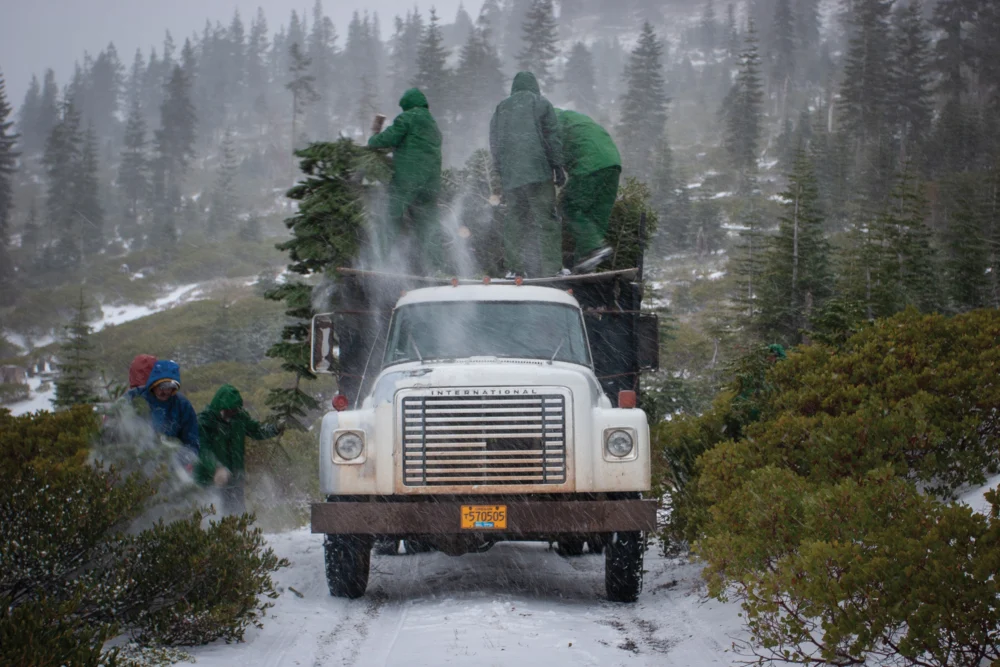
High on the volcanic slopes of Northern California’s Cascade Range, amidst air that bites with autumnal chill, a fleeting tradition unfolds. Between mid-October’s first frost and November’s deep snow, the sharp sound of chainsaws punctuates the resin-scented air. Here, on the challenging terrain of mountains like Haight and Worley, crews work under the nascent winter sky to harvest wild red firs, scientifically known as Abies magnifica, or more commonly, silvertips. These iconic Christmas trees, distinguished by their silvery-tinged needles and naturally symmetrical branching, thrive at elevations between 6,500 and 8,000 feet, their growth shaped by the region’s stark cycles of scorching summers and freezing winters. The short, intense harvesting season, often lasting just two to three weeks, is a race against the elements, with early snows threatening to shut down access and end the arduous work.

John Wayne Strauch, affectionately known as "Bambi" by his peers, has been a part of this wild Christmas tree harvest for five decades. Now 80 years old, he holds timber rights on over 300 acres of land on Worley Mountain, a testament to his enduring connection to this demanding profession. "You only get a few weeks," Strauch explained, reflecting on the tight window of opportunity. He described the critical conditions necessary for a successful harvest: "If the ground doesn’t freeze, the needles won’t set," a crucial factor for needle retention, and "If it snows early, you’re done." Despite the immense physical toll and often slim profit margins, Strauch expressed a sentiment shared by many in this niche industry: "Guys are barely breaking even… but we just keep doing it." This deep-seated commitment speaks to the cultural significance and personal fulfillment derived from this annual endeavor.

Strauch’s journey into wild tree harvesting began in the early 1970s alongside his godfather, Joe McNally. As novices in the business, they sought adventure and learned invaluable lessons through trial and error, battling snowdrifts with broken-down trucks and enduring the frustration of sudden storms that could decimate their efforts. Yet, each winter, they returned with the same unwavering goal: to bring a piece of the untamed wilderness into homes across the nation.

The workforce for this challenging harvest is largely composed of migrant workers, many of whom travel north each winter, often transitioning from agricultural jobs in orchards and vineyards. This year, however, brings a layer of added complexity and uncertainty. Dan Barker, who assists in overseeing the harvest, noted that significant shifts in immigration policies and an increased risk of Immigration and Customs Enforcement (ICE) raids have introduced new anxieties for these workers, impacting the stability and predictability of the labor force.

Typically, the operation relies on two dedicated crews, totaling around 18 individuals, forming the core of the harvesting process. This team includes essential roles such as a cook to sustain the remote workforce, two drivers for transportation, two skilled cutters responsible for felling the trees, and a bail operator. The remaining crew members are tasked with the labor-intensive job of hauling the harvested trees from the dense forest. Working with remarkable speed and efficiency, these teams expertly slice and drag the silvertips down steep inclines.

Once at the collection point, each tree undergoes a meticulous grading process. Its shape, symmetry, and the density of its branches are carefully assessed, with trees categorized into grades ranging from "2s" and "1s" to "primos" and "double primos." This grading system, coupled with height, determines the tree’s price, a crucial element in connecting the remote mountain forests to living rooms hundreds of miles away. For instance, an 8-foot silvertip with a "double primo" grade could command a price of approximately $250 at a retail lot, while a "2" grade of the same size might fetch only half that amount.

The sustainability of this wild harvest hinges on a time-honored practice known as coppicing, or stump culturing. This technique involves making a precise cut that leaves the tree’s base intact, allowing it to regenerate. Within a few years, one of the remaining branches receives natural signals and redirects its growth towards the sun, eventually developing into a new tree. Strauch emphasized the ecological wisdom of this method: "We’re not clear-cutting," he stated. "The better we take care of the trees, the better they take care of us. Some, we’ll get five, 10 harvests. Those are the mothers." This cyclical approach ensures the forest replenishes itself naturally, eliminating the need for replanting, tilling, or chemical treatments, a sustainable model that has sustained these slopes for generations.

Strauch’s operation on Worley Mountain yields approximately 7,000 trees annually, positioning it as one of the nation’s few remaining commercial wild Christmas tree harvests. While small in scale compared to the vast operations of farmed Christmas trees, its value is amplified by the unique qualities of the silvertip, its inherent sustainability, and the profound connection forged between the land and the labor involved. "These are beautiful trees with a beautiful story," Barker remarked, expressing a hope that resonates with the heart of this tradition. "We don’t just want people to accept them—we want them to love them like we do." This sentiment underscores the deep respect and care that define this enduring, albeit challenging, mountain livelihood.