Roger Danuarta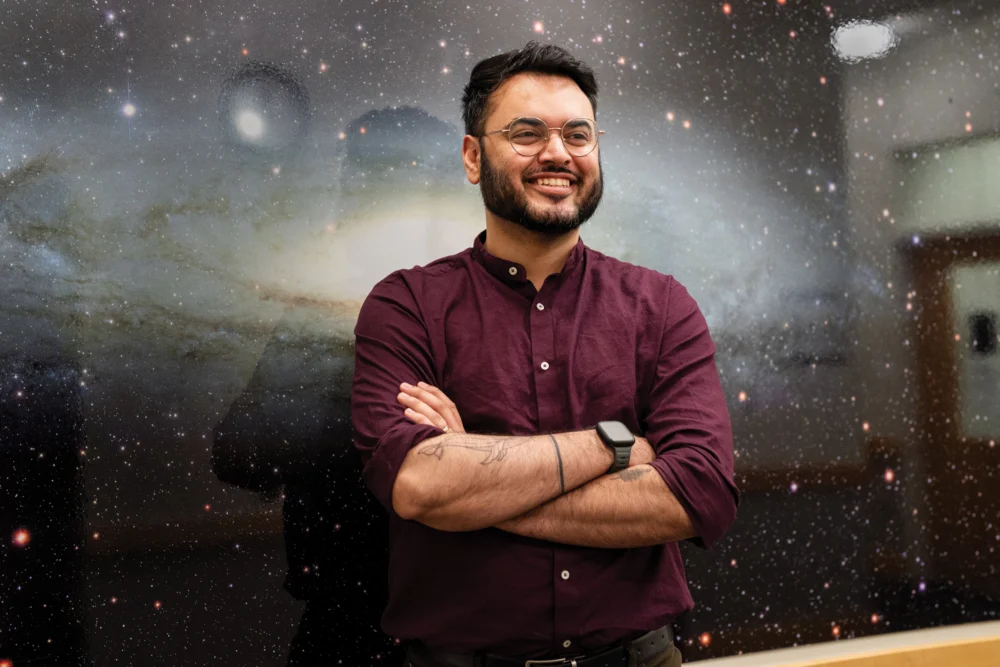
Gourav Khullar, a Baum postdoctoral fellow for innovative astronomy at the University of Washington, grapples with a profound paradox central to his field: the immense, almost incomprehensible scale of cosmic time versus the fleeting brevity of human existence. This fundamental dichotomy, a constant companion for many astronomers, forces a reckoning with what our "blip" of individual and collective history truly signifies against a backdrop of billions of years of universal evolution. Khullar, based in Seattle, Washington, articulates a perspective where the abstract grandeur of the cosmos, though intellectually captivating, must continually be brought back to the tangible, immediate needs of human communities.
The concept of "deep time" fundamentally reorients our understanding of existence, stretching far beyond human memory, written history, or even the entire span of our species on Earth. It encompasses geological eras measured in millions of years, tracing the slow, relentless dance of tectonic plates, the rise and fall of mountain ranges, the ebb and flow of ancient oceans, and the gradual evolution of life from single-celled organisms to complex ecosystems. On an even grander scale, cosmological deep time extends back 13.8 billion years to the Big Bang, charting the formation of galaxies, stars, and planets, including our own solar system. This vastness, once an abstract philosophical concept, has become quantifiable through the rigorous methodologies of modern science, particularly astronomy and geology. Scientists meticulously analyze starlight, ancient rock strata, and fossil records to construct a detailed, albeit still unfolding, narrative of cosmic and planetary history.
For Khullar and his peers, daily work involves contemplating these staggering timescales. They decipher light signals from distant galaxies that began their journey billions of years ago, observe the life cycles of stars spanning millions of years, and model the universe’s evolution over eons. This immersion in cosmic scales inevitably leads to a philosophical introspection about humanity’s place. While the intellectual pursuit of understanding the universe’s origins and ultimate fate is intrinsically rewarding, it often clashes with the immediate, pressing "ground realities" faced by communities worldwide. Issues such as climate change, resource scarcity, social inequality, and global health crises demand urgent attention, often framed within human-centric timescales of decades or centuries.

Khullar highlights this tension: the immense effort dedicated to philosophizing and constructing abstract models of the universe feels dwarfed when juxtaposed with the tangible struggles of everyday life. This is not to diminish the value of fundamental research, which has consistently driven technological advancement and expanded human understanding, but rather to acknowledge the ethical and existential challenge it presents. How does one reconcile the pursuit of knowledge about black holes and dark energy with the urgent need for clean water, sustainable energy, or equitable education on Earth? This question underscores a broader societal debate about the allocation of resources and the ultimate purpose of scientific endeavor.
Intriguingly, Khullar suggests that our very understanding of deep time has, paradoxically, "shrunk in size." This counter-intuitive notion stems from the fact that as scientific knowledge advances, the once-unfathomable concept of "billions of years" becomes more concrete, more measurable, and less a boundless void. We now have a clearer picture of what these vast stretches of time entail—specific epochs, geological events, and evolutionary milestones. This precision, while expanding our intellectual grasp, also brings into sharper focus the definite, finite nature of our own existence within that grand timeline. No longer is deep time merely an infinite abyss; it is a structured, if immense, chronology. And within that structured immensity, our "blip" becomes more pronounced, more clearly defined as the brief, precious moment we inhabit.
This heightened awareness of brevity, rather than inducing despair or nihilism, can foster a profound appreciation for the present. Khullar reflects that this understanding cultivates "a deeper appreciation of the life I’m living, the space I’m occupying and the time I get to spend with the people that I care about." When confronted with the universe’s indifferent majesty and the vastness of cosmic history, the transient nature of human experience gains immense value. It emphasizes the importance of connection, empathy, and responsible stewardship of our shared planet during our brief tenure.
The recognition of humanity’s "blip" within deep time carries significant implications for our approach to global challenges. A deep time perspective can inform environmental policies, urging us to consider the long-term consequences of our actions on ecosystems and future generations, rather than solely focusing on immediate economic gains. It underscores the fragility of Earth’s delicate balance, reminding us that planetary conditions conducive to complex life have evolved over billions of years and can be disrupted in mere centuries by human activity. This awareness can foster a sense of shared responsibility, uniting diverse communities under the common goal of preserving the only home we know in the vast, indifferent cosmos.

Moreover, a deep time perspective offers a powerful antidote to presentism—the tendency to view current events and values as universally applicable or as the culmination of history. It reminds us that our cultural norms, political systems, and technological advancements are but momentary snapshots in an ongoing, evolving story. This broader lens can promote humility, encouraging us to learn from the past, adapt to change, and envision futures that extend beyond our immediate horizons. Indigenous knowledge systems, for instance, often embody a profound connection to ancestral lands and a multi-generational view of stewardship, offering valuable lessons on living in harmony with the natural world over extended periods.
Ultimately, the contemplation of deep time, as articulated by Gourav Khullar, is not merely an academic exercise but a transformative philosophical journey. It forces individuals and societies to confront their own scale within the universe, prompting a re-evaluation of priorities. While astronomers continue to unravel the universe’s grand narrative, their insights serve as a poignant reminder that our finite time on this pale blue dot is an extraordinary opportunity—a "blip" that, precisely because of its brevity, demands our deepest appreciation, most thoughtful actions, and most profound connections. This cosmic humility, far from diminishing human endeavor, elevates the urgency and significance of our collective efforts to build a sustainable and compassionate future within the vast expanse of time and space.