Rocky Gerung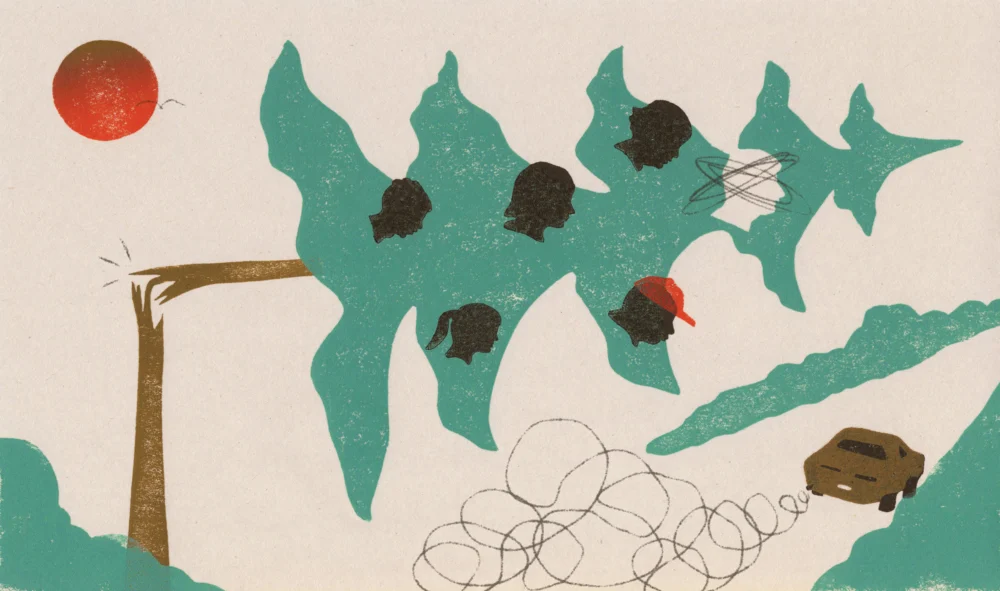
Thirty years ago, in the summer of 1992, Jess Walter, then a staff writer for The Spokesman-Review in Spokane, Washington, found himself drawn to an isolated mountaintop cabin in northern Idaho. His on-the-ground reporting documented the events that would become known as the Ruby Ridge standoff, a pivotal moment that continues to resonate in the American consciousness. The incident began when Randy Weaver, an adherent of the Aryan Nations with fervent apocalyptic beliefs, failed to appear in court to face charges related to the sale of a sawed-off shotgun. This triggered a forceful response from federal agents who surrounded his remote dwelling. The ensuing 11-day siege culminated in a tragedy that claimed the lives of Weaver’s wife, his son, and a U.S. Marshal. Ruby Ridge served as a powerful catalyst for the anti-government militia movement, its echoes shaping political discourse to this day.
The intense siege was the subject of Every Knee Shall Bow, Walter’s sole work of nonfiction. Now, after a distinguished career spanning three decades as a best-selling and award-winning novelist, Walter is once again confronting the profound impact of Ruby Ridge on a nation grappling with its ideals of freedom, values, and the very nature of government.
His latest novel, So Far Gone, delves into the story of Rhys Kinnick, a middle-aged man adrift in a sea of disillusionment following a divorce. His son-in-law, Shane, has become deeply entrenched in a labyrinth of conspiracy theories, leaving Kinnick bewildered by his daughter’s continued devotion to him. Having lost his newspaper job and witnessing the election of Donald Trump, Kinnick finds the weight of these societal shifts unbearable and retreats to an off-the-grid cabin, seeking solace in isolation. His fragile peace is shattered when his grandchildren, whom he has not seen in years, arrive with a plea: their mother, Kinnick’s daughter, is missing, and Shane has embarked on a solitary quest to find her.

While So Far Gone is not a direct fictional retelling of the Ruby Ridge saga and the Weaver family’s ordeal, it features characters who embody the spirit of those who might have once rallied behind such causes. Set in and around Walter’s hometown of Spokane, the novel offers a poignant exploration of disillusionment and its far-reaching consequences. "I think that disillusionment is one of the most human things that happens to us," Walter explains, "So, for Rhys to suddenly find himself the disillusioned one and feeling pushed out of society struck me as a great starting point for a novel."
Kinnick is not the sole character experiencing profound alienation; his daughter struggles to comprehend Shane’s worldview, particularly his finds fellowship among Idaho’s well-armed religious separatists. Walter himself admits to experiencing growing anxiety over the political climate, a feeling amplified by his phone’s screen time usage report. "It informed me that I had been spending five and a half hours a day on my phone, doomscrolling," he shared. "I realized I couldn’t go on like this, imagining the demise of the country. I imagined myself going into a metaphoric woods to write the novel, turning my back on all of it."
Despite its engagement with weighty themes such as the proliferation of conspiracy theories and the rise of militia-affiliated churches, So Far Gone infuses its narrative with a distinctive humor through its cast of quirky characters. In one memorable early scene, Kinnick expresses his exasperation as Shane fervently espouses the belief in a vast conspiracy within the National Football League, where he claims the world’s most powerful figures are attempting to control both players and spectators. Later, the tension escalates to a gunfight erupting over a set of brand-new truck tires.
Walter posits that this comedic sensibility renders the story "in some ways more real, and that makes it more horrible. People do get shot over things like tires. I believe so fully in the folly and fallibility of human beings; in many ways, it’s the only constant. So I don’t write humor as an effect; I write it as a philosophical underpinning of the world as I see it."

In the three decades since he witnessed the anti-government protesters gather at Ruby Ridge, Walter has observed the disconcerting mainstreaming of what were once fringe conspiracy theories. "Now, we live in such a conspiracy-rich world," he remarks. "I don’t think Ruby Ridge was the cause of this so much as a harbinger of what was to come." So Far Gone powerfully captures this unique contemporary moment, as Americans navigate a profound sense of lost purpose amidst an increasingly polarized and fractured political landscape.
Walter is now revisiting his seminal work, which was later retitled Ruby Ridge, to provide its first update since 2008. The new edition will include an afterword acknowledging the passing of Randy Weaver in 2022 and Gerry Spence, Weaver’s legendary and formidable attorney, who died in August. Walter is also re-examining the historical trajectory that allowed anti-government sentiment to flourish in the American West following the incident. "Part of the update is looking at the way in which conspiracy theories have not only been absorbed into the mainstream but have really become a winning political formula," he observes.
Despite the serious and often somber topics that have occupied his life and writing for many years, Walter maintains a spirit of optimism. "My son calls me a toxic optimist because I am so optimistic in general," he shares. "I’m optimistic about human beings and their capacity for change and decency."