Roger Danuarta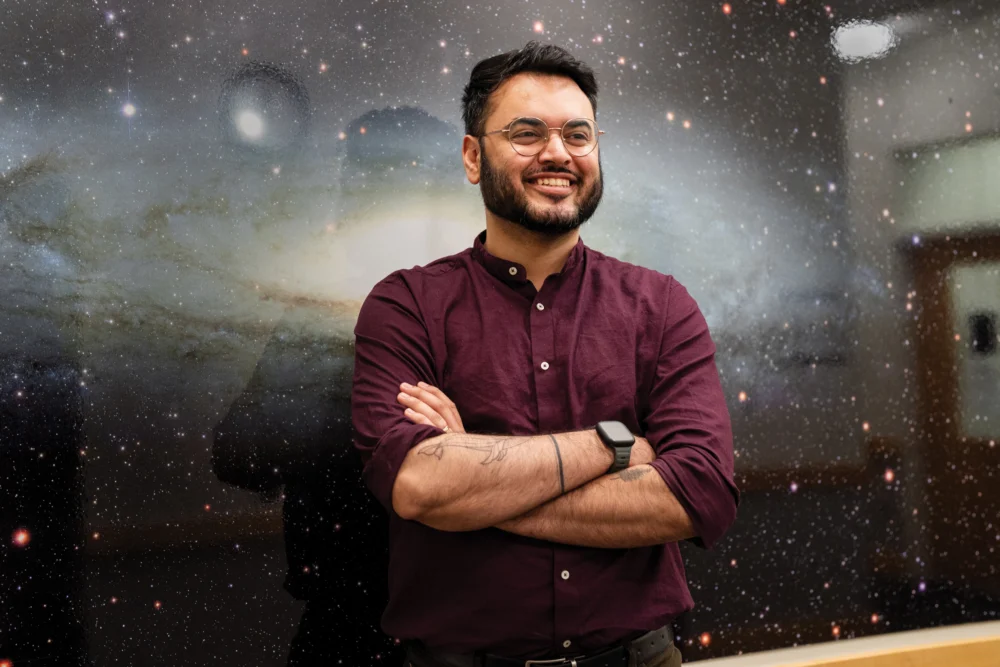
Deep time, in its most encompassing definition, refers to the immense stretches of time involved in the formation of the universe, the Earth, and life itself. It spans from the Big Bang approximately 13.8 billion years ago, through the formation of galaxies, stars, and planets, to the 4.5-billion-year history of Earth and the nearly 4-billion-year saga of life’s evolution. Geologists measure deep time through rock strata, fossil records, and radiometric dating, revealing epochs of continental drift, ice ages, and mass extinctions that dwarf human historical records into mere footnotes. For astronomers like Khullar, deep time is an even more expansive canvas, charted by light-years that reveal ancient galaxies, the lifecycle of stars, and the cosmic microwave background radiation – an echo from the universe’s earliest moments. Understanding these scales provides a fundamental framework for comprehending our place within the cosmos, yet it also presents an existential challenge to the human psyche.
Khullar’s reflection on his "history as a blip" against this cosmic backdrop resonates with a universal human struggle to find meaning in a seemingly indifferent universe. This philosophical quandary, where individual experience feels infinitesimally small, is a recurring theme among those who dedicate their lives to studying the cosmos. The abstract beauty of astronomical theories and the pursuit of fundamental truths, while intellectually stimulating, can sometimes feel disconnected from the "ground realities" – the pressing societal challenges of poverty, inequality, environmental degradation, and conflict that demand immediate attention and tangible solutions. This tension between the sublime and the urgent forces a re-evaluation of priorities and purpose.

The very landscapes of the Western U.S., which formed the backdrop for the original discussion, are a testament to deep time. The region’s iconic features—the Grand Canyon’s exposed geological layers, the ancient volcanic fields, the vast desert basins—are products of millions, if not billions, of years of tectonic activity, erosion, and climate shifts. Indigenous communities across the West have long held a profound connection to this deep history, often articulating a cyclical understanding of time and a stewardship ethic that spans generations, emphasizing responsibility for the land and its resources far beyond immediate human lifespans. Their perspectives offer a vital counterpoint to a Western societal tendency towards short-term thinking, urging a longer view that aligns more closely with the geological and ecological timescales.
Khullar’s observation that "Our idea of deep time has actually shrunk in size compared to what you would have thought was potentially possible, because we know what deep time is," is particularly insightful. This isn’t a statement about the physical reduction of time, but rather a commentary on human perception and comprehension. As scientific understanding solidifies the boundaries and events within deep time, the sheer, unimaginable vastness becomes more defined, perhaps making the "blip" of human existence feel even more acutely finite. When the universe’s beginning and end points are theorized, and Earth’s geological clock is meticulously measured, the window for humanity’s presence appears incredibly brief. This solidified understanding, rather than expanding our sense of possibilities, can paradoxically make our immediate moment feel more precious and constrained.
This acute awareness of human transience, far from leading to nihilism, has a transformative effect on Khullar. He articulates a "deeper appreciation of the life I’m living, the space I’m occupying and the time I get to spend with the people that I care about, because I know that this is a blip." This perspective underscores a profound human coping mechanism: when confronted with overwhelming scales, individuals often turn inward, valuing the immediate, the personal, and the relational. It highlights the inherent human capacity to find profound meaning and joy within limited time, emphasizing the significance of human connection and present-moment experiences.

The implications of this perspective extend beyond individual introspection. A collective understanding of deep time can foster a heightened sense of global responsibility, particularly concerning environmental stewardship and the long-term sustainability of our planet. Recognizing that human civilization represents an incredibly recent phenomenon on Earth’s timeline, and that our current actions have ripple effects that will last for geological epochs, can catalyze more urgent and far-reaching efforts to address climate change, biodiversity loss, and resource depletion. The "ground realities" Khullar mentions become even more critical when viewed through the lens of deep time; ensuring equitable access to resources, promoting social justice, and mitigating environmental crises are not just contemporary issues but foundational challenges for the future of humanity within this cosmic blip.
Moreover, the study of deep time through astronomy, while seemingly detached, is intrinsically linked to humanity’s future. Research into exoplanets, for instance, informs our understanding of planetary habitability, offering insights into Earth’s unique conditions and potential pathways for future human expansion or survival. Exploring the evolution of stars and galaxies provides context for our own solar system’s origins and ultimate fate, prompting questions about intergenerational responsibility and long-term planning for humanity. The very act of pushing the boundaries of knowledge about deep time can inspire innovative solutions for terrestrial problems, fostering scientific literacy and critical thinking essential for navigating a complex world.
In essence, the dialogue between the infinite scale of deep time and the finite reality of human experience serves as a powerful catalyst for introspection and action. It encourages individuals and societies to embrace the preciousness of the present moment, to nurture human connections, and to act with a profound sense of responsibility towards the planet and future generations. For scientists like Gourav Khullar, the cosmic perspective is not merely an academic pursuit but a deeply personal journey that reshapes the understanding of life’s purpose within the grand, unfolding narrative of the universe. It is a reminder that even a "blip" can hold immeasurable significance when lived with intention and care.