Rocky Gerung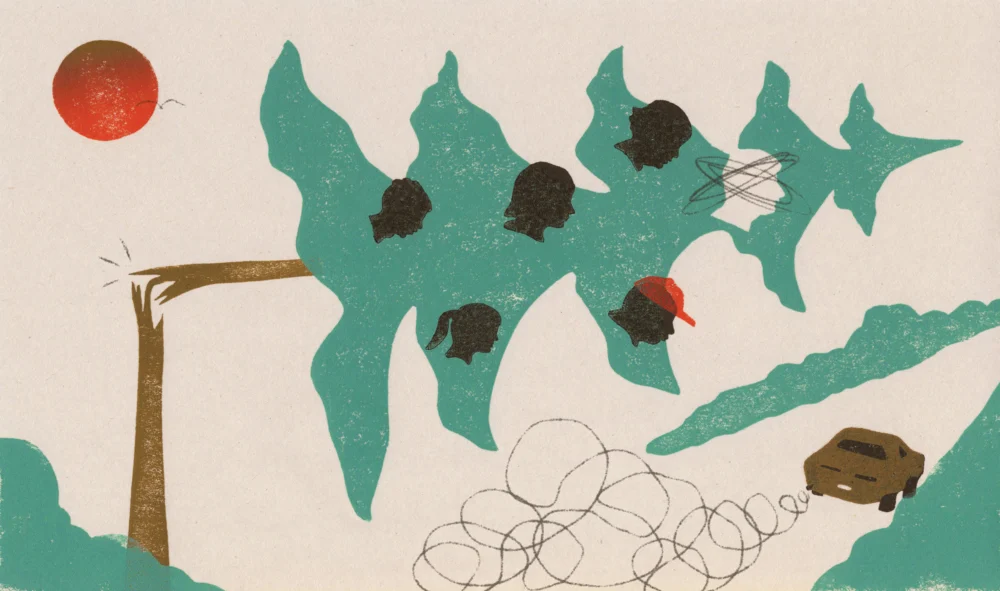
Thirty years ago, in the summer of 1992, Jess Walter, then a staff writer for The Spokesman-Review in Spokane, Washington, found himself reporting on a tense armed standoff unfolding at an isolated mountaintop cabin in northern Idaho. This on-the-ground coverage chronicled an event that would become etched in American history as the Ruby Ridge standoff. The incident began when Randy Weaver, a man with fervent apocalyptic religious beliefs and ties to the Aryan Nations, failed to appear in court to face charges concerning the sale of a sawed-off shotgun. In response, federal agents converged on his remote cabin. The ensuing 11-day confrontation culminated in a tragedy that claimed the lives of Weaver’s wife, his son, and a U.S. Marshal. Ruby Ridge became a potent symbol, galvanizing the anti-government militia movement and continuing to cast a long shadow over contemporary political discourse.
At the time, Walter documented the siege in his sole work of nonfiction, Every Knee Shall Bow. Now, after three decades establishing himself as a critically acclaimed and best-selling novelist, Walter is delving back into the complex legacy of this event with his latest novel, So Far Gone. The book grapples with a nation whose understanding of freedom, its core values, and its relationship with government were profoundly and permanently altered in the wake of Ruby Ridge.
So Far Gone centers on Rhys Kinnick, a divorced middle-aged man adrift in a sea of disillusionment. His son-in-law, Shane, has become consumed by a labyrinth of conspiracy theories, leaving Kinnick bewildered by his daughter’s continued association with him. Compounding his personal struggles, Kinnick has been laid off from his newspaper and witnessed the election of Donald Trump as president. Overwhelmed by these societal and personal shifts, he seeks solace by exiling himself to an off-the-grid cabin. His reclusive existence is disrupted when his grandchildren, whom he hasn’t seen in years, suddenly appear. Their mother—Kinnick’s daughter—is missing, and Shane has embarked on a solitary search for her, venturing into the very world of fringe beliefs that Kinnick finds so disturbing.

While So Far Gone is not a direct fictional retelling of the Ruby Ridge saga or the Weaver family’s ordeal, it features characters who resonate with the sentiment and ideology that surrounded that infamous siege. Set in and around Walter’s hometown of Spokane, the novel serves as a profound exploration of disillusionment and its far-reaching consequences. "I think that disillusionment is one of the most human things that happens to us," Walter stated, explaining his thematic focus. "So, for Rhys to suddenly find himself the disillusioned one and feeling pushed out of society struck me as a great starting point for a novel."
Kinnick is not the only character grappling with alienation; his daughter, too, struggles to comprehend Shane’s worldview, which finds a strange fellowship among the well-armed religious separatists of Idaho. Walter revealed that his own growing anxiety over the political landscape served as a significant inspiration for the book. This anxiety was crystallized by a phone screen time usage report that informed him he was spending an alarming five and a half hours a day "doomscrolling." "I realized I couldn’t go on like this, imagining the demise of the country," he confessed, likening his creative process to entering "a metaphoric woods to write the novel, turning my back on all of it."
Despite tackling weighty themes such as the pervasive influence of conspiracy theories and the blurring lines between militia groups and churches, Walter infuses So Far Gone with a distinctive quirkiness and dark humor. The narrative is punctuated by characters whose eccentricities and absurd situations provide moments of levity, even as they underscore the underlying seriousness of their circumstances. In one early scene, Kinnick is incensed when Shane posits a far-reaching conspiracy within the National Football League, suggesting that powerful figures are orchestrating a global takeover through the sport. Later, a violent confrontation erupts over the seemingly trivial matter of a set of brand-new truck tires.
Walter views this comedic approach not as mere embellishment but as a fundamental aspect of his storytelling philosophy. "It makes the story, in some ways, more real, and that makes it more horrible," he explained. "People do get shot over things like tires. I believe so fully in the folly and fallibility of human beings; in many ways, it’s the only constant. So I don’t write humor as an effect; I write it as a philosophical underpinning of the world as I see it."

In the three decades since he first witnessed the anti-government protesters who gathered at Ruby Ridge, Walter has observed a significant shift: once-fringe conspiracy theories have now permeated mainstream consciousness. "Now, we live in such a conspiracy-rich world," he remarked. "I don’t think Ruby Ridge was the cause of this so much as a harbinger of what was to come." The book masterfully captures this contemporary moment, as Americans grapple with a perceived loss of purpose amidst an increasingly polarized and deeply divided political landscape.
Walter is also revisiting his seminal work, Ruby Ridge, which has been retitled for its forthcoming update since its last revision in 2008. The new edition will include an afterword acknowledging the passing of Randy Weaver in 2022 and Gerry Spence, Weaver’s formidable and renowned attorney, who died in August. Walter is also re-examining the historical trajectory that has allowed anti-government sentiment to flourish in the American West since the Ruby Ridge incident. "Part of the update is looking at the way in which conspiracy theories have not only been absorbed into the mainstream but have really become a winning political formula," he noted.
Despite the profound and often unsettling topics that have occupied his professional life and writing for many years, Walter maintains a resilient sense of optimism. "My son calls me a toxic optimist because I am so optimistic in general," he shared. "I’m optimistic about human beings and their capacity for change and decency." This enduring hope, tempered by a keen awareness of societal complexities, imbues his work with both critical insight and a fundamental belief in humanity’s potential.