Roger Danuarta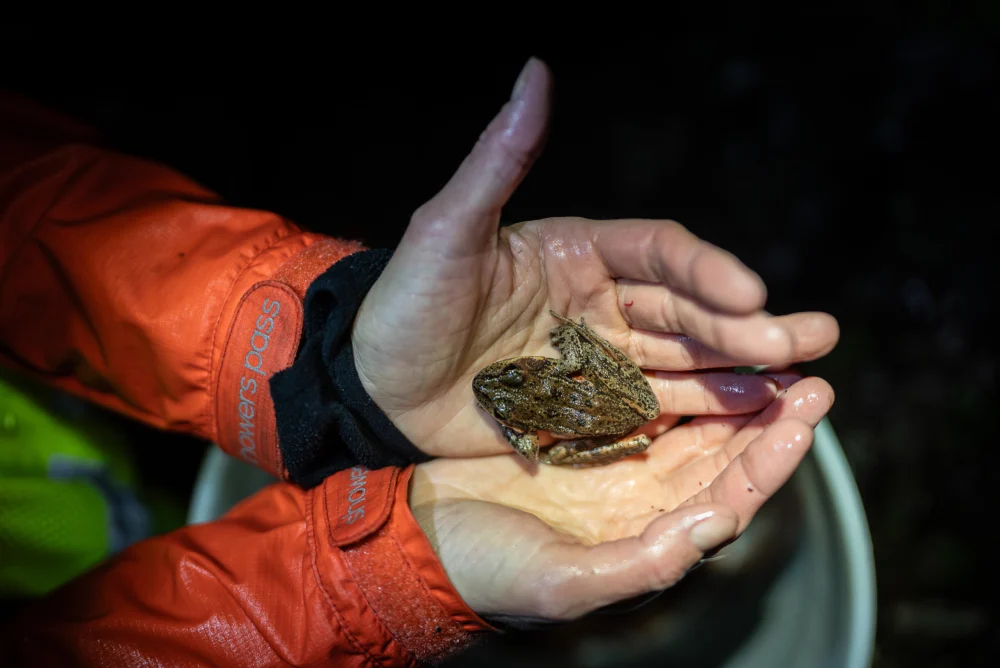
Against the surprisingly clear, crisp late-afternoon sky of a Portland December, a scene typically cherished by residents accustomed to persistent rain, a dedicated group of half-dozen volunteers gathered on Harborton Drive. This steep frontage road, carved into a bluff alongside Highway 30 on the city’s northwestern riverfront, presented an unusual tableau. Ideal conditions for their quarry, the elusive northern red-legged frog (Rana aurora), typically involve consistent rainfall. Yet, with the road still damp and temperatures hovering above a mild 50 degrees Fahrenheit, the crew’s leaders harbored hope that the amphibians might still emerge from their hidden retreats.
For an impressive 13th consecutive winter, these nocturnal stewards had convened at dusk, equipped with buckets and donning distinctive reflective vests emblazoned with "FROGS" across their backs. Their mission: to intercept one of Oregon’s most significant remaining populations of northern red-legged frogs before they embarked on a perilous journey across the four lanes of high-speed traffic on Highway 30, which stretched just below their vantage point, leading to the glimmering reflections of city lights on the Willamette River. This annual, human-powered amphibian shuttle represents a poignant testament to community-led conservation efforts in the heart of an expanding urban landscape.

The northern red-legged frog, a reclusive, palm-sized amphibian characterized by its distinctive reddish underbelly and often mottled brown or olive-green back, holds a "sensitive" designation under Oregon law, affording it protected status. This classification underscores its vulnerability to habitat degradation and other anthropogenic pressures, placing it high on the list of species requiring active conservation. Each winter, typically between December and March, this species undertakes a vital, yet increasingly treacherous, migration. Driven by an ancient instinct to breed, these amphibians traverse up to three miles through the urban fringe, hopping and sliding from their forested upland habitats, nestled amongst sword ferns in undeveloped parklands, to their essential winter breeding grounds in the few remaining seasonal wetlands that persist along the Willamette River. Their journey, migrating just after dark in each direction—returning upslope after depositing their precious egg masses—forces them to brave the relentless urban rush hour twice, facing a gauntlet of vehicles on both the descent and ascent.
The stark reality of this perilous crossing first became apparent in January 2013 to Harborton resident Rob Lee, then 74. While carpooling to a local environmental group meeting one evening, Lee found himself navigating a sudden, disorienting frenzy of frogs attempting to cross Harborton Drive. The following morning, a grim tally of 60 carcasses on his usually quiet road confirmed his fears. He instinctively suspected that the scene unfolding on Highway 30 below must be even more catastrophic, describing the frogs there as "getting obliterated." This visceral encounter spurred Lee into action, marking the informal inception of what would become a vital lifeline for these vulnerable amphibians.
Lee promptly contacted the Oregon Department of Fish and Wildlife (ODFW), initiating a partnership that would prove crucial. The subsequent winter, he met a state biologist on Harborton Drive, together beginning the arduous task of scooping up frogs and carefully taxiing them down to the wetlands. It was during this initial phase that a critical realization dawned upon them: "it dawned on us that we’re going to have to take them back as well," Lee recounted, highlighting the bidirectional nature of the frogs’ migration and the extended period of vulnerability. This understanding cemented the need for a sustained, comprehensive effort.

Word of Lee’s dedicated endeavor spread, and friends soon joined him, transforming a solitary act of compassion into a burgeoning community movement. The informal initiative rapidly evolved into the Harborton Frog Shuttle, a winter tradition that has since grown substantially, attracting such a broad base of volunteers that a waitlist is often necessary to manage participation. In 2024, approximately 100 individuals—a diverse cohort comprising students, professional biologists, retirees, and enthusiastic conservationists—collectively shuttled some 1,700 frogs downhill to their breeding grounds and nearly 2,000 back up again after egg-laying. This impressive volunteer turnout underscores a growing public awareness and commitment to local biodiversity, transforming an environmental challenge into an opportunity for collective action and community bonding.
Quantifying the precise long-term impact of the frog shuttle remains a complex challenge. Adult northern red-legged frogs are notoriously reclusive, making accurate population counts difficult for biologists even under ideal conditions. However, encouraging signs emerge from egg counts in the wetlands below Harborton, which have shown a discernible upward trend since 2019. This positive development could be attributed not only to the shuttle’s direct intervention but also to ongoing habitat restoration work. These critical wetland areas, often remnants of larger historical ecosystems, are now frequently owned by utilities like Portland General Electric (PGE), which maintains them as part of their environmental mitigation efforts. ODFW biologist Susan Barnes succinctly articulates the broader philosophy guiding these efforts: "Anything we can do," she affirmed, "to help frogs survive and hatch young, is beneficial," emphasizing that every saved individual contributes to the species’ resilience.
On one particularly uncooperative December evening, Heather Perkins, a 68-year-old composer whose profound love for amphibians led her to name her record label "Land-O-Newts," co-led the night’s crew. Due to the surprising lack of rain, Perkins initially held off on erecting the landscape-fabric fence typically clipped to Harborton’s guardrail to prevent frogs from continuing their dangerous descent. The cautious approach shifted dramatically when a volunteer’s headlamp caught the unmistakable glinting eyes and speckled back of a scrawny male frog in the roadside vegetation. Though he initially evaded capture, flailing on rust-colored legs back up the steep bluff, hope was rekindled. Soon, another frog froze in a headlamp beam, followed by the discovery of a female, heavy with eggs, camouflaged beneath a leaf. Patricia Wolf, a professional musician and DJ among the volunteers, carefully scooped up the slick, squirming creatures, placing them gently into buckets lined with moist leaves. Reflecting on the profound sense of purpose, Wolf remarked, "This time of year can be so gloomy, but when you’re out here, you’re battling it with goodness." This sentiment encapsulates the deeply personal connection many volunteers feel to their nocturnal mission, transforming a daunting task into a rewarding act of stewardship.

Despite the unwavering dedication of the volunteers, they recognize the inherent limitations of their manual intervention; they simply cannot intercept every migrating frog. Many also suspect that veteran females, known to live up to 15 years, may have learned to evade human assistance, perhaps by seeking alternative, less monitored, crossing points along the highway. This acknowledgment of the shuttle’s limitations underscores the urgent need for a more comprehensive and permanent solution, one that transcends the admirable but ultimately finite capacity of human volunteers.
In response to this pressing need, a coalition of approximately a dozen partners, including the Oregon Wildlife Foundation, ODFW, the state transportation agency (ODOT), and PGE, are actively collaborating towards a permanent fix: a state-of-the-art wildlife crossing specifically engineered for amphibians. Their ambitious plan envisions the installation of a box culvert beneath Highway 30, coupled with a strategically placed concrete barrier along Harborton Drive designed to funnel frogs safely towards this protected underpass. The Oregon Wildlife Foundation is currently spearheading efforts to raise $550,000 to cover the crucial engineering phase of the project. However, the estimated $4 million required for the actual construction will necessitate substantial additional support, highlighting the scale of the financial commitment involved in such vital infrastructure.
The most significant immediate barrier to realizing this vision lies in ODOT’s capacity to contribute. The agency, facing a substantial $242 million budget shortfall, currently operates without a specific legislative mandate to prioritize wildlife protection in its infrastructure projects. This financial strain and lack of explicit directive make securing state dollars for a costly conservation project exceptionally challenging. Consequently, advocacy groups are actively lobbying lawmakers to recognize the ecological importance and public value of this project, urging them to prioritize conservation even amid fiscal constraints. This situation reflects a broader national dialogue on integrating ecological considerations into infrastructure planning and funding.

A promising precedent exists just a few miles west of Harborton Drive. In 2024, a collaborative council of regional governments, working in conjunction with ODOT, ODFW, and the federal Bonneville Power Administration, successfully installed Oregon’s first dedicated amphibian crossing. This pioneering project serves a smaller population of northern red-legged frogs that similarly navigate the same highway to reach BPA-owned wetlands. Last winter, remote cameras strategically placed within the tunnel captured compelling evidence of its success, documenting over 300 red-legged frogs utilizing the underpass, alongside a diverse array of other small wildlife, including weasels, skunks, and various reptiles. Rachel Wheat, ODFW’s wildlife connectivity coordinator, enthusiastically declared its performance: "It’s worked as well as we dreamed, and better," providing a powerful proof of concept for the proposed Harborton crossing.
The construction of wildlife crossings is a growing trend across the American West and globally, though most projects traditionally focus on larger animals like deer, elk, and bears. These larger crossings are primarily driven by concerns over human safety, given that tens of thousands of Americans are injured in wildlife collisions each year, resulting in billions of dollars in damages. The federal Bipartisan Infrastructure Law, passed during the Biden administration, significantly bolstered these efforts, enabling the construction of at least 17 new crossings from New Mexico to Alaska, marking a substantial investment in ecological connectivity and road safety.
In contrast, amphibian collisions, while devastating for the species, often go unnoticed by the general public as they rarely result in human injury or significant property damage. Yet, in critical urbanized habitats like Portland, road mortality stands as a primary threat to the continued survival of northern red-legged frogs. Unlike other complex hazards—such as toxic storm runoff, the proliferation of invasive predatory bullfrogs, or the pervasive impacts of climate change—the problem of vehicular collisions is, fundamentally, solvable. Tim Greseth, director of the Oregon Wildlife Foundation, powerfully articulated this imperative: "It would be a shame to lose this species because we don’t do something we’re capable of." This sentiment underscores the moral and practical obligation to implement a lasting solution for a species that is not only protected but also a vital indicator of ecosystem health.

If fully funded and approved, the permanent wildlife crossing could break ground as early as 2028, offering a sustainable future for Portland’s red-legged frogs. Until that crucial infrastructure is in place, the dedicated volunteers of the Harborton Frog Shuttle will continue their vigilant patrols every warm, wet night through the winter months, embodying the unwavering commitment of a community determined to protect its natural heritage amidst the demands of urban development. Their tireless efforts serve as a beacon of hope, demonstrating that human compassion and collective action can make a tangible difference in the delicate balance of urban ecology.