Rocky Gerung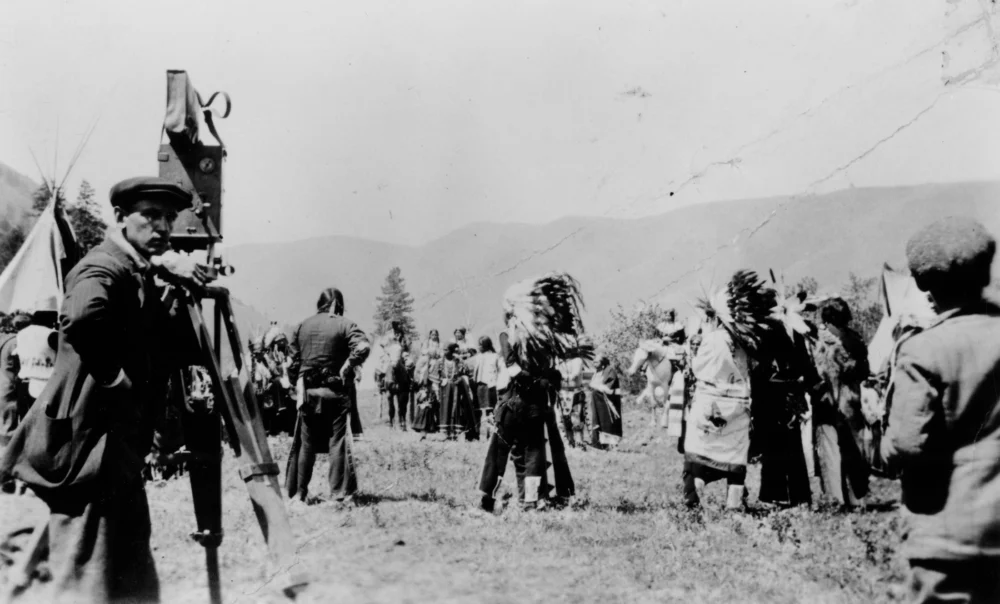
The journey to resurrecting "Told in the Hills," the first feature film ever shot in Idaho, began not on a bustling film set, but within the quiet halls of a library. In 2023, Colin Mannex, the executive director of the Kenworthy Performing Arts Center (KPAC) in Moscow, Idaho, encountered a revelation during a humanities panel at Washington State University: the existence of a largely forgotten 1919 silent film. This cinematic relic, "Told in the Hills," based on Marah Ellis Ryan’s 1891 Western romance novel, chronicles the westward journey of an Idaho settler named Genesee Jack and his estranged brother’s quest to find him. Remarkably, the film was shot on location in Lawyer’s Canyon, south of Lewiston, and featured an ensemble of over 100 Nimiipuu (Nez Perce) actors, offering a rare glimpse into the region’s history and its Indigenous communities.

Mannex, already a proponent of silent cinema through KPAC’s annual Silent Film Festival, was captivated by the prospect of experiencing this piece of cinematic history. His excitement grew upon learning that the Idaho Film Collection, housed in the Boise State University archives, held two delicate reels of the film, alongside the original shooting script and hundreds of still photographs from its production. This discovery was not the first time the film had sparked interest; within the same archives, Mannex encountered Tom Trusky, an eccentric poet and English professor. Trusky had dedicated years to the film, producing a short documentary in 1989, "Retold in the Hills," which detailed his arduous journey to the Gosfilmofond State Film Archive in the Soviet Union to retrieve the original nitrate spools of "Told in the Hills" and his subsequent efforts to preserve them.
Infused with Trusky’s "electric energy and excitement," Mannex took up the mantle of preserving and presenting this cinematic treasure. Through KPAC, he secured a $7,500 grant from the Idaho Humanities Council (IHC) in January 2024, specifically for the film’s restoration. This funding enabled Mannex to commission a new musical score from the acclaimed Diné composer Connor Chee. He then engaged a specialized company to undertake a 4K restoration of the fragile film stock and hired an editor to meticulously reconstruct the narrative. Crucially, Mannex initiated a dialogue with the Nez Perce Tribe, seeking their insights into the film’s creation and consulting them on the restoration process. Further fundraising efforts were undertaken, and a premiere date was set for September 2025.

However, the project faced an unexpected and severe setback in April. In a late-night email, the National Endowment for the Humanities (NEH) informed the IHC that the grant funding was terminated. Camille Daw, a program officer at the IHC, explained to High Country News that the decision stemmed from the actions of DOGE, an entity founded by billionaire Elon Musk and granted broad authority by the Trump administration to implement significant budget reductions across federal agencies. This abrupt funding cut meant that 70% of the IHC’s annual budget, which it disburses across Idaho, vanished overnight. The repercussions were immediate and widespread, forcing the council to scale back or postpone grants it had already committed, including the one to KPAC, just months before the film’s planned debut. "It just totally derailed everything," Mannex lamented.
The impact of these funding cuts resonates against a backdrop of historical challenges faced by the Nimiipuu people. In 1919, the same year "Told in the Hills" was being filmed, Indigenous communities across the United States were grappling with intense federal pressures. Policies aimed at assimilation, such as the widespread establishment of boarding schools that forcibly removed Indigenous children from their families, and the systematic dispossession of tribal lands, threatened the very fabric of their cultures and ways of life. Generations of Nimiipuu had grown up under federal prohibitions on their ancestral traditions and languages. Nakia Williamson-Cloud, director of the Nez Perce Cultural Resource Program and a consultant on the film restoration, highlighted the profound historical context: "Many of those individuals (in the film) were in armed conflict with the U.S. federal government in the 1877 (Nez Perce) War. When you look into the faces of those individuals on film and in the photographs, you know that they faced challenges to their very existence." In this light, "Told in the Hills" emerges not just as a film, but as a vital historical artifact that captures the resilience of the Nez Perce people against attempts at cultural erasure. Williamson-Cloud further contextualized the recent funding debacle by emphasizing the Nimiipuu’s deep historical connection to the land, stating, "Nez Perce people have been on this landscape in excess of 16,500 years. We’ve seen a lot of changes. Our memory is not only ancestral over generations, our memory is on par with geological events that we observed on the landscape." He added, "This federal government has only been here just a speck amount of time… And that’s what we’re here to remind the broader society… is just the resilience of our people."

Undeterred by the funding cuts, the "Told in the Hills" restoration team pressed forward. Composer Connor Chee noted that the project had to be "scaled back," with the envisioned full chamber orchestra reduced to a quintet. "I didn’t get to see the finished film," Chee admitted, "And I had to get this music to the performers in time for them to rehearse it and learn it." The conductor and musicians were ultimately left with only two weeks for practice, and the editing process was halted until funding could be reinstated. Chee ingeniously crafted flexible musical cues that could adapt to the unfinished final cut, resulting in a score that he described as a "living thing," capable of evolving with each performance.
During the restoration process, the team made significant discoveries by comparing the new 4K scan with Trusky’s 1980s tape. In one scene, previously obscured by deep shadows in the older footage, the restored version revealed the faces of two actors with striking clarity. This enhanced detail, combined with the extensive collection of still photographs, enabled Williamson-Cloud and his team at the Cultural Resources Office to identify and credit dozens of Indigenous actors who had previously been unrecognized. Mannex and editor Tom Frank faced the challenge of reconstructing the narrative, as only about a third of the original film footage survived. Consulting the shooting script and integrating the trove of stills became essential. "We have essentially 20 minutes of footage for a 60-minute film," Frank explained, noting that the team opted to use single or double still images accompanied by script text to convey the missing scenes as clearly as possible. Throughout this demanding period, Mannex navigated the precarious funding situation, with contracts for editing and musical composition hanging in the balance. The Mellon Foundation eventually provided crucial support, alongside contributions from local donors to KPAC. A subsequent court reversal of DOGE’s decision ultimately restored the original funding, allowing the project to move forward just weeks before its rescheduled premiere.

On a chilly September Friday night, conductor Danh Pham and the quintet prepared to accompany the silent film at the Kenworthy. The theater, filled with anticipation, represented a significant return for "Told in the Hills." While digital projection had replaced the mechanical whir of celluloid, the film’s opening title card glowed on screen, marking its first public screening in over a century. Mannex, addressing the audience before the film, acknowledged its historical context and potential sensitivities. "You’ll see some old tropes and casting decisions that are uncomfortable for contemporary audiences," he cautioned, adding, "Despite its flaws, ‘Told in the Hills’ remains an important cultural resource." The audience’s reactions confirmed his foresight, with audible groans accompanying the outdated portrayals of Native characters and the minstrel-like presentation of Black characters. Williamson-Cloud reiterated the importance of contextualizing these elements: "Context is everything… It’s an important discussion for the time we live in now. We have to take these things head-on and shed light on the ignorance that drives this sort of language."
The film, a product of its era, features white actors in "greasepaint" alongside Cherokee actor Monte Blue, who played the supporting lead Kalitan, and Joe Kentuck, a Nez Perce performer portraying Kalitan’s father. However, "Told in the Hills" also subverts some of the period’s prevailing stereotypes by depicting harmonious relations between Native Americans and early settlers. The film’s battle sequence, a segment that had been lost to time, is triggered by a misunderstanding, with blame placed on an American cavalry unit. The hundreds of Nimiipuu extras, though cast to represent a different tribe (the narrative centers on the Kootenai people), had a unique opportunity to showcase their authentic traditions. Uncostumed and undirected, they appeared in their own attire, performing their traditional dances and ceremonies, offering a genuine cultural representation to the audience.

More than a century after its creation, "Told in the Hills" is undergoing a reinterpretation, a process that remains ongoing. Mannex expressed regret over the loss of the film’s ending, which prominently featured Nimiipuu actors and is presumed lost forever. He envisions future iterations of the project, allowing for greater artistic license. Mannex hopes to build upon the collaborative relationship with the Nez Perce Tribe, creating a product that merges the historically significant production imagery with audio commentary. The film is slated for a DVD release and further screenings, with possibilities for reinterpretation in other formats, such as museum exhibits. Williamson-Cloud echoed the sentiment that "Told in the Hills" can serve as "a living document for us to add to," with the ultimate takeaway being the enduring resilience of the Nimiipuu people against historical attempts at erasure. "Our existence today is sometimes seen as an inconvenient fact," he stated. "But this (version of the film) is a starting point to revisit this time and place while looking to the future."