Rocky Gerung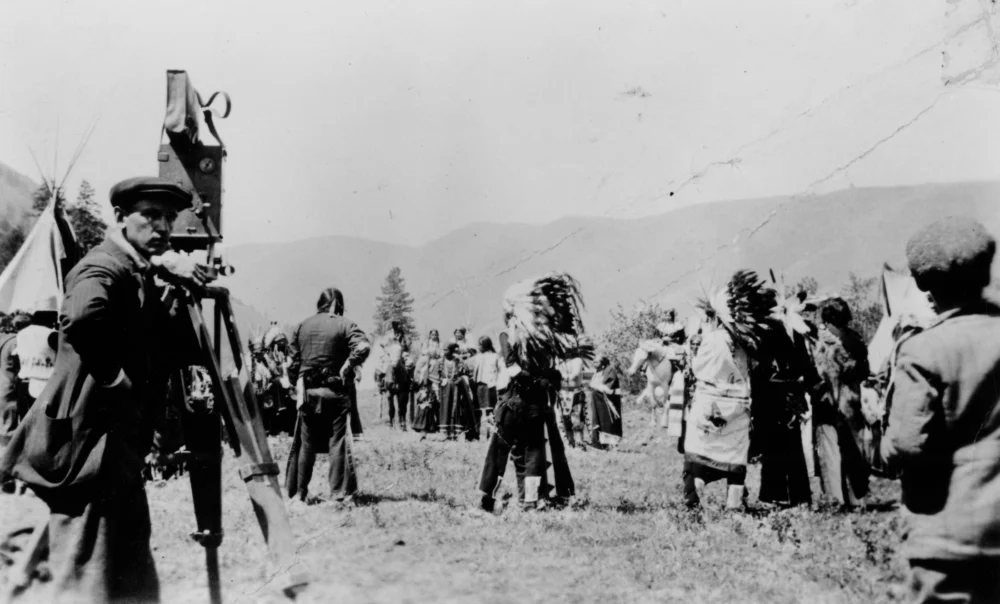
The quest to resurrect a century-old cinematic treasure began not on a film set, but within the hushed aisles of a library. In 2023, Colin Mannex, executive director of the Kenworthy Performing Arts Center (KPAC) in Moscow, Idaho, learned of a largely forgotten silent film, "Told in the Hills," the very first feature film ever shot in Idaho. This revelation, sparked during a humanities panel at Washington State University, ignited a passion project that would navigate historical preservation, cultural collaboration, and unexpected governmental hurdles.
Based on Marah Ellis Ryan’s 1891 novel of the same name, "Told in the Hills" is a Western romance that chronicles the journey of Genesee Jack, an Idaho settler forging a new life, and the estranged brother who ventures west in search of him. The silent film, shot entirely on location in Lawyer’s Canyon, south of Lewiston, was a significant undertaking, featuring over 100 Nimiipuu (Nez Perce) actors. Mannex, already a devotee of the silent film era and the curator of KPAC’s annual Silent Film Festival, was captivated by the prospect of viewing this lost piece of cinematic history. His excitement grew upon discovering that two delicate reels of the film, along with the original shooting script and hundreds of production stills, were carefully preserved within the Idaho Film Collection at Boise State University’s archives.

Mannex’s archival exploration led him to another kindred spirit: Tom Trusky, an eccentric poet and English professor. Trusky had embarked on his own mission in 1989, producing a short documentary, "Retold in the Hills," detailing his arduous journey to the Gosfilmofond State Film Archive in the then-Soviet Union to retrieve the original nitrate spools of "Told in the Hills." His subsequent efforts to preserve these fragile remnants of cinematic history were a testament to his dedication. Mannex, recognizing Trusky’s "electric energy and excitement," felt inspired to pick up the mantle and see the project through to completion.
Through KPAC, Mannex initiated the process by applying for a $7,500 grant from the Idaho Humanities Council (IHC) in January 2024. The council, recognizing the film’s cultural significance, awarded the funding for its restoration. Mannex then commissioned a new musical score from the acclaimed Diné composer Connor Chee, who envisioned a dynamic accompaniment to the silent narrative. A specialized company was engaged for a meticulous 4K restoration of the delicate film, and an editor was hired to help reconstruct the narrative. Crucially, Mannex reached out to the Nez Perce Tribe to gather their insights into the film’s creation and to seek their consultation throughout the restoration process. As additional funds were raised through further grants and local support, a premiere date was set for September 2025, marking the culmination of years of dedicated effort.
However, the path to rediscovery was abruptly obstructed by an unforeseen governmental directive. In April, amidst the quiet hours of the night, an email arrived from the National Endowment for the Humanities (NEH). Camille Daw, program officer at the IHC, relayed the devastating news: "that our grant was terminated." The decision stemmed from the actions of DOGE, a newly established "Department of Government Efficiency" championed by billionaire Elon Musk and empowered by the Trump administration to implement sweeping budget cuts across federal agencies. This arbitrary slashing of funds, which included the termination of employees, cast a long shadow over the IHC.

"It was a big surprise for our office," Daw admitted. The Idaho Humanities Council, which annually disburses NEH funds across the state, found itself in a precarious position. Within two days of DOGE’s intervention, a staggering 70% of the IHC’s funding vanished. These cuts reverberated throughout Idaho, forcing the council to scramble to scale back or postpone grants that had already been committed, including the vital funding for KPAC’s film restoration. With the film’s premiere only months away, the implications were dire. "It just totally derailed everything," Mannex lamented.
The challenges faced by the "Told in the Hills" restoration team stood in stark contrast to the historical context of the film itself. Over a hundred years prior to the advent of DOGE, the Nimiipuu people were confronting their own existential threats. By 1919, the era of "Told in the Hills," federal boarding schools were actively removing Indigenous children from their families, and government policies were systematically dispossessing tribes of their ancestral lands, fundamentally threatening their cultural practices and way of life. An entire generation of Nimiipuu had grown up under government prohibitions against their traditions.
Nakia Williamson-Cloud, Director of the Nez Perce Cultural Resource Program and a consulting partner on the film restoration, offered profound perspective. "Many of those individuals (in the film) were in armed conflict with the U.S. federal government in the 1877 (Nez Perce) War," he stated. "When you look into the faces of those individuals on film and in the photographs, you know that they faced challenges to their very existence." In this light, "Told in the Hills" transcends its narrative, becoming a poignant artifact that vividly preserves the resilience and resistance of the Nez Perce people against a concerted effort at cultural erasure.

Williamson-Cloud placed the DOGE funding crisis into a broader historical context, emphasizing the enduring presence of Indigenous peoples. "Nez Perce people have been on this landscape in excess of 16,500 years," he asserted. "We’ve seen a lot of changes. Our memory is not only ancestral over generations, our memory is on par with geological events that we observed on the landscape." He underscored the fleeting nature of the current federal government’s presence, stating, "This federal government has only been here just a speck amount of time. Tiny amount of time. And that’s what we’re here to remind the broader society… is just the resilience of our people."
Despite the financial setback, the "Told in the Hills" restoration team remained undeterred. Composer Connor Chee explained that after the funding cuts, "things got scaled back." The ambitious vision of a full chamber orchestra accompanying the film was reduced to a quintet. "I didn’t get to see the finished film," Chee admitted, highlighting the pressure of delivering the music to performers in time for rehearsal. Ultimately, the conductor and musicians had a mere two weeks to prepare. Editing was suspended until funding could be secured, and Chee crafted flexible musical cues that could adapt to the incomplete final cut of the film, acknowledging that "This kind of music can stay alive, it can change. It’s like a living thing."
During the restoration process, comparisons between the new 4K scan and the 1980s tape produced by Trusky revealed striking improvements. In one scene, Trusky’s footage depicted two actors whose faces were obscured by deep shadows. The restored 4K version, however, brought their features into sharp relief. This enhanced clarity, coupled with the extensive collection of still photographs, enabled Williamson-Cloud and his team at the Cultural Resources Office to identify and credit dozens of previously unrecognized Indigenous actors. Mannex and editor Tom Frank faced the challenge of reconstructing the narrative, with only a third of the original footage surviving. They consulted the shooting script and integrated the trove of still images to bridge the gaps in the restored film. "We have essentially 20 minutes of footage for a 60-minute film," Frank explained, noting their decision to use "just one or two photos to represent the scene with text from the script" to maintain clarity for the audience.

Throughout this period, Mannex worked tirelessly to secure the necessary funding. Contracts for editing and score composition were contingent on the uncertain financial situation. In the critical final months, the Mellon Foundation provided crucial support, alongside contributions from local donors to KPAC. A subsequent court reversal of DOGE’s decision ultimately restored the original funding, alleviating the immediate crisis. After a summer of uncertainty and logistical challenges, the film was ready for its premiere with less than a week to spare.
On a crisp September Friday night, conductor Danh Pham and his musicians took their positions at the base of the stage in the Kenworthy theater. As the audience filled the seats, the silent film was projected digitally, its cursive title glowing on the screen. For the first time in over a century, "Told in the Hills" was presented to an audience. Mannex, however, opted to contextualize the viewing experience, forewarning attendees of "some old tropes and casting decisions that are uncomfortable for contemporary audiences." He emphasized that "Despite its flaws, ‘Told in the Hills’ remains an important cultural resource."
The film’s portrayal of and language used to refer to Native characters, as well as the minstrel-like presentation of its Black characters, elicited uncomfortable reactions from the audience. Williamson-Cloud acknowledged the presence of racist tropes and language, stating, "Context is everything. It’s an important discussion for the time we live in now. We have to take these things head-on and shed light on the ignorance that drives this sort of language." He stressed that the film, a product of its era, also presented aspects that challenged contemporary stereotypes by depicting peaceful relations between Native Americans and early settlers. Notably, a lost battle scene in the film was initiated not by conflict between settlers and Native peoples, but by a misunderstanding involving an American cavalry unit.

While the film features white actors in makeup alongside Cherokee actor Monte Blue, a rising star who played the supporting lead Kalitan, and Joe Kentuck, a Nez Perce performer who portrayed Kalitan’s father, it also provided a rare opportunity for the hundreds of Nimiipuu extras. Though they were portraying a different tribe (the story centers on the Kootenai people), these individuals were able to present their own traditions to a wider audience. Unburdened by specific costumes or directorial instructions, the Native actors appeared in their own attire, performing their traditional dances and ceremonies.
More than a century after its creation, "Told in the Hills" is being reinterpreted, and its journey continues. Mannex expressed a wish that the film’s original ending, which prominently featured Nimiipuu actors and is presumed lost, had survived. He envisions future iterations of the project, potentially building on the collaborative relationship with the Nez Perce Tribe to create a product that combines the culturally significant production images with audio commentary. The film is slated for release on DVD and may see further screenings, but its future could also involve reinterpretation in new forms, such as a museum exhibit. Williamson-Cloud echoed the hope that "Told in the Hills" can serve as "a living document for us to add to," and that the ultimate takeaway is the enduring survival of the Nimiipuu people against attempts at erasure. "Our existence today is sometimes seen as an inconvenient fact," he remarked. "But this (version of the film) is a starting point to revisit this time and place while looking to the future."