Roger Danuarta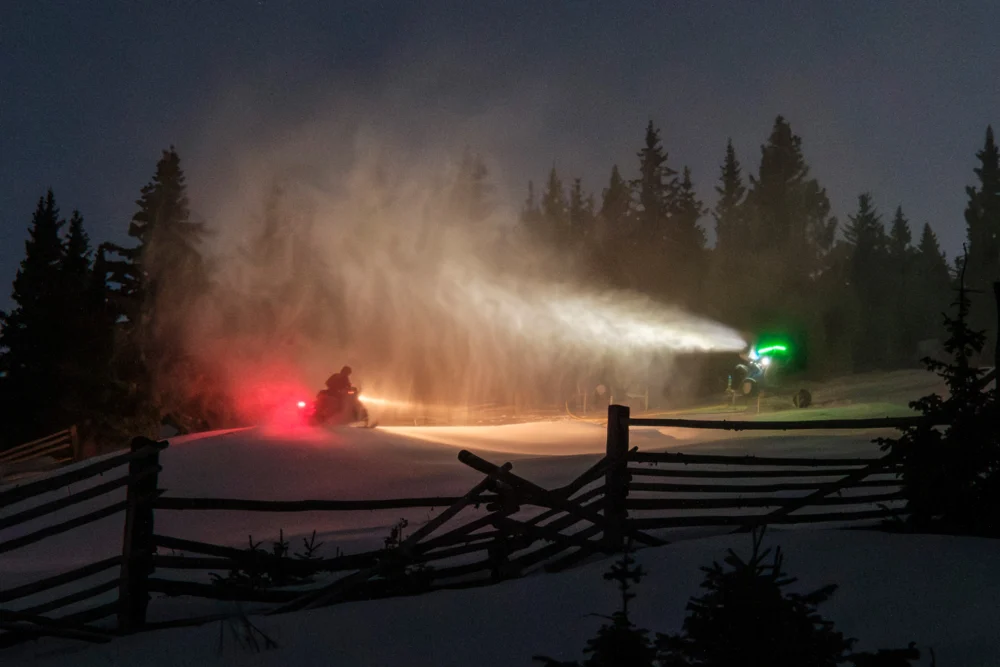
The Western United States is grappling with its lowest recorded winter snow cover, a stark indicator of escalating climate pressures that threaten not only the region’s iconic ski industry but also critical water supplies and wildfire management for millions. This unprecedented snow drought, while immediately impacting the vibrant winter sports economy, casts a long shadow over the spring and summer months, portending an increased risk of devastating wildfires and diminished water availability for agriculture, urban centers, and vital aquatic ecosystems. For now, however, the immediate concern for many residents and businesses across the mountainous West revolves around the rapidly melting white gold that fuels a multi-billion dollar industry.
Across the Rocky Mountains and Pacific Northwest, the consequences are stark and immediate. Colorado’s renowned Arapahoe Basin, typically boasting expansive terrain, has seen less than a third of its runs operational. In Washington State, the legendary Mt. Baker Ski Area was forced to cancel its annual snowboard race, a hallmark event, citing an "unworkable snowpack"—a phrase rarely heard with such gravity in a region celebrated for its prodigious snowfall. Oregon’s Hoodoo Ski Area and Mt. Ashland Ski Area endured weeks of temporary closures, while the prestigious college ski championships were abruptly relocated from their planned venue in Bozeman, Montana, to the more reliably snowy slopes of Utah, underscoring the regional variability and precariousness of the season. These disruptions ripple through local economies, affecting everything from lift ticket sales and equipment rentals to hospitality services and seasonal employment, demonstrating the profound interdependence between natural snowfall and economic vitality.

In response to these increasingly frequent lean winters, ski resorts are leaning heavily on artificial snow production, a practice that has become a critical, albeit complex, lifeline. Major industry players, including Alterra Mountain Company and POWDR Corporation, have largely remained reticent about their specific snowmaking operations, reflecting a competitive landscape and perhaps an awareness of the environmental sensitivities involved. Vail Resorts, a global giant operating 42 ski areas worldwide, confirmed that while they do not disclose detailed snowmaking data, "weather conditions, particularly temperature," are the primary determinants of their capacity and duration for snow production. This reliance on specific temperature thresholds highlights a fundamental vulnerability as average winter temperatures continue to rise.
However, significantly scaling up snowmaking operations in the Western U.S. presents formidable challenges, as noted by Steven Fassnacht, a distinguished professor of snow hydrology at Colorado State University. He points out that such an expansion would necessitate resorts acquiring additional water rights, an intricate and often prohibitively expensive legal undertaking in a region already grappling with chronic water scarcity and complex water allocation systems dating back over a century. Historically, Western ski resorts have operated with a far lesser dependence on manufactured snow compared to their counterparts in other parts of the country. On average, less than 10% of skiable terrain in the West is covered by man-made snow, a stark contrast to the Northeast, where over 50% is routinely augmented, and the Southeast and Midwest, where this figure can exceed 80%. This historical reliance on abundant natural snowfall is now a significant disadvantage as climate change ushers in warmer, more erratic winter patterns, making snowmaking an increasingly essential, yet resource-intensive, adaptation strategy with potential environmental repercussions and escalating operational costs.
The concept of artificial snow, once a novel idea, dates back to 1949, when a forward-thinking Connecticut ski resort owner experimented by spreading 700 pounds of ice onto a single run, a fleeting effort that lasted a mere two weeks. This rudimentary attempt, however, sparked an innovative idea among a group of engineers and aspiring ski entrepreneurs. As recounted by ski historian John Fry, these pioneers, working outside their defunct ski factory, ingeniously connected a 10-horsepower compressor via a garden hose to a spray-gun nozzle originally designed for painting skis. This rudimentary setup laid the foundation for the sophisticated snowmaking systems of today. While the core technology remains fundamentally the same—propelling highly pressurized water into sub-freezing air to crystallize—modern systems have evolved to become far more efficient, utilizing advanced fan guns and snow lances that optimize water atomization and energy consumption, though the fundamental requirement for specific atmospheric conditions persists.

Despite these technological advancements, the environmental footprint of snowmaking remains a significant concern, primarily centered on its substantial energy and water demands. The process requires considerable energy to pump and pressurize water uphill and to compress air, often across vast mountain terrains. Studies indicate that snowmaking can account for an average of 18% of a ski resort’s total energy consumption, a figure that can fluctuate based on terrain, climate, and the efficiency of the equipment. This energy often comes from regional power grids that, in many Western states, still rely heavily on fossil fuels, contributing to greenhouse gas emissions. Beyond energy, water consumption is equally critical. Palisades Tahoe, a prominent California resort, for instance, utilizes between 50 and 70 million gallons of water annually for snowmaking, enough to blanket approximately 60 acres of terrain with 1.5 feet of snow. While 70 million gallons is a substantial volume, comparable to the annual indoor water usage of about 50 American families, Fassnacht highlights that an estimated 80% of this water eventually re-enters the natural hydrological system through snowmelt, with the remaining 20% lost to evaporation. This cyclical return of water, however, does not negate other potential impacts, which can range from localized soil degradation due to repeated heavy snow cover and altered runoff patterns to the release of trace chemicals from snowmaking additives or the disruption of aquatic habitats when water is drawn from streams during critical low-flow periods. Furthermore, the practice has often met with strong opposition from Indigenous communities, who view the artificial alteration of natural landscapes and water bodies as a desecration of sacred ancestral lands.
The timing of water demand for snowmaking often distinguishes it from other major users, as ski resorts typically draw water during the late fall and early winter months. This period generally precedes the peak agricultural and municipal demands, which intensify in late spring and summer. In the intricate legal landscape of Western water rights, ski resorts are typically junior rights holders, meaning their access to water is subordinated to senior claims, such as those for agricultural irrigation or municipal supply. In Colorado, for example, snowmaking accounts for a mere 0.05% of the state’s annual water consumption, a stark contrast to agriculture’s dominant share of approximately 85%. This hierarchy of water rights provides a theoretical safeguard against resorts monopolizing water resources during periods of extreme scarcity. Nevertheless, the ecological implications of extracting water from streams during low-flow conditions, regardless of overall volume, can be detrimental to aquatic life, disrupting sensitive ecosystems during crucial periods for fish spawning and invertebrate populations.
Crucially, machine-made snow, while visually convincing and functionally effective for skiing, differs fundamentally from natural snow in its hydrological contribution to regional water supplies. Researchers at the University of California, Berkeley, emphasize that approximately 75% of the water relied upon by Western populations originates from mountain snowpack. Manufactured snow, despite its volume, does not replenish this vital natural reservoir at a comparable scale. As Fassnacht aptly states, "Snowmaking should be considered a temporary storage on the mountain, instead of in a reservoir. The water is not really taken out of the system, just stored somewhere else. It does not replace snow that falls from the sky." This distinction is paramount, meaning that even robust snowmaking efforts cannot fully compensate for the long-term impacts of diminishing natural snowfall on regional water security, a critical concern for communities navigating prolonged drought cycles.

In a bid to reduce reliance on fresh water sources and enhance sustainability, some resorts are exploring innovative, albeit controversial, approaches. Big Sky Resort in Montana, for instance, has embarked on a program to produce snow from treated wastewater. While conservation groups have lauded this as a "win-win for the health of our rivers and the resort economy," it has ignited heated debate elsewhere. The ski area near Flagstaff, Arizona, began utilizing treated wastewater for snowmaking in 2013 on a mountain considered sacred by local Indigenous peoples and members of 13 Native American tribes. This practice sparked immediate and sustained protests, which continue to this day, highlighting the profound cultural and spiritual significance of these landscapes and water sources for Indigenous communities, who view such actions as a profound desecration and a violation of their ancestral heritage. The controversy underscores the complex ethical and social dimensions of climate adaptation strategies, especially when they intersect with long-standing cultural rights and environmental justice concerns.
The increasingly widespread adoption of snowmaking raises a critical question: Is it a genuine climate adaptation strategy, or does it risk becoming a form of maladaptation, potentially exacerbating the very climate challenges it seeks to mitigate? A seminal 2022 paper published in the Journal of Sustainable Tourism meticulously examined the environmental impacts of snowmaking, concluding that its effects are highly contingent on a resort’s specific geographical and infrastructural context. In regions boasting relatively clean electric grids and robust water security, such as parts of Washington State, the environmental impact of snowmaking is considerably lower. Conversely, in states like New Mexico, Colorado, Nevada, and Wyoming, where electric grids are more carbon-intensive and water stresses are already acute, the ecological footprint of snowmaking is significantly higher. While many of these states have committed to decarbonizing their energy grids over the coming decades, projections simultaneously indicate a parallel increase in water scarcity, creating a complex and potentially conflicting environmental outlook. The researchers further highlighted the often-overlooked impact of skier travel. They found that, on average, skiers drive approximately 36 miles before their carbon dioxide emissions from transit surpass those generated by the ski area itself. This intriguing finding suggests that if enhanced snowmaking capabilities encourage skiers to patronize closer, regional mountains rather than undertaking long-distance travel, it could paradoxically result in a net-positive environmental outcome by reducing overall carbon emissions from transportation.
Irrespective of snowmaking’s role, the long-term prognosis for skiing, particularly in coastal regions and at lower elevations, remains undeniably grim. Jesse Ritner, an assistant professor of history at Georgia College & State University and an author currently penning a book on snowmaking, candidly states, "There’s a level to which, to put it bluntly, the ski industry is screwed." He adds that despite this sobering reality, snowmaking is destined to become progressively more indispensable. The industry itself is acutely aware of these impending shifts. In 2019, Vail Ski Resort made a monumental investment, acquiring 421 new snow guns for its Colorado mountain, an initiative hailed as the "largest snowmaking expansion in North American history." Other resorts, such as Bogus Basin in Idaho, are pioneering innovative techniques like "snowfarming," a practice involving the strategic collection and storage of natural snow under insulating covers during the summer months for use the following winter. Yet, even these ambitious efforts offer no complete immunity from the vagaries of a warming climate. Earlier this year, Vail Resorts disclosed to investors that meager snowfall across its Western North American properties had contributed to a significant 20% decrease in visitation, underscoring the direct economic vulnerability. Michael Pidwirny, an associate professor at the University of British Columbia who specializes in climate change and skiing, observes, "Bad years were a real rarity; now they’re becoming more common." He warns that these challenging seasons will only intensify, posing the fundamental question: "If it’s too warm, how do you make snow?" Snowmaking technology is inherently constrained by temperature, requiring the "wet bulb temperature"—a combined measure of air temperature and humidity—to remain below 28 degrees Fahrenheit (approximately -2.2 degrees Celsius) for efficient operation. Pidwirny projects that iconic resorts like Whistler Blackcomb, a Vail-owned property in his home province, could face a situation where "one out of two years are really too poor to support good skiing in about 2050 (or) 2060." The inevitable adaptation, he contends, will compel resorts to acknowledge that a guaranteed ski season is no longer a given. Ultimately, even the most advanced snowmaking infrastructure may prove insufficient against the relentless march of a warming planet, forcing a fundamental re-evaluation of the future of winter sports.