Roger Danuarta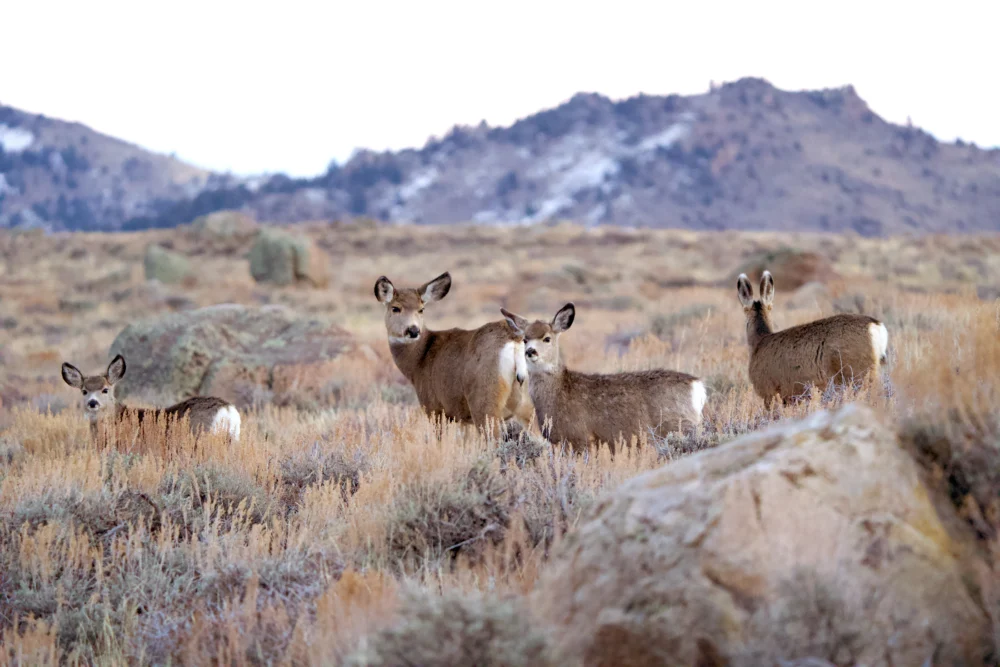
Thousands of mule deer embark on an arduous annual journey across southwest Wyoming’s vast Red Desert, a landscape defined by its rolling sagebrush plains. While some members of the Sublette herd remain sedentary or undertake shorter excursions into nearby foothills, a significant portion embarks on an extraordinary ungulate odyssey, tracing ancient paths up to 150 miles into the high mountains. This epic trek, driven by the instinct to follow emergent forage, has now been definitively linked to the survival and reproductive success of these iconic animals.
A groundbreaking study, spearheaded by researchers at the University of Wyoming and the Wyoming Game and Fish Department, conclusively demonstrates that the mule deer undertaking the longest migrations emerge from the summer months with greater fat reserves and, consequently, exhibit longer lifespans. This robust body condition directly translates into higher reproductive rates, as fatter does are significantly more likely to carry fawns to term. The findings, recently published in a leading scientific journal, underscore the profound ecological importance of these extensive migratory pathways.
Anna Ortega, the lead author of the study, emphasized the critical role of these long-distance migrants. "The migrating mule deer are the engine for the whole population," Ortega stated, highlighting that any disruption to these migrations would result in a drastic reduction in the overall deer population. This revelation stems from an ambitious, nearly decade-long research initiative, requiring scientists to conduct intensive field work. Using helicopters, they captured and studied hundreds of deer each spring and fall, meticulously monitoring their body fat levels, assessing pregnancies through advanced imaging, and tracking fawn survival rates from birth through their first vulnerable months.

The research provides compelling scientific validation for what many seasoned wildlife observers in the region have long suspected: the ability of mule deer to "surf the green wave" – an ecological phenomenon where animals track the progressive emergence of nutrient-rich forage as spring advances up mountain slopes – is absolutely vital. As temperatures rise and snow recedes, new vegetation sprouts, providing a continuous supply of high-protein sustenance. This strategic timing allows long-distance migrants to exploit a richer and more varied diet than their sedentary counterparts. Brandon Scurlock, a Wyoming Game and Fish wildlife biologist involved in managing the Sublette herd, commented on the inherent risks of such journeys. "Long-distance migrants have a lot of risk associated with them, with fences, vehicles, and predator assemblages," Scurlock observed, "But is the risk worth it? It seems like it is."
Historically, the Sublette herd likely employed a mix of migratory strategies, allowing different segments to thrive under varying environmental conditions. During periods of early or exceptionally harsh mountain winters, deer that remained in the more protected desert environments might have fared better, as long-distance migrants faced increased challenges returning to winter ranges. However, contemporary climate trends are dramatically altering this balance. The American West is experiencing increasingly hotter and drier conditions, leading to diminished year-round forage availability in the desert. This environmental shift has created a scenario where only the medium and long-distance migrants are consistently thriving, with the desert-dwelling segment of the herd showing signs of decline and facing the grim prospect of disappearing within the next half-century.
Unlike species such as elk or pronghorn, which exhibit greater flexibility in their movements based on immediate food availability and weather patterns, mule deer are remarkably "hard-wired" to their ancestral migratory routes. "Mule deer are really hard-wired," explained Matt Kauffman, a U.S. Geological Survey researcher at the Cooperative Fish and Wildlife Unit at the University of Wyoming, who initiated the study. "They’re not like, ‘How are conditions this year? Is this a good year to stay or go?’ They have a strategy and do the strategy." This innate behavioral rigidity means that desert residents are highly unlikely to adapt by adopting longer migration patterns, underscoring the critical need to preserve existing corridors.
The conservation implications of these findings are profound. Protecting the integrity of these ancient pathways is not merely an ecological endeavor but also an economic and cultural imperative for the region. Mule deer are a cornerstone species, supporting robust hunting economies, fostering a deep cultural connection to the land, and contributing to the biodiversity that attracts wildlife enthusiasts and tourists. However, these vital migration corridors face relentless pressure from human expansion and development. Joey Faigl, co-founder and president of the Muley Fanatic Foundation, a southwest Wyoming-based conservation organization, detailed the persistent threats. "There are so many things they face every year. It can either be housing or oil and gas or highway crossings," Faigl stated. "There is always going to be something. And if people stop fighting for them, populations will continue to decline."

These challenges are not unique to Wyoming; long-distance wildlife migrations are among the most imperiled ecological phenomena globally, with species from African wildebeest to Arctic caribou facing similar threats of habitat fragmentation and climate change. In Wyoming, the Sublette deer migration did receive a measure of protection under a 2020 executive order, a positive step towards acknowledging their significance. However, the order is merely a framework, requiring ongoing vigilance and proactive measures. Effective conservation demands a multi-faceted approach, including the implementation of wildlife-friendly infrastructure such as overpasses and underpasses at critical highway crossings, the modification of fences to allow safe passage, and the strategic acquisition of conservation easements to protect key stopover points and bottlenecks along the migration routes.
Furthermore, managing the cumulative impacts of energy development, agricultural expansion, and burgeoning residential areas within and adjacent to these corridors is paramount. As the climate continues to warm, altering vegetation patterns and water availability, the pressure on these migratory populations will intensify. The loss of genetic diversity that would accompany the disappearance of the desert-dwelling deer population would further diminish the herd’s resilience to future environmental shocks. The fate of the Sublette mule deer herd, and indeed many other migratory species worldwide, hinges on our collective ability to understand, protect, and restore the critical landscapes that define their remarkable journeys. Without dedicated and sustained conservation efforts, the vibrant spectacle of these long-distance migrations, and the health of the ecosystems they sustain, risk fading into history.