Johny Prima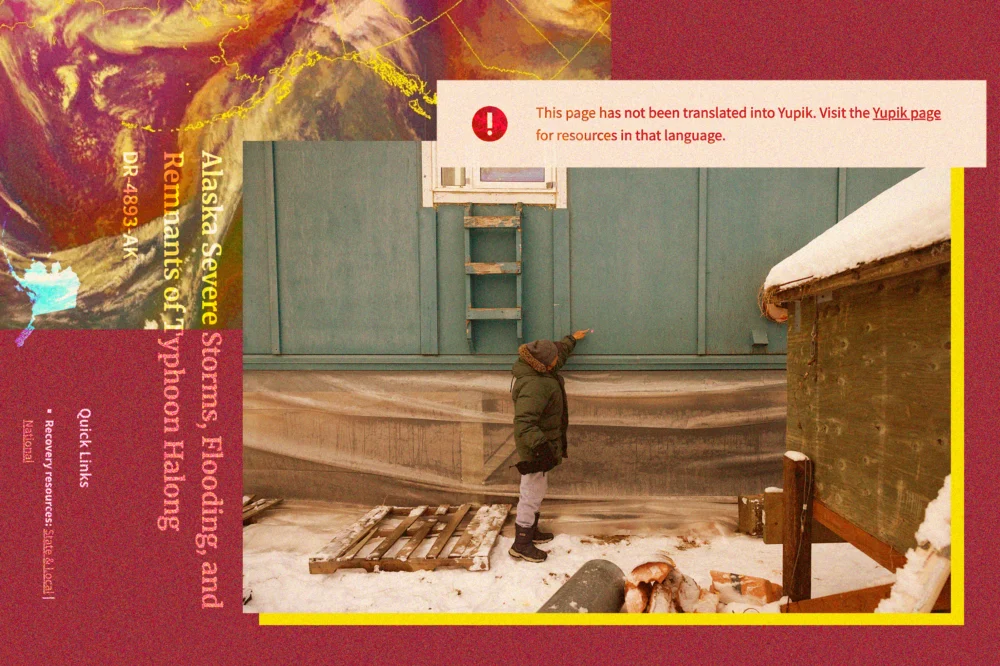
Western Alaska’s remote villages, already grappling with the devastating aftermath of Typhoon Halong in mid-October, now face a renewed and complex challenge regarding access to vital federal disaster aid: the potential integration of artificial intelligence into language translation services. This development has reignited concerns about cultural integrity, data sovereignty, and effective communication for communities where Indigenous languages remain primary, casting a shadow over the promise of swift relief for over 1,500 displaced residents and the family of at least one person tragically lost in Kwigillingok. The storm, whose remnants swept through the region, underscores the recurring vulnerability of these communities to increasingly severe weather events, making reliable, culturally sensitive aid paramount.
Just three years prior, in 2022, a similar crisis unfolded after historic storms, including Typhoon Merbok, ravaged the Yukon-Kuskokwim Delta. At that time, the Federal Emergency Management Agency (FEMA) contracted a California-based company, Accent on Languages, to facilitate disaster aid applications. The mandate was clear: bridge the linguistic gap for a region where nearly half the population—approximately 10,000 people—learn Yugtun, the Central Yup’ik dialect, before English, and where roughly 3,000 individuals farther north speak Iñupiaq. However, the translations provided were profoundly flawed. Journalists at the local public radio station, KYUK, discovered the translated materials were unintelligible, rendering them useless to those they were intended to help. Julia Jimmie, a Yup’ik translator at KYUK, recounted the experience, stating, "They were Yup’ik words all right, but they were all jumbled together, and they didn’t make sense. It made me think that someone somewhere thought that nobody spoke or understood our language anymore." This egregious failure not only hampered recovery efforts but also sparked a civil rights investigation into FEMA’s practices and ultimately led to the contractor reimbursing the agency for the faulty work. In response, FEMA committed to significant policy changes, pledging to employ only Alaska-based vendors for Alaska Native languages, prioritize those within disaster-impacted areas, and implement a secondary quality-control review for all translations. The agency also affirmed continuous consultation with tribal partners to determine and meet language service needs effectively.
Despite these assurances, the specter of communication breakdown looms once more. On October 21, the day before the Trump administration approved a disaster declaration for Typhoon Halong, Minneapolis-based Prisma International posted an advertisement seeking "experienced, professional Translators and Interpreters" for Yup’ik, Iñupiaq, and other Alaska Native languages. Government records reveal Prisma’s extensive history with FEMA, having secured over 30 contracts in recent years across various states. The company’s website highlights its methodology, stating it "combine[s] AI and human expertise to accelerate translation, simplify language access, and enhance communication." Crucially, the job listing for Alaska Native languages specified that translators would be required to "provide written translations using a Computer-Assisted Translation (CAT) tool," signaling a reliance on technology that often incorporates artificial intelligence.

While FEMA declined to confirm whether it planned to contract with Prisma for the Alaska response, the job posting’s preference for applicants with experience translating for emergency management agencies like FEMA, coupled with a requirement for knowledge of the recent storm and a connection to local Indigenous communities, strongly suggested an impending engagement. Indeed, multiple Yup’ik language speakers in Alaska, including Julia Jimmie, confirmed being contacted by a company representative who identified Prisma as "a language services contractor for the Federal Emergency Management Agency." Jimmie, who would readily offer her translation skills for FEMA, expressed reservations about working with Prisma given its stated approach.
The expanding role of AI in various sectors, including translation, elicits a complex mix of excitement and apprehension within Indigenous communities. Many Native tech and culture experts recognize AI’s transformative potential, particularly in the critical domain of language preservation. Projects led by Indigenous innovators, such as an Anishinaabe roboticist designing a robot to teach Anishinaabemowin or a Choctaw computer scientist creating a chatbot for conversational Choctaw, exemplify the positive applications when Indigenous people retain control over the technology’s development and deployment. However, a significant and often overlooked risk is the potential for AI to distort cultural knowledge and undermine language sovereignty, especially when the technology is developed and controlled by external entities.
A core concern revolves around data. Morgan Gray, a member of the Chickasaw Nation and a research and policy analyst at Arizona State University’s American Indian Policy Institute, emphasizes that "Artificial intelligence relies on data to function." Gray warns, "One of the bigger risks is that if you’re not careful, your data can be used in a way that might not be consistent with your values as a tribal community." This concept underpins "data sovereignty," the inherent right of tribal nations to define how their data is collected, stored, accessed, and utilized. Internationally, this right is increasingly central to discussions surrounding Indigenous intellectual property, with the United Nations Declaration on the Rights of Indigenous Peoples (UNDRIP) stipulating the necessity of free, prior, and informed consent (FPIC) for the use of Indigenous cultural knowledge. UNESCO, the UN body safeguarding cultural heritage, has explicitly called upon AI developers to respect tribal sovereignty in their engagement with Indigenous communities’ data. Gray insists that tribal nations require complete information about AI’s intended use and the specific types of tribal data it might employ, along with ample time to consider the implications and the unequivocal right to refuse its use, even if motivations appear altruistic.
The practical accuracy of AI in translating highly complex Indigenous languages like Yup’ik presents another formidable challenge. Julia Jimmie articulated this concern, noting, "Yup’ik is a complex language. I think that AI would have problems translating Yup’ik. You have to know what you’re talking about in order to put the word together." Most advanced AI models rely on vast datasets to achieve accurate translations, a resource rarely available for Indigenous languages, many of which are considered "low-resource" in the computational linguistics field. Consequently, AI has a documented poor record in translating these languages, frequently producing inaccurate sentences, nonsensical phrases, or even fabricating words entirely. Sally Samson, a Yup’ik professor of language and culture at the University of Alaska Fairbanks, voiced skepticism that AI could master the unique syntax of Yugtun, which diverges significantly from English. Her apprehension extends beyond mere misinformation; she fears AI’s inability to convey the profound nuances of a Yup’ik worldview. "Our language explains our culture, and our culture defines our language," Samson stated, highlighting how the intricate values of respect are embedded in communication.

Beyond technical accuracy, there is a deep-seated concern about exploitation. Crystal Hill-Pennington, who teaches Native law and business at the University of Alaska Fairbanks and consults with Alaska tribes, worries about the potential for non-Native companies to train AI on the invaluable work of Indigenous translators and then capitalize on that knowledge without sustained engagement with the originating communities. This concern is not without precedent; Indigenous communities possess centuries of experience with outsiders extracting and exploiting their cultural knowledge. A recent example from 2022 saw the Standing Rock Sioux Tribal Council banish a non-profit organization that, after years of Lakota elders sharing cultural knowledge, copyrighted the material and attempted to sell it back to tribal members in textbooks. Hill-Pennington articulated the critical question this dynamic poses: "Who ends up owning the knowledge that they’re scraping?"
FEMA’s stance on AI and Indigenous data sovereignty remains opaque. While the agency has reiterated its commitment to working closely with tribal governments and partners to ensure responsive services, its email communications did not directly address specific policies regulating AI use or safeguarding Indigenous data. Prisma’s website mentions an "AI Responsible Usage Policy" that governs its AI applications, and states that clients can opt for human-only translations. However, the details of this policy are not publicly accessible, and the company did not respond to requests for clarification. A case study on Prisma’s website highlights its "LexAI" technology used to provide disaster relief information in over 16 languages, including "rare Pacific Island dialects," for a federal agency following a wildfire, demonstrating its capacity and willingness to apply AI to less common languages.
Standards concerning AI and Indigenous cultural knowledge are rapidly evolving alongside the technology itself. Hill-Pennington notes that some companies utilizing AI may still be unfamiliar with the expectation of informed consent and the critical concept of data sovereignty. However, she asserts that these standards are becoming increasingly relevant, especially for entities collaborating with federal agencies that operate under executive orders mandating authentic consultation with Indigenous peoples in the United States. In the wake of Typhoon Halong and the urgent need for effective disaster response, the imperative to ensure that technology serves, rather than undermines, the linguistic and cultural sovereignty of Alaska’s Indigenous communities has never been more critical. The stakes extend far beyond mere translation; they encompass the preservation of unique worldviews, the protection of intellectual heritage, and the fundamental right of self-determination in an increasingly digital and climate-challenged world.