Roger Danuarta
On Wednesday, December 10, at 3:30 P.M., an unsettling wail from the city’s flood alarm pierced the afternoon calm in Sumas, Washington, a small community nestled within the Nooksack River floodplain on the state’s northwest border. The urgent siren, heard even across the international boundary in Abbotsford, British Columbia, signaled the rapid rise of floodwaters, prompting most residents to heed the immediate warning. Families swiftly gathered children, pets, and essential belongings, seeking refuge in designated flood shelters, local hotels, or the homes of friends and relatives further afield.
By the following morning, the Nooksack River had fully asserted its power, transforming Sumas into an isolated island. Every road leading in and out of the town lay submerged, cut off by multiple feet of frigid, silt-laden water. The inundation damaged hundreds of homes and businesses, leaving behind a pervasive, gritty layer of mud on nearly every surface. For those who had not evacuated, the situation became dire, necessitating dramatic rescues by U.S. Coast Guard helicopters from rooftops, a stark testament to the speed and severity of the deluge. As waters slowly receded on December 12, the high-water line offered a grim visual record of the disaster, marked by a chaotic trail of trash, leaves, and debris clinging to chain-link fences, and muddy streaks etching themselves onto the sides of homes and vehicles throughout the flood zone.
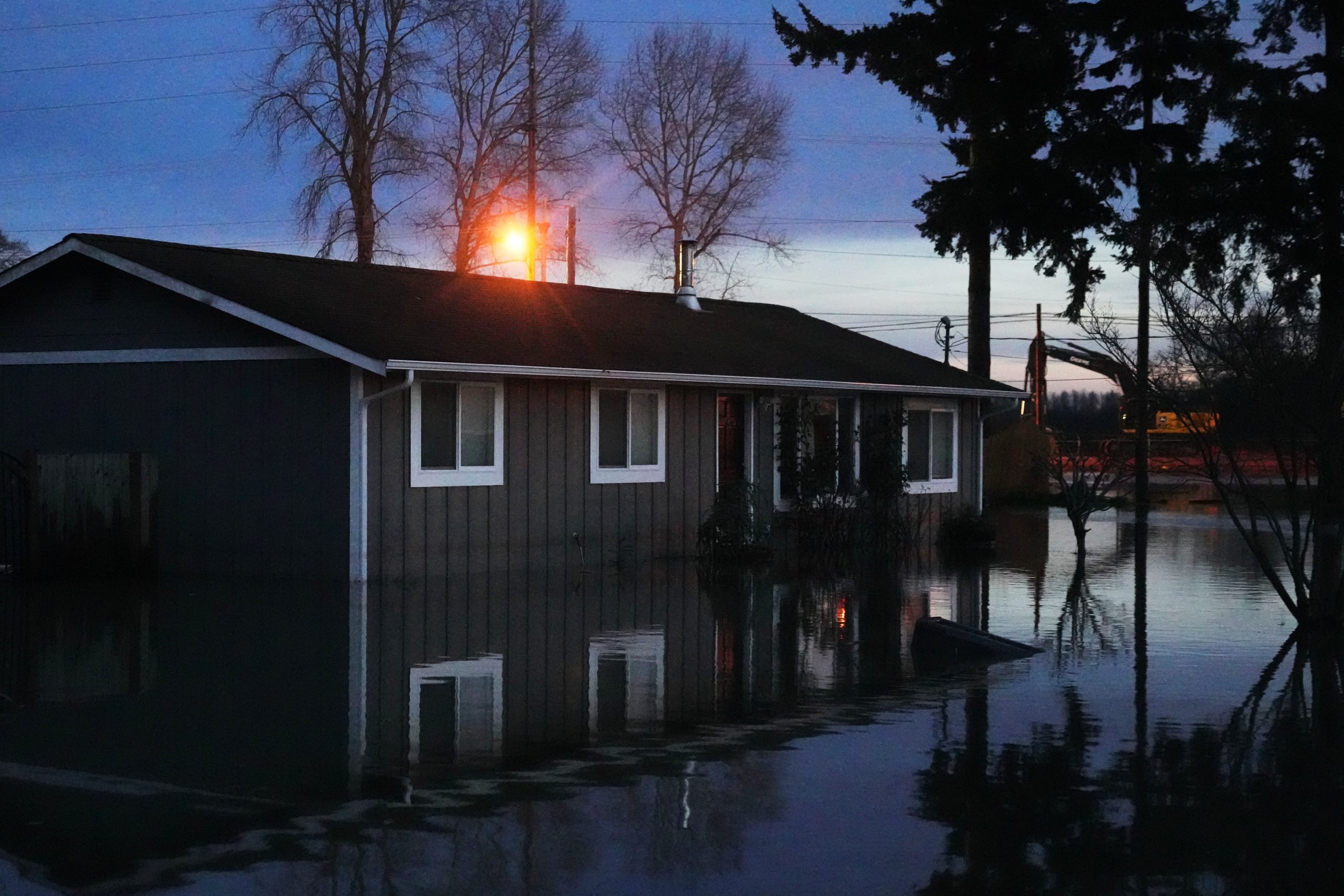
This catastrophic event stemmed from a relentless barrage of two back-to-back atmospheric rivers, meteorological phenomena that typically bring vital precipitation to the West Coast but, in this instance, delivered an overwhelming torrent. Washington’s west coast bore the brunt of these systems in early December, with some localized areas receiving an astonishing 14 inches of rain within a concentrated 72-hour period at the storms’ zenith. While major urban centers like Seattle, Everett, and Bellingham experienced less severe impacts, low-lying agricultural zones, particularly in Whatcom and Skagit counties, found themselves at the epicenter of the crisis. The Pacific Northwest, accustomed to heavy winter rains, was caught off guard by the sheer volume and sustained nature of this precipitation, which overwhelmed river systems and drainage infrastructure.
The immediate aftermath quickly transitioned into a long and arduous recovery process. In Nooksack, a community just down the road from Sumas, the collective effort to reclaim homes and lives began on December 12. Volunteers, equipped with thick work gloves, high rubber boots, and waterproof jackets, joined homeowners in the arduous task of cleanup. Waterlogged carpets and saturated building materials were painstakingly hauled to the streets for eventual disposal. Others ventured into still-inundated crawlspaces, grappling with soaked insulation and mud-caked vapor shields, confronting the unseen damages that often accompany such deep flooding. The Whatcom Long Term Recovery Group, an organization forged in the wake of north Whatcom County’s similarly devastating 2021 floods, provided crucial support. Stationed at the Nooksack Valley Church, volunteers offered assistance with complex insurance claims and state aid applications, alongside vital emotional support for flood victims confronting their devastated communities and uncertain futures. By December 19, nearly 800 families in Whatcom County had formally requested assistance from the recovery group, underscoring the immense scale of human need and the critical role of community solidarity in disaster response.
Atmospheric rivers, often described as "rivers in the sky," are narrow, elongated bands of concentrated water vapor originating over the warm expanse of the Pacific Ocean. These potent corridors of moisture are a natural and often beneficial component of the Pacific Northwest’s hydrology, contributing significantly to the region’s water supply and snowpack. However, in a warming climate, their character is changing. This particular series of storms proved exceptionally potent and widespread, with their reach extending unusually far south, impacting areas as distant as central Oregon. Over 100,000 Washington residents faced evacuation orders as coastal rivers, fed by runoff from the Cascade Range, swelled to unprecedented levels on December 11 and 12, testing the limits of emergency services and infrastructure.

The devastation was geographically diverse, highlighting the vulnerability of various landscapes. Sixty miles north of Seattle, in Skagit County, the communities of Concrete and Hamilton suffered particularly severe impacts. Bridget Moran, a fisheries biologist assisting with cleanup efforts in Skagit County, reported high-water marks exceeding six feet in some Hamilton homes, indicating comprehensive structural damage. Further downstream, the mighty Skagit River itself reached a record-breaking flow of 37.7 feet, its fury only held at bay from downtown Mount Vernon by the presence of a robust floodwall, a testament to decades of flood control investment that narrowly averted an even greater catastrophe.
Not all communities were as fortunate in their defenses. In nearby Burlington, approximately 55 homes and significant portions of the downtown area were inundated on December 12, necessitating the evacuation of nearly 10,000 residents and disrupting local commerce. In south King County, a pre-existing vulnerability became a critical failure point when floodwaters breached an already weakened levee on the Lower Green River near the town of Pacific in the early hours of December 16. This breach triggered the swift evacuation of 2,100 residents and ultimately impacted around 220 homes and 800 individuals, raising questions about aging infrastructure and flood protection strategies. Tragically, in Snohomish County, south of Skagit, the floods claimed their first confirmed fatality when a 33-year-old man attempted to drive on a closed road and was swept away by the raging waters, a somber reminder of the inherent dangers and the importance of heeding official warnings.
The destructive reach of these atmospheric rivers extended even to the typically colder, drier communities of the East Cascades, including Naches, Leavenworth, and Methow. The unseasonably warm temperatures meant that the majority of precipitation fell as rain, rather than the expected snow, even at the highest elevations of the Cascade Range. This "rain-on-snow" event dramatically exacerbated runoff, as the warm rain rapidly melted existing snowpack, leading to a synergistic surge of water that overwhelmed natural and engineered drainage capacities. The result was catastrophic flooding, widespread power outages, and dangerous mudslides. In Stehekin, located near the area scarred by the 2024 Pioneer Fire, residents and businesses sustained significant damage from landslides and post-fire debris flows. Scorched soils and denuded vegetation in recently burned areas are inherently less stable and lose their water-retaining capacity, making them highly susceptible to such destructive phenomena, a growing concern in regions impacted by increasingly severe wildfire seasons. Further south along the Cascade crest, Stevens Pass sustained such extensive damage that officials anticipated its closure for several months, while multiple landslides ripped across the eastbound lanes of I-90, the crucial trans-Cascade thoroughfare, causing immense disruption to transportation and supply chains.

A third, slightly colder atmospheric river swept through Washington during the week of December 15. While this system brought less severe flooding than its predecessors, as watersheds were already saturated, its primary impact came from powerful winds. Gusts tore through the state, leaving approximately 380,000 people across Western Washington without power, highlighting the multi-faceted nature of extreme weather threats and the cascading impacts that can follow initial flooding events. These successive storms underscore a global trend of increased weather volatility, pushing communities worldwide to reconsider their preparedness and resilience strategies.
Experts attribute the increasing severity and frequency of these events to the confluence of naturally occurring atmospheric rivers and the accelerating effects of climate change. The USDA Northwest Climate Hub emphasizes that a warmer atmosphere possesses a greater capacity to hold water vapor—a principle rooted in the Clausius-Clapeyron relation—while a warming Pacific Ocean provides an amplified source of moisture. This fundamental shift directly translates into an increase in both the duration and strength of atmospheric river events. Guillaume Mauger, Washington state climatologist, observed that when these factors align, "we’d expect the storms to be more intense." Mauger further underscored that the danger of this particular series of atmospheric rivers lay not just in their individual intensity, but in their rapid succession, offering no respite between deluges and preventing saturated ground from recovering.
While Mauger cautioned that researchers require more extensive data to precisely quantify climate change’s influence on this specific storm series, he pointed to the unseasonably warm temperatures and the critical shift from snow to rain at higher elevations as strong indicators of its impact. "Atmospheric rivers are warm in general," he explained, "but if this event had happened in 1950, the snowline wouldn’t have been quite so high. That’s the big effect: that it’s just less snow and more rain." This critical change significantly increases the volume of water flowing into river systems, overwhelming natural and engineered drainage capacities and converting what might once have been beneficial snowpack into destructive runoff. This phenomenon is a direct consequence of global warming, pushing historical weather patterns into uncharted and dangerous territory.

As communities across Washington now fully embark on the challenging recovery phase, residents face the daunting tasks of removing water-damaged belongings and saturated building materials from their homes, all while navigating the complexities of financial assistance. Washington Governor Bob Ferguson, a Democrat, has allocated $3.5 million in emergency funding to aid flood victims and has proposed a supplemental budget containing $55 million specifically earmarked for home repair and recovery efforts. In a crucial development, President Donald Trump approved Governor Ferguson’s request for federal disaster assistance, a move that enables the Federal Emergency Management Agency (FEMA) to provide support to communities and local governments in their recovery endeavors, though it does not automatically unlock direct federal funding for individual victims, highlighting the persistent challenges in securing comprehensive aid.
Several systemic factors are poised to complicate and prolong the recovery in many of the hardest-hit areas, according to a report from the Urban Institute. These include a high prevalence of renters, the widespread use of manufactured homes, and a significant lack of adequate flood insurance. Alarmingly, only about a quarter of homes situated within the designated 100-year floodplain in Whatcom, Skagit, and Snohomish counties hold National Flood Insurance Program (NFIP) policies. These federally administered policies are designed to provide coverage for individuals in high-risk areas who might otherwise be unable to obtain insurance, underscoring a critical gap in preparedness that leaves many vulnerable to catastrophic financial losses and often reliant on limited government aid or charitable organizations. The economic burden on these communities will be immense, stretching for years.
The personal toll of the disaster became poignantly clear in Nooksack on December 12. Working with another volunteer, I carefully removed ornaments and lights from a family’s waterlogged Christmas tree, its lower branches caked in mud, the floor around it thick with river silt. Others worked quietly, methodically, around us, carrying out sodden couches and children’s toys still dripping with river water, each item a small piece of a life upended and a memory tainted by the flood. Later, standing in the driveway, I observed a continuous stream of volunteers lugging wet, ruined items from every home on the block – a scene that would undoubtedly be replicated in thousands of homes across the state in the ensuing weeks and months. The sheer scale of the devastation was overwhelming, yet there was little time for reflection. The immediate imperative was action: trim to remove, flooring to rip out, paperwork to complete, lives to rebuild, and, ultimately, communities to renew with a profound sense of resilience and collective purpose, all while facing the stark reality that such extreme weather events are becoming the new normal in a changing climate.