Rocky Gerung
Conservationists working to revitalize coho salmon populations along California’s rugged North Coast have adopted an unusual mantra: a healthy coho stream resembles a teenager’s bedroom, albeit one filled with discarded logs and branches instead of clothes. This seemingly chaotic approach to river restoration is precisely what Anna Halligan, a conservation biologist with Trout Unlimited, observed with delight one spring morning along the Navarro River. "This is exactly what we want," she remarked, surveying the water, which was slowed and deepened by a natural accumulation of woody debris. A fallen redwood, magnified by the addition of another large log likely dislodged by winter rains, had created a sun-dappled pool, a vital sanctuary for young salmon. This particular improvement was the result of a deliberate effort in September 2020, when Trout Unlimited and its partners carefully placed a redwood into the river to enhance coho habitat. The subsequent arrival of an even larger redwood, creating what Halligan described as a more profound "mess," had inadvertently amplified the desired effect, leading to the emergence of a young, silvery coho salmon from the newly formed pool.
Coho salmon, anadromous fish that journey between freshwater streams and the vast Pacific Ocean, have historically played a crucial role in the ecological and cultural fabric of the Pacific Coast. Fred Simmons, an environmental technician for the Cahto Tribe of Laytonville Rancheria, reminisced about a childhood where coho runs were so abundant they could "go out there any time of evening and just get whatever you needed for your family." However, decades of intensive logging, coastal development, and the escalating impacts of climate change have severely degraded these vital aquatic ecosystems, pushing coho salmon populations to the brink of collapse. In Mendocino County, a significant portion of the species’ southern range, coho salmon were first listed as threatened by the U.S. Fish and Wildlife Service in 1996 and later as endangered in 2005.
The recent sighting of the young coho in the Navarro River signifies a hopeful resurgence. For the past two years, conservationists have witnessed a notable increase in coho salmon returning to the coast, leading Peter Van De Burgt, a restoration manager with The Nature Conservancy, to express cautious optimism: "Recovery seems possible. We’re on the right track." This turnaround marks a significant shift from the early days of restoration efforts, which began in the 1960s.
Initial attempts to restore Mendocino’s streams for salmon focused on removing woody debris that had accumulated in channels due to extensive logging of old-growth forests. This debris, while creating miles of navigational barriers, was also an unintended consequence of past forest management practices. Conservationists at the time, guided by a "Western concept" of tidiness, as described by Anira G’Acha, environmental director for the Cahto Tribe, perceived these natural logjams as impediments to be cleared. The result was the creation of hundreds of miles of straightened, simplified stream channels that resembled "bowling-alley lanes," characterized by fast-flowing water devoid of the complex habitat features salmon require.
This oversimplified approach proved detrimental to salmon populations. "It’s hard to be a salmon," Van De Burgt explained, highlighting the constant threats from predators like birds, otters, and even other fish. Without the natural structure provided by fallen logs, streams lost the overhanging banks, intricate debris formations, and deep pools that offer crucial shelter and refuge for juvenile salmon. The fast currents offered no respite, making young fish vulnerable to predation and hindering their development.

Recognizing the critical role of woody debris, a paradigm shift began to occur within the conservation community. By the time coho salmon populations were afforded protection under the Endangered Species Act, state agencies acknowledged their past mistakes. "Basically did an ‘Oops’ and said, ‘Well, let’s put them back in again,’" recounted John Andersen, a California forester and policy director for the Mendocino and Humboldt Redwood Companies, referring to the efforts to reintroduce wood into stream channels. Historically, natural processes, including fire, played a vital role in felling trees and creating these essential habitats. "Stream habitat evolved around fire for thousands of years," noted Ron Reed, a Karuk tribal member, cultural biologist, and dipnet fisherman. However, the era of aggressive wildfire suppression, coupled with the expansion of the logging industry, disrupted this natural cycle, necessitating human intervention to recreate these vital structures.
In the late 1990s, companies like Mendocino Redwood began collaborating with Trout Unlimited to restore coho habitat on their lands. This initiative soon expanded, with organizations such as The Nature Conservancy, bolstered by state and federal grants, undertaking similar restoration projects across the region. Halligan emphasized the formation of an "ecological system" of collaborators, channeling millions of dollars into local economies and supporting rural contractors.
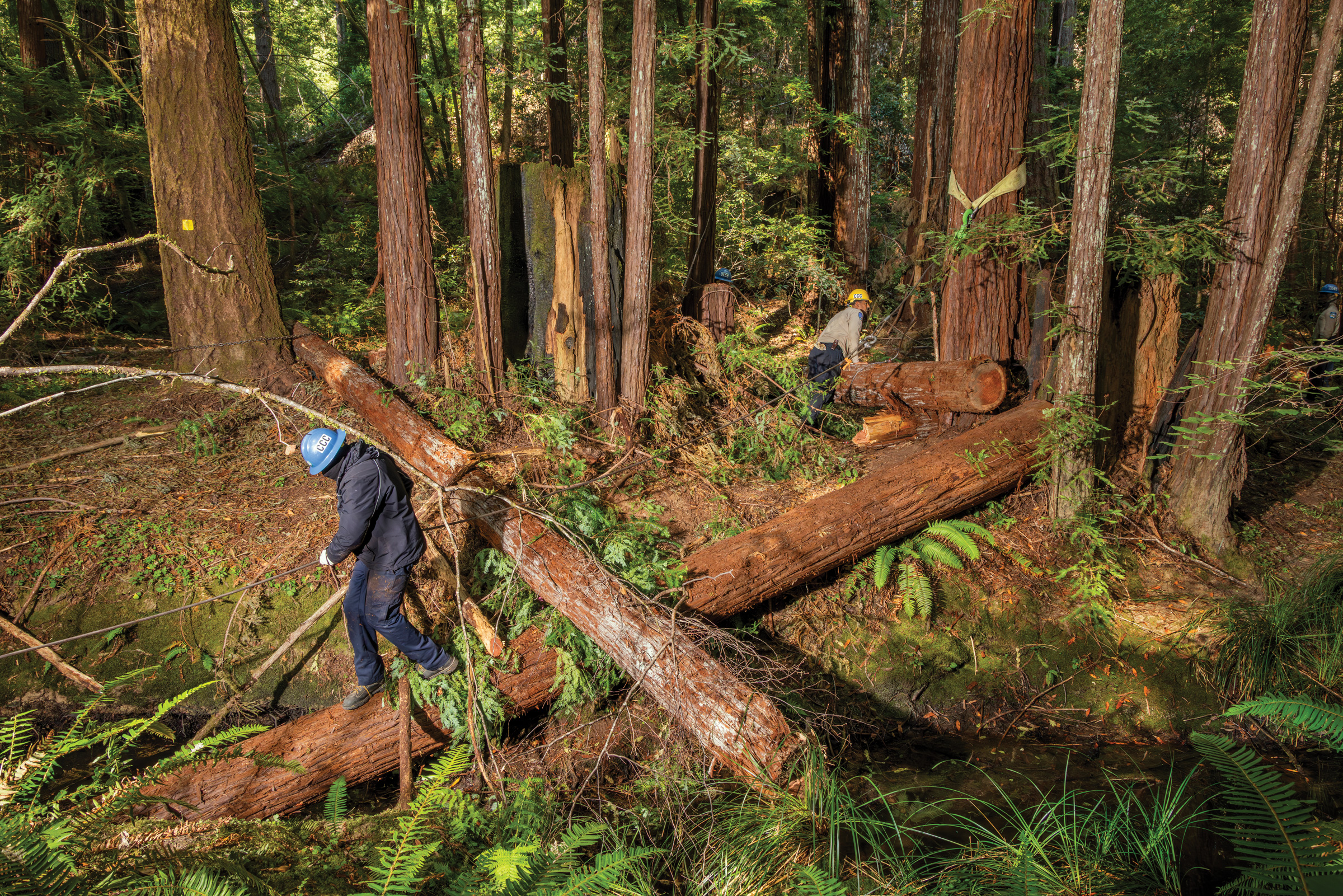
The practicalities of reintroducing wood into streams, however, proved more challenging than its removal. Early restoration projects faced bureaucratic hurdles, often requiring the same state environmental permitting processes as conventional logging operations, despite their fundamentally different ecological goals. Some projects were delayed for over a decade due to these regulatory complexities. Beyond permitting, practical challenges emerged. Chris Blencowe, a forester who consults on projects for The Nature Conservancy and Trout Unlimited, shared his early experiences. He initially used second-growth redwoods for creating logjams, only to find they often "just break like an overweight watermelon" when toppled into streambeds. He has since transitioned to using Douglas fir, which has proven more durable.

Blencowe also learned the importance of anchoring logs between standing trees to prevent them from being swept away during high winter flows, a common issue in earlier efforts. The Nature Conservancy has adopted specialized equipment that uses vibrations to sink logs into the sediment, avoiding the use of power hammers that could harm or kill nearby fish. Even with two decades of experience, the unpredictable nature of river systems remains a constant factor. Van De Burgt views this unpredictability not as a failure, but as an intrinsic element of successful restoration: "We want to implement projects that create chaos in the river." This controlled "chaos" generates a diversity of microhabitats, providing young coho with more opportunities to survive and thrive on their journey to the ocean.
These restoration efforts extend benefits beyond coho salmon, positively impacting other salmonid species, including steelhead trout, and the riparian forests that line the waterways. Marisa McGrew, an assistant natural resources director for the Wiyot Tribe and of Karuk and Yurok descent, explained via email that felling nearby second-growth trees for logjams "encourages understory plant relatives to grow," underscoring the interconnectedness of stream and forest restoration.
The winter of 2023-2024 saw a significant return of coho salmon to the Mendocino coast, with 15,000 individuals counted, the highest number recorded by the California Department of Fish and Wildlife in 16 years. Preliminary estimates suggest this number nearly doubled in the subsequent winter. Sarah Gallagher, who leads the agency’s monitoring program, attributed this surge to a confluence of favorable factors: improved ocean conditions, a respite from prolonged drought, and the extensive miles of restored stream habitat.

Despite this encouraging trend, the current population remains a fraction of historic levels, which once numbered in the hundreds of thousands. The plight of other salmon species, such as chinook and steelhead, continues to be dire; the interstate Pacific Fishery Management Council has extended its ban on ocean salmon fishing for a third year. Furthermore, hundreds of miles of North Coast streams still require significant woody debris additions. Halligan of Trout Unlimited acknowledged the scale of the remaining work, noting that "sometimes, when you look at it on a map, it looks like we’ve barely done anything at all."
The long-term future of these recovering populations and their habitats faces ongoing uncertainty. Earlier this year, proposed budget cuts to the National Oceanic and Atmospheric Administration, a key funder of the Pacific Coastal Salmon Recovery Fund and coho monitoring programs, raised concerns. In response, Northern California conservationists are actively exploring alternative funding avenues, including the $10 billion allocated for climate resilience projects through Proposition Four, approved by California voters last November. As the restoration efforts gain momentum, the commitment to bringing coho salmon back remains strong. Simmons expressed a deep connection to the land, observing that the salmon "are realizing this is their homeland where they were born… It seems like they’re trying to heal."