

 Roger Danuarta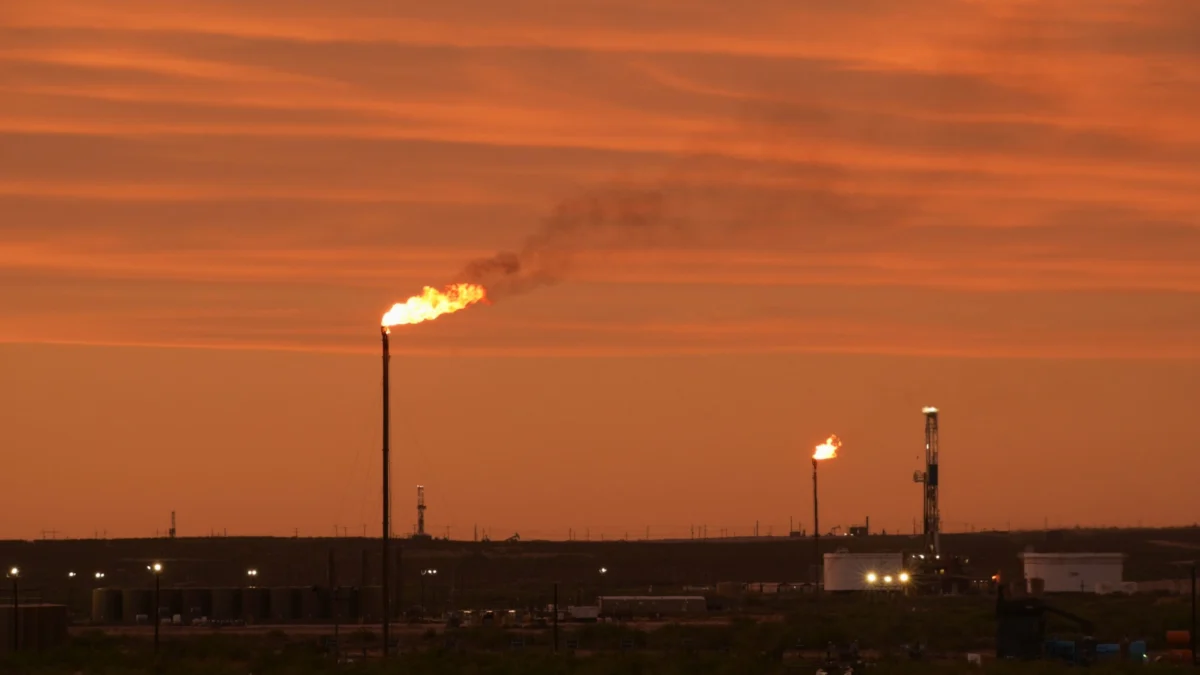
Recent scientific investigations have unveiled a disturbing correlation between the intensive oil and gas operations within the Permian Basin and significant atmospheric pollution, including radioactive airborne plumes and hazardous ozone levels, particularly impacting the small New Mexico town of Loving. These findings, based on rigorous data collection and analysis, underscore the escalating environmental and public health concerns in one of the world’s most prolific energy-producing regions.
A peer-reviewed scientific paper, published this month in Elementa by the University of California Press, specifically links oil and gas activities to elevated levels of airborne radioactivity near Loving. Concurrently, an associated study, presented at the Air & Waste Management Association’s annual conference, highlights how high concentrations of ground-level ozone pollution in the same vicinity are direct byproducts of the extensive petroleum extraction and processing activities. Both studies draw from a year’s worth of comprehensive data, collected between May 2023 and May 2024, at an air monitoring station established in Loving, a project funded by a grant from HEI Energy, an independent research organization focused on energy and health.
The radiation study meticulously measured various forms of air pollution, specifically focusing on radon and its radioactive decay products. The findings revealed that airborne radiation levels in Loving surged up to five times beyond typical background levels, with fluctuations directly influenced by wind direction. While the monitoring station’s localized readings prevented pinpointing a single definitive source, the authors strongly implicated the area’s dense oil and gas infrastructure, emphasizing the urgent need for more targeted, follow-up investigations. Detlev Helmig, an atmospheric scientist with Boulder AIR’s air quality program and a co-author of the study, articulated the compelling evidence: "The analyses of our monitoring data provide evidence that oil and gas operations in the Loving area are a likely source of atmospheric releases of radioactivity." Helmig played a crucial role in the establishment and management of the original monitoring station in Loving, offering firsthand insight into the environmental conditions.
Loving, a community nestled deep within the Permian Basin, effectively serves as a stark illustration of the environmental hazards inherent in living amidst intense oil and gas development. Hundreds of active oil wells punctuate the landscape within a two-mile radius of the town, complemented by over a dozen sprawling processing facilities. Local residents frequently report the pervasive smell of raw hydrocarbons, a constant reminder of the industrial activity that engulfs their daily lives. Jackie Onsurez, a Loving resident and former Democratic primary candidate for lieutenant governor, voiced the community’s frustration: "It’s pollution. You don’t have to be a scientist to wake up and see it’s brown and it’s not dirt." The radiation study specifically identifies several industrial emission sources contributing to this airborne radioactivity, including gas flares at active well pads, gas-fired compressors at midstream sites, and evaporation ponds containing produced water. Produced water, a byproduct of oil and gas extraction, often contains naturally occurring radioactive materials (NORM) that can become concentrated and released into the atmosphere through these operational processes.
The study’s conclusions are particularly alarming regarding public health, indicating that exposure to this airborne radiation could lead to a small but statistically measurable increase in lung cancer risk among residents. Helmig underscored the severity of this risk, stating, "There is no safe level of radioactivity. Similar to smoking, even a low number of smoked cigarettes and even passive smoking has been found to be harmful. That’s about the same with the exposure to radioactivity in the air that people breathe." The authors of the study unequivocally call for "continued investigation" given the well-established health risks associated with radioactivity exposure.
The affiliated ozone pollution study, though still undergoing peer review for anticipated publication early next year, presented compelling preliminary data. Initial findings from the 2023-2024 monitoring in Loving had already highlighted elevated levels of nitrogen dioxide (NOx), a primary precursor to ozone. The new analysis meticulously tracks wind patterns and pollution densities, concluding that the elevated ozone levels are almost entirely attributable to oil and gas production within the Permian Basin, rather than distant urban emissions from cities like El Paso or other metropolitan areas. In fact, the weighted ozone measurements recorded in Loving surpassed those found in major Texas cities such as Houston or Dallas, signaling a significant localized air quality crisis.
The sources of these ozone precursors largely overlap with those identified in the radiation report, encompassing emissions from diesel compressors used in natural gas pipeline operations, gas flares, and the extensive fleet of trucks serving the oil and gas industry. Gunnar Schade, an associate professor of atmospheric sciences at Texas A&M University and another key figure in managing the Loving air monitoring station, affirmed that these industrial emissions are "critical in driving ozone formation" around Loving. While acknowledging some ozone may originate from Texas, Schade noted, "most is likely New Mexico-made," pinpointing the localized nature of the problem. He also offered a sobering global perspective, remarking that while Loving’s pollution figures are severe, "Ozone values in urban areas of China and India are still worse," referencing regions frequently cited for the world’s most extreme air pollution.
Ground-level ozone, a harmful air pollutant distinct from the protective stratospheric ozone layer, forms when volatile organic compounds (VOCs) and nitrogen oxides (NOx) react in sunlight. It is a principal component of smog and poses serious health risks, particularly damaging the lungs and aggravating pre-existing respiratory conditions such as emphysema and asthma. The continuous leakage of these ozone precursors from oil and gas operations creates a persistent atmospheric cocktail, especially on warm, sunny days characteristic of the desert Southwest.

Dani Caputi, the lead investigator of the radiation study who also contributed to the initial air data collection in Loving, expressed a strong desire for continuity: "We are really hoping that this line of inquiry doesn’t end with this study." This plea stems from a critical juncture in the monitoring efforts. When the comprehensive monitoring project in Loving concluded in 2024, the research group offered to sell the sophisticated monitoring station to the New Mexico Environment Department (NMED), an offer the state agency declined. This decision is particularly concerning given that the Loving facility had been monitoring a broader spectrum of chemical sources than the NMED’s existing infrastructure at the time.
However, the NMED has taken steps to bolster its monitoring capabilities. In April, the department received a new mobile radiation monitoring van, a substantial investment of $480,000. This state-of-the-art mobile laboratory is equipped to measure radon levels, similar to those assessed near Loving, and can detect "all radioisotopes including tritium." Tritium, a radioactive isotope of hydrogen, occurs rarely in nature but is a common byproduct in nuclear reactors and nuclear weapons production. Its inclusion in the van’s capabilities is significant, as the NMED oversees environmental compliance at several sensitive nuclear sites, including former uranium mines, the nation’s only commercial uranium enrichment plant, and the Los Alamos National Laboratory (LANL), a primary facility for nuclear research and weapons manufacturing where tritium is used in nuclear warhead production. Last year, the NMED controversially approved LANL’s plans to release gases containing tritium into the atmosphere from over-pressurized containers, sparking public concern. Drew Goretzka, NMED’s director of communications, clarified that the "tritium capability is not intended solely for Los Alamos National Laboratory," asserting that the van enhances the state’s overall radiation monitoring capacity, including for potential releases from oil and gas operations.
Beyond radiation, the NMED has also enhanced its stationary monitoring network in the Permian Basin. Air quality stations in the cities of Carlsbad and Hobbs now monitor for sulfur dioxide (SO2), a common and highly toxic byproduct of flaring in oilfield operations. Studies conducted in both China and the U.S. have linked prenatal exposure to SO2 to lower birth weights, while the Centers for Disease Control and Prevention warns that inhaling the gas can irritate the eyes and respiratory tract, exacerbating symptoms for individuals with asthma and emphysema. Michelle Miano, director of the Environmental Protection Division at NMED, highlighted the significance: "These are the first sulfur dioxide monitors in the Permian in New Mexico. I’m not even sure Texas has any sulfur dioxide monitors in the Permian on its side."
Miano explained that natural gas in the Permian Basin often contains naturally high levels of sulfur. While some SO2 can escape through facility leaks, a significant portion originates from the flaring—or controlled burning—of natural gas. Despite a theoretical ban on routine flaring in New Mexico, companies frequently resort to it for various reasons, including overpressurized gas lines or contaminated gas. Between September 1, 2025, and September 1, 2026, companies reported flaring a staggering 33,651 times, demonstrating the pervasive nature of this practice and its impact on air quality.
The pollution from this widespread flaring is precisely what a long-awaited mobile air-pollution monitoring truck, currently in procurement, is intended to track. The acquisition of this crucial piece of equipment has been a protracted process. In 2022, a $6.5 million settlement between the environmental advocacy group WildEarth Guardians and Oxy USA Inc. over alleged Clean Air Act violations included a $500,000 allocation specifically for air quality projects in southeast New Mexico. In 2024, WildEarth Guardians transferred these funds to the NMED for the purchase of a mobile air lab. Miano candidly admitted that "That one has been a long time coming for all kinds of procurement issues," citing delays related to staffing needs and the final cost, which ultimately exceeded the initial settlement funds, reaching $589,000. The additional money, Miano noted, came from recently increased air pollution permit fees, a funding mechanism that has drawn sharp criticism.
Haley Jones, an organizer with Citizens Caring for the Future, an environmental group based in Carlsbad, voiced her apprehension regarding this funding source. "This means that in order to pay for air monitoring & enforcement, [the Environment Department] must continue to issue air permits, which makes our already poor air quality worse," she stated in an email. These permits legally define the maximum tonnage of toxic pollutants that industrial facilities, such as natural gas processing plants, are allowed to release annually. Carlsbad itself is a city enveloped by oil and gas wells and infrastructure, situated in a corner of New Mexico with the state’s highest concentration of permitted polluting facilities. Jones highlighted the dire local situation, reporting that over the preceding month, Carlsbad experienced only a single "good" air quality day, according to the EPA’s AirNow map. "Our air quality was worse than El Paso, Las Cruces, Albuquerque and Los Angeles over the same time period," she emphasized, painting a grim picture of the region’s air quality crisis. Miano assured that the new truck, once operational, will possess capabilities for measuring an even wider array of pollutants than the HEI Energy-funded facility used in the initial studies.
Despite these assurances, those involved in the initial settlement express profound dissatisfaction with the pace and direction of the state’s response. Rebecca Sobel, climate and health program director at WildEarth Guardians, remarked, "We certainly didn’t expect it would take four years to get that monitoring on the ground." Her concerns extend beyond mere acquisition. "Buying the truck isn’t the finish line, what matters is what [the Environment Department] does with it," Sobel asserted, questioning the decision-making process for deployment and the accessibility of data to the public. "If polluter-paid enforcement dollars buy sophisticated equipment but the equipment isn’t available when something happens, or the public can’t see the results, we’ve missed the point."
Jeremy Nichols, who worked on the original Oxy settlement at WildEarth Guardians and is now with the Center for Biological Diversity, echoed these sentiments, calling the situation "an utter disappointment." Nichols criticized the NMED’s emphasis on further monitoring over decisive enforcement. "The Environment Department wants to do more monitoring of air pollution in the Permian Basin? That’s like a police department saying they need to do more murder monitoring before they decide to enforce murder laws," he contended, pointing out that existing data already reveals serious problems. He specifically criticized Governor Michelle Lujan Grisham’s administration for not requesting the EPA to designate the Permian Basin as an ozone nonattainment area. Such a designation would legally compel both New Mexico and Texas to implement far more stringent measures to reduce ozone emissions, likely requiring much tougher regulation and enforcement on the oil and gas industry. Nichols and Sobel firmly believe that this designation was the ultimate objective of the settlement. "The intent of the settlement," Nichols concluded, "was to direct funds toward pollution reduction efforts, not more data gathering and paperwork." The ongoing struggle highlights a critical tension between economic imperatives and the fundamental right to clean air for communities living on the front lines of energy production.








