

 Johny Prima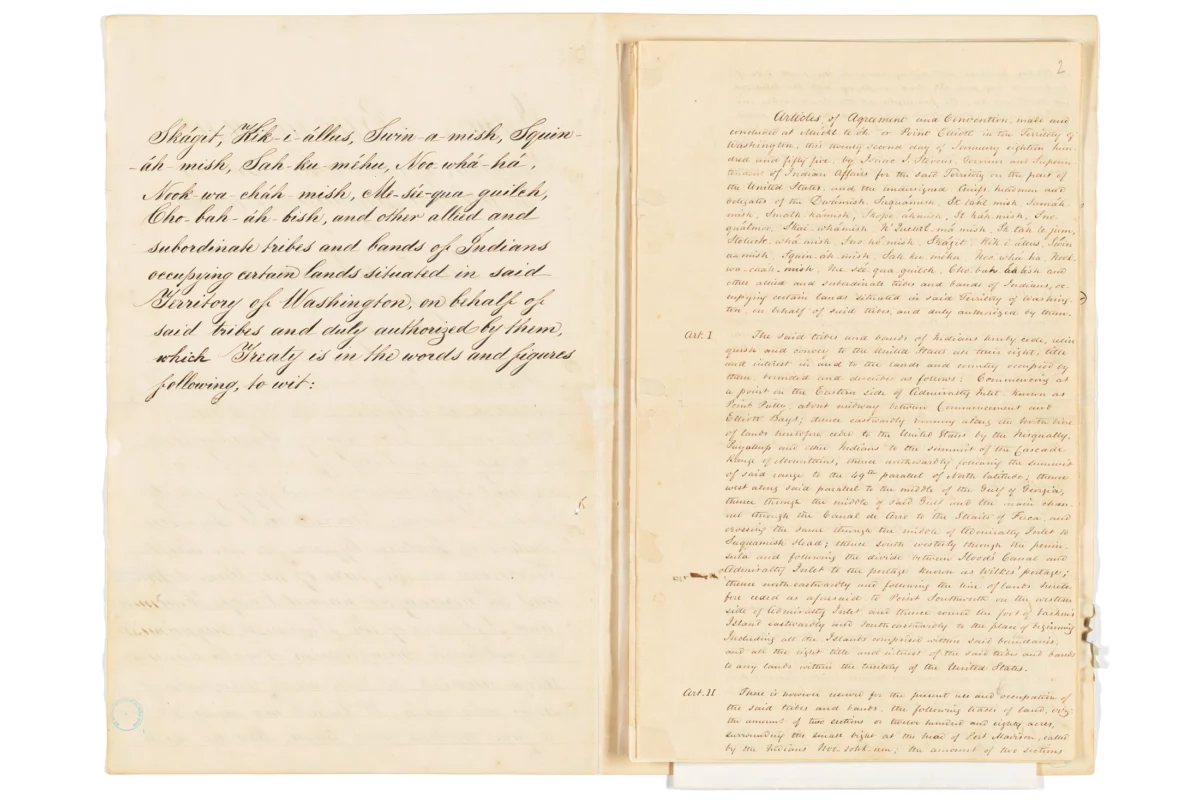
By 1855, when siʔaɫ had matured into the revered leader Chief Seattle, the landscape of his homeland had irrevocably changed; only 272 Suquamish people remained, a stark testament to the ravages of introduced diseases like smallpox, measles, and influenza, which decimated Indigenous populations across the continent long before significant settler populations arrived. The colonizers had solidified their presence, establishing a territorial government and pressing for land cessions. In this dire context, a treaty, though born of immense duress, appeared to Chief Seattle as potentially the sole viable path to negotiate enduring protections for his beleaguered descendants and their ancestral way of life.
Rob Purser, a Suquamish tribal member and director of treaty rights for the Suquamish Tribe, emphasizes Chief Seattle’s profound foresight and pragmatism: "Chief Seattle signed that treaty with the government after witnessing so many deaths that he had (to be) looking out for survival for future generations. There wasn’t no way of fighting your way out of that problem." Faced with overwhelming demographic and technological disparities, Indigenous leaders like Chief Seattle had to engage with the nascent colonial government, making difficult concessions in exchange for what they believed were guaranteed rights and lands. Yet, as Purser notes, a persistent pattern of non-Native governments routinely ignoring or reinterpreting these solemn agreements has led to dynamic and continuous legal and cultural engagements involving Native ancestors, the U.S. courts, and contemporary tribal nations.
The negotiation process itself was fraught with complexities, requiring multiple layers of interpretation that often convoluted the original intent of both parties. English statements were first translated into Chinook Jargon, a pidgin trade language with a limited vocabulary, and then further translated into diverse local languages such as Muckleshoot and Lushootseed. This linguistic chain inevitably resulted in final translations that frequently failed to capture the nuanced legal and cultural understandings of the Indigenous signatories, who represented over 80 distinct communities. Despite these challenges, the document was signed, and today, it profoundly impacts a wide spectrum of issues, from crucial fishing rights and resource co-management to vital provisions for education and medical care. The Suquamish Tribe, for instance, has vigorously defended the treaty’s provisions nine times before the U.S. Supreme Court, winning every case, a testament to what Purser hails as "Chief Seattle’s wisdom, looking at the situation his people were under, to try to protect future generations."
Professor Joshua L. Reid (Snohomish), a prominent historian and American Indian studies scholar at the University of Washington, highlights the fundamental divergence in property concepts that underpinned these negotiations. "Coast Salish peoples had, and continue to have, different ideas of what constitutes property, what constitutes ownership. Simply put, it’s more a system where people belong to places rather than people own places in that fee simple property way that United States property concepts observe." This profound difference meant that while Indigenous leaders understood the concept of negotiations and treaties—having been aware of the Douglas treaties signed by the British colonial governor with First Nations around Vancouver Island—they conceptualized land cessions and reservations differently, reserving inherent rights within these agreements.
Andrew Gobin (Tulalip), director of treaty rights for the Tulalip Tribes, underscores the encompassing nature of these agreements from an Indigenous perspective. "Our people saw what was coming, and they had the wisdom and the foresight to protect the things that are important to our people in our way of life, because truly, our entire culture is protected in the treaty. The rights to hunt, fish and gather protect everything." He explains that "usual and accustomed place" refers to family village sites, thereby protecting bloodlines, heritage, and the vital oral traditions passed down through generations of practice. "When you look out at the land and water, you see every aspect of our culture," Gobin asserts, illustrating how deeply intertwined culture and land are for Indigenous communities.
Despite the clarity of these "knowns"—the specific obligations and protections enshrined in treaties—federal agencies often act as if these agreements do not exist unless tribes actively advocate for their enforcement. As Gobin points out, "Treaty rights are knowns: We know what is obligated, we know what is protected. And yet… if the tribes weren’t there to stand up and voice the concern, then (federal agencies) just move forward like (the treaty) doesn’t exist." This ongoing struggle belies the common misconception that treaties were gifts from the government. Rob Purser firmly corrects this notion: "The government didn’t give us nothing. No tribe got gifts from the government. We reserved those treaty rights in exchange for land. And that’s the same all across the U.S." This crucial distinction underscores that treaties are agreements between sovereign nations, not acts of charity.
Historical context reveals that Washington Territory Governor Isaac Stevens, the primary U.S. negotiator, had significant motivations to secure these treaties swiftly. At the time, Indigenous peoples still vastly outnumbered settlers, and successful Native resistance against homesteaders was not uncommon. "There were plenty of times that Natives successfully fought back or chased settlers out of these homesteads that they were laying claim to," Professor Reid explains. "This loomed large in (Washington Territory Gov. Isaac) Stevens’ mind, because he knew that if Native nations banded together, they could push the settlers out. He had real motivation to try to get these treaties negotiated and signed to prevent something like that from happening."
Further complicating the historical record are documented instances of unfulfilled promises. Oral histories collected in the 1920s from elders who were children or teens at the Mukilteo treaty negotiations consistently recount Stevens’ promise of a vast reservation in western Washington, large enough to allocate 80 acres to every Coast Salish man, woman, and child. Indigenous leaders understood this as a clear guarantee of land rights. However, as Professor Reid reveals, "As it turned out, that big reservation that dozens of Coast Salish peoples talk about in these depositions, it doesn’t appear anywhere in the negotiation notes. That’s one of those examples of the power dynamic at play — that the United States was powerful enough to ignore some of these key promises that were made in the negotiations." This stark omission exemplifies the systemic disregard for Indigenous interests embedded in the colonial process.

A landmark legal victory in 1974, the Boldt Decision, profoundly re-affirmed the enduring power of these treaties. U.S. District Court Judge George H. Boldt famously interpreted the treaty phrase "in common with all citizens of the Territory" regarding fishing rights to mean that treaty tribes were entitled to harvest 50% of the fish in Washington state. Judge Boldt wrote, "There is no indication that the Indians intended or understood the language ‘in common with all citizens of the Territory’ to limit their right to fish in any way. For many years following the treaties the Indians continued to fish in their customary manner and places, and although non-Indians also fished, there was no need for any restrictions on fishing." This ruling was revolutionary, recognizing the tribes’ pre-existing sovereignty and their right to a share of the resource, not merely access.
The precise boundaries of a tribe’s "usual and accustomed" fishing grounds, as defined by the Treaty of Point Elliott, continue to be a subject of contemporary legal dispute. For instance, the Quinault Tribe recently sought access to new fishing grounds in Western Washington, asserting they fall under their "usual and accustomed" rights. Conversely, in 2021, the Sauk-Suiattle Tribe went to court to prevent the Quinault from fishing the Skagit River, arguing it lay outside their designated traditional areas. These ongoing legal challenges highlight the persistent need for judicial interpretation to uphold treaty commitments in a constantly evolving environmental and social landscape.
The very concept of "fishing" itself reveals a deep cultural divide that further illustrates the potential for misinterpretation during treaty negotiations. Professor Reid elaborates: "From Stevens’ perspective, fish didn’t become property until you caught it and brought it into your boat or net, whereas from Indigenous perspectives, fish were people. They were more-than-human people who were part of the larger community of the Salish Sea." This worldview posits that fish "gave themselves" to Coast Salish peoples due to reciprocal relations and protocols of respect. Disrespecting salmon, it was believed, would lead to their disappearance. Therefore, "fishing isn’t just the simple act of putting a fishing pole in the water and yanking a fish out. Fishing included all those protocols, the reciprocity, the preparation that went into it and all the management structures." When Stevens’ assurances about securing fish were clumsily translated, Indigenous leaders understood it to encompass this holistic system of management, protocols, and relationality, a profound "disjuncture between different understandings of what fishing meant." Andrew Gobin further explains that the Lushootseed word for salmon is verb-based, tied to yearly cycles and embodying the entire cultural calendar around the salmon’s return.
Rob Purser hails the Boldt Decision as "the biggest positive court decision in Indian Country, period," because it confronted arguments that treaties were "old and outdated, no longer needed." Judge Boldt’s ruling recognized the treaty as a "living document," asserting its status as the supreme law of the land, a principle enshrined in Article VI of the U.S. Constitution. This decision, in turn, revitalized the legal standing of all signed treaties across the U.S., reaffirming their enduring relevance and enforceability.
Today, treaty rights face new and emerging threats, including the existential challenge of climate change. "These are the types of things that we deal with in policy, how these historic agreements move into current events, ongoing issues, and emerging issues," Andrew Gobin explains. "We’re always looking at climate change, one example being sea-level rise. Our rights are place-based. Our rights, preserved under the treaty, exist in our usual and accustomed places. Well, with sea-level rise, we get displaced of our usual and accustomed places." Similarly, land-based rights on open and unclaimed lands are jeopardized as environments shift, displacing wildlife populations and rendering them inaccessible if they move outside treaty-reserved areas. Development further exacerbates these challenges, underscoring the dynamic nature of treaty protection in the 21st century.
Even seemingly universal concepts like "family" and "friendship" held radically different meanings during treaty negotiations. From an Anglo perspective, the "Great Father" (referring to the U.S. President) wielded paternalistic power over his "children." However, from an Indigenous viewpoint, such a "father" could only exercise power if he genuinely cared for his children. Professor Reid points out, "When Chief Seattle would acknowledge the Great Father, Stevens got very excited and thought, ‘This means the chiefs are submitting to the power of the United States.’ Chief Seattle was actually bringing the president of the United States and other U.S. officials into the larger political family of Coast Salish peoples, and that came with all kinds of rights and responsibilities that the United States just blindly ignored in subsequent generations." Similarly, "friendship" in a Coast Salish context implied a network of relationality, rights, and responsibilities: feeding, supporting, and allying with friends, not taking their lands or causing them harm. These fundamental cultural misinterpretations highlight the systemic failures of the U.S. government to honor its commitments.
The failure to uphold specific treaty provisions, such as promises for schools and clinics, further illustrates this pattern. Rob Purser laments, "(The promise of a school and a clinic) is definitely what was in the treaty. That’s not what happened. We had to buy our own school. We’re buying our own medical facilities. None of that was ever provided." Anthony Hillaire (Lummi), chairman of the Lummi Nation, emphasizes that despite tribes undertaking the work to provide these services for themselves, they will "in no way ever or will we ever let the United States of America off the hook of their treaty and trust responsibility to us." This constant advocacy, he notes, is necessary across healthcare, education, salmon recovery, and co-management of natural resources, a list that "goes on."
Professor Reid strongly asserts that the notion of treaties being "one-and-done" historical artifacts is "flat-out wrong." From a settler perspective, treaties often concluded a historical period, their continuing relevance subject to debate. However, from Indigenous perspectives, treaties established "perpetual relations" between the United States and Indigenous peoples, requiring continuous action and maintenance. As Lummi Tribal Council member Lisa Wilson eloquently states, "treaties are for all of us. They aren’t just for Indian people in western Washington. The treaties bind all people, Native and non-Native, together around these ideas of relationality, of how to interact with each other."
Defending treaty rights remains an everyday challenge, primarily due to a pervasive lack of public knowledge and education. Rob Purser highlights the enduring legacy of misinformation from the Boldt Decision era, which continues to affect public understanding. While there is a growing segment of the population aware of Indigenous history and struggles, "there’s still a lot that don’t know." His department engages in constant government-to-government education, a cycle that restarts with every new official hired, underscoring the vital, ongoing work required to ensure that the supreme law of the land is understood, respected, and upheld for all.







