Rocky Gerung
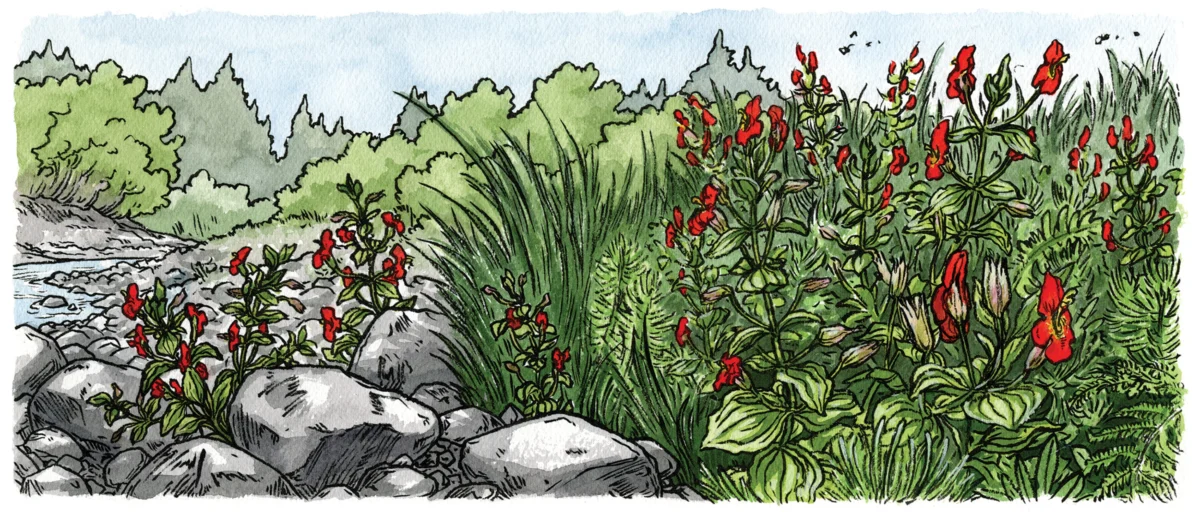
Throughout the summer, hummingbirds navigate a vibrant tapestry of red, trumpet-shaped blossoms that carpet streambanks from the Pacific Northwest down to Northern Mexico, a botanical marvel finely tuned to their avian visitors. As autumn arrives, these striking flowers transform into elongated, brown capsules, each teeming with thousands of microscopic seeds. These tiny packets of genetic material, though not intended for human study, have become an invaluable resource for scientists dissecting the intricate mechanisms of evolutionary biology and forecasting how shifting climate patterns will reshape Western ecosystems. A recent study, spearheaded by University of British Columbia ecologist Amy Angert, has utilized the scarlet monkeyflower (Mimulus cardinalis) to provide the first definitive evidence that certain plant species can evolve rapidly enough in natural settings to adapt and even thrive amidst the pressures of climate change. This groundbreaking research adds to a growing body of work centered on this captivating, thumb-length bloom, revealing profound insights into how pollinators drive speciation, how a plant’s capacity for evolution can vary significantly across its geographical distribution, and how a form of transgenerational adaptation, akin to "floral trauma response," can equip them to cope with climatic shifts without necessarily relying on new genetic mutations. Angert anticipates that this remarkable species will continue to yield significant discoveries, with her lab currently developing sophisticated models based on monkeyflower populations. These models aim to predict the adaptive potential of other species facing escalating threats from drought, heatwaves, wildfires, and other climate-induced stressors, ultimately guiding conservation efforts to identify vulnerable populations and recognize those, like many of her beloved monkeyflowers, that possess the inherent resilience to overcome challenges independently.

The journey from streambank to laboratory has been a decade-long endeavor for Angert’s research team. Since 2010, they have meticulously surveyed numerous monkeyflower habitats, documenting ecological observations and collecting seeds for controlled study. Through a series of experimental designs, they have "resurrected" multiple generations of seeds within greenhouse environments, demonstrating that lineages subjected to drought conditions consistently developed traits conferring drought tolerance, such as modified leaf structures and altered blooming cycles. The scarlet monkeyflower itself is characterized by fuzzy leaves that secrete a sticky resin, releasing a distinct aroma described by Angert as "a little sweet, a little pungent." This unique scent immediately transports her back to the field, evoking the essence of its natural habitat. These perennial plants typically establish themselves in the narrow ecological niches found between rocks along streambanks and creeks, where the water flow is neither so rapid as to dislodge them nor so sluggish that it allows competing meadow grasses to dominate. Their vibrant scarlet blossoms emerge in attractive sprays atop stems that can range in height from a modest six inches in arid, exposed locations to an impressive three feet in more mesic environments.

The scarlet monkeyflower serves as a crucial "model species" in the field of evolutionary biology, offering insights with broad applicability to a diverse range of organisms. Its utility stems from several key factors: a long history of scientific study dating back to the early 19th century, a relatively short life cycle that facilitates laboratory cultivation, and the prolific production of seeds – often exceeding two thousand per capsule – which simplifies collection and experimental setup. Historically, its small genome size also contributed to its appeal, although this advantage is diminishing as the cost of gene sequencing continues to decrease and sophisticated computational tools become more accessible.

Research originating from Angert’s laboratory has revealed a compelling geographical disparity in the adaptive capacity of scarlet monkeyflower populations. Specifically, populations found in the southern reaches of its range exhibit a greater degree of adaptive genetic variation compared to their northern counterparts. This means southern populations possess a higher capacity to evolve more rapidly in response to environmental pressures, such as drought. This finding underscores a critical principle for conservationists and researchers: broad generalizations about a species’ adaptive potential cannot be made based on studies of only a few geographically isolated populations. Furthermore, many plant species demonstrate a phenomenon known as "stress memory." This involves the epigenetic inheritance of compounds or markers that influence gene expression without altering the underlying DNA sequence, effectively passing down adaptive responses from grandparents to parents to offspring. This "memory" mechanism, much like direct genetic evolution, can also vary in its effectiveness across a species’ geographic distribution. Angert’s team hypothesizes that even those populations lacking the genetic raw material for rapid evolution might still leverage this "stress memory" to adapt to a rapidly changing climate.

The scarlet monkeyflower’s evolutionary trajectory has been profoundly shaped by its primary pollinator, the hummingbird. Its vibrant red coloration, tubular corolla, generous nectar production, and the precise positioning of its long stamen are all adaptations designed to facilitate pollination by hummingbirds. When a hummingbird visits the flower, its forehead is ideally positioned to receive pollen grains, which are then transferred to the stigma of the next flower it visits. In contrast, a closely related species, the Lewis’s monkeyflower (Mimulus lewisii), has evolved to attract bumblebees. Its pink blossoms produce less nectar, and its broader petals offer a convenient landing platform for bumblebees, which are more robust and collect pollen differently. While these two species, the scarlet and Lewis’s monkeyflower, share overlapping ranges and can hybridize, they rarely do so due to the distinct preferences of their respective pollinators. Evolutionary biologists have demonstrated that the divergence in floral morphology between these species is attributable to changes in just a few specific genomic regions, suggesting that adaptation to a new pollinator can occur relatively rapidly on an evolutionary timescale, within millennia. This intricate dance between plant and pollinator, driven by the forces of natural selection, highlights the dynamic nature of speciation and adaptation in the face of environmental pressures. The ongoing research into monkeyflowers promises to provide invaluable predictive tools for understanding and mitigating the impacts of climate change on plant biodiversity worldwide, offering a glimmer of hope for the resilience of natural ecosystems.