Rocky Gerung
As the full moon graced the night sky on a wedding day, two sacred datura blossoms unfurled, a rare and beautiful offering from a plant cultivated from seed. The toxic nightshade, Datura wrightii, had never before bloomed so spectacularly for its human caretakers, a moment described as pure magic, perhaps orchestrated by the unseen forces of subterranean life. This ephemeral display followed a year of nurturing, when the couple had carefully gathered and dispersed the plant’s deliriant seeds throughout their garden, a deliberate act of integrating potent, wild elements into their domestic landscape. The following morning, the deeply-throated flowers drooped, their nocturnal work with sphinx moths complete. Amidst the aftermath of a celebratory gathering, amidst the lingering scent of churros and the clatter of glassware, a small cottontail rabbit was discovered, its chest bleeding, lying as if a sacrifice. It was a stark reminder of the constant, often brutal, cycle of life and death in the desert, likely a victim of a recently hatched rattlesnake that had overreached. Despite a gentle offering of water, the young creature succumbed, its brief life extinguished by the unforgiving desert environment. A quiet ritual followed, the rabbit’s body tenderly placed in a wash, its eyes covered with dried chia, forming a small memorial with quartzy granite and datura leaves. This act of creating a resting place, a passage for a nonhuman neighbor, was a familiar practice, a way of honoring the departed and facilitating their transition into the spirit world.
Weeks later, these interwoven images – the ethereal white blooms and the departed cottontail – resonated deeply as the couple journeyed from their desert home down the Twentynine Palms Highway towards the vibrant oasis of Palm Springs. Their destination was the Palm Springs Art Museum, home to an exhibition that would further illuminate these profound connections between art, nature, and the spiritual realm. The exhibit, "A Queer Arcana: Art, Magic, and Spirit," presented a compelling collection spanning over a century of LGBTQ+ artists who had explored themes of magic, spirituality, and the esoteric in their diverse works, encompassing paintings, sculptures, performances, and photography. This exhibition is not an isolated event but rather part of a growing trend that recognizes and celebrates alternative spiritualities and their significant role in artistic and cultural expression. Similar exhibitions, such as "QUEER MAGIC" in Santa Fe in 2023 and "Sci-fi, Magick, Queer L.A." in Los Angeles in 2024, underscore a burgeoning interest in these often-marginalized spiritual pathways.
Many of the artists featured in "A Queer Arcana" share a deep affinity for the American Southwest and California, a region whose dramatic landscapes have long drawn seekers of all kinds. The powerful natural formations, from the enigmatic boulderfields of Joshua Tree to the spiritual resonance of Sedona, Arizona, and the serene heights of Crestone, Colorado, are frequently depicted in their artwork. These spiritual landscapes are often rendered with a potent, body-centric, and fantastical aesthetic, suggesting a permeable boundary, a "thin veil," between the tangible physical world and the boundless spirit realm. This approach often challenges conventional understandings of reality, inviting viewers to consider a more fluid and interconnected existence.

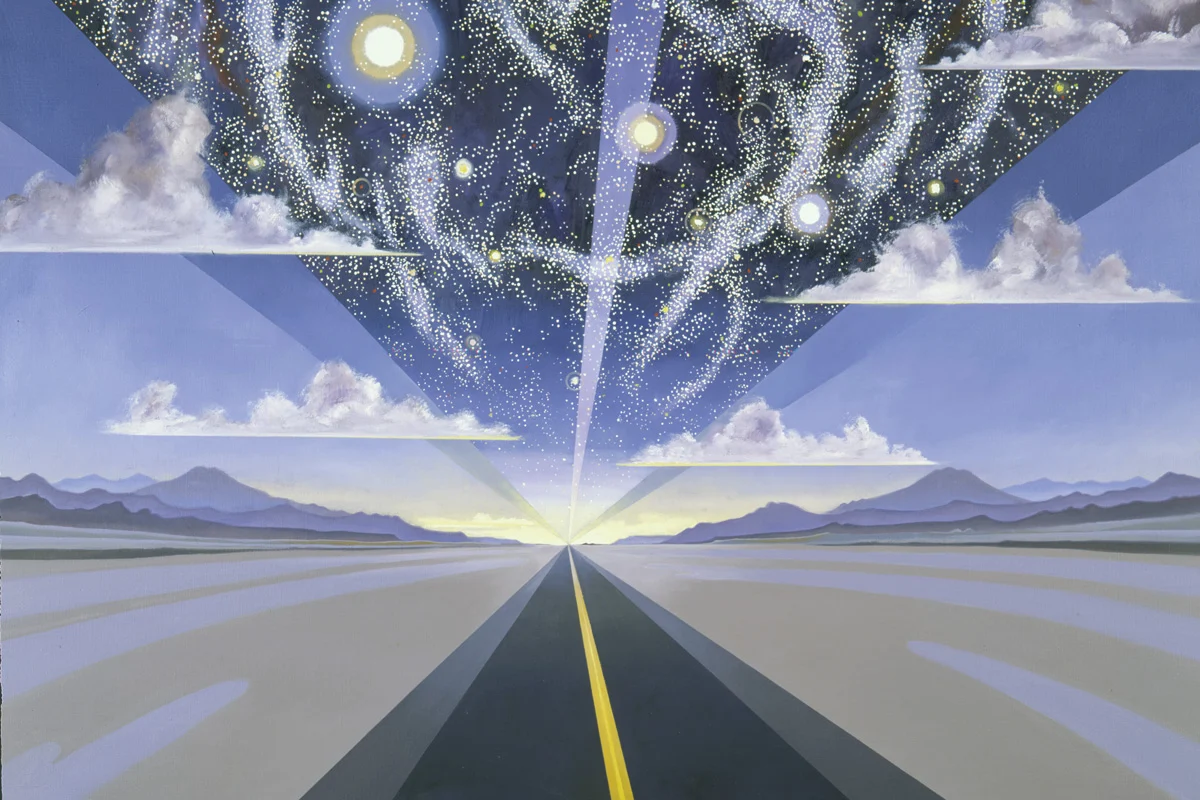
Within the exhibition, the works explore a rich tapestry of personal and collective spiritual experiences. Telluride-born Ingo Swann’s 1986 painting, Proto Adam, for instance, depicts a celestial go-go dancer emerging from a desert river, a powerful juxtaposition of the earthly and the cosmic. Clarity Haynes’s Altar for Laura Aguilar (2022), a tender pastel offering for the late photographer, incorporates images from Aguilar’s renowned nude desert self-portraits, celebrating the body and its connection to the natural world. Other pieces offer a more subtle yet equally profound exploration of these themes. Eric-Paul Riege’s chestplate [3] (2026), a meticulously woven textile, elegantly merges traditional Diné beliefs with his personal experiences of queerness, demonstrating how ancestral wisdom can be reinterpreted and integrated into contemporary identity. The exhibition also features striking visual narratives, including representations of cosmic encounters, clandestine occult gatherings, and even fantastical alien beings, suggesting a broad spectrum of imaginative explorations into the unknown. Complementing the visual arts, a collection of magazine archives delves into the histories of witchcraft and New Age goddess worship, further contextualizing the exhibition’s focus on alternative spiritual practices.
Curator David Evans Frantz articulated the exhibition’s core premise in a press release, stating, "Queer artists, activists, and cultural producers have long sought spiritual practices outside the mainstream to affirm their identities, build community, and envision new ways of being in an often-oppressive world." This sentiment resonated deeply upon entering the exhibition, where large text on a striking wine-colored wall introduced the influential work of queer Chicana poet and theorist Gloria Anzaldúa. Anzaldúa, who described herself as a "spiritual mestiza," understood spiritual seeking as an inherently queer mode of engaging with the world and the infinite, a perspective that frames the entire exhibition.
One particularly captivating piece was Edgar Fabián Frías’s Give Us Home Spider: Ritual 5: TXI Cement Quarry, Bloomington, CA (2017). As a brujx, a gender-neutral Spanish term for a practitioner of magic, and a descendant of the Wixárika people, Frías organized a series of rituals across Southern California to confront environmental racism and health disparities. Frías, who grew up in close proximity to the quarry featured in the video, witnessed firsthand the community’s exposure to hexavalent chromium, a carcinogenic chemical. The video depicted Frías and thirteen other healers, adorned in vibrant fluorescent attire, engaging in a ritualistic performance. Accompanied by the hypnotic drone of a pipe and the pulse of techno music, they dug into the earth, invoked the land through vocalizations, and shared pomegranates, a potent symbol of life and renewal.
This ritual, performed nearly a decade prior to the exhibition, felt remarkably prescient, especially in the context of recent environmental challenges. The lingering smoke from the Lineage Fire in Los Angeles’s Boyle Heights, which had spread toxic fumes across Southern California from a compromised food-storage facility, served as a stark reminder of ongoing ecological and health crises. Frías’s ritual offers a powerful call to acknowledge and address past harms in the present moment to cultivate a more intentional and equitable future. Regardless of one’s spiritual affiliations, recognizing the damage inflicted upon both people and the planet is crucial. This awareness can provide solace by confronting denial and can serve as a catalyst for meaningful action against injustice. At its most fundamental level, this recognition can be as simple as pausing to honor the fleeting existence of a desert cottontail.

"A Queer Arcana" did not emerge spontaneously; it represents a deliberate convergence of ancestral wisdom and contemporary community, a collection of voices whispering from the liminal spaces to remind those who are listening to connect, to foster community, and to actively resist not only queer repression but all forms of oppression. The exhibition serves as an invitation to engage in acts of resistance, from challenging city councils approving environmentally damaging data centers to creating protective circles of salt around creative souls threatened by the proliferation of AI-generated content. It champions the formation of vital coalitions with our nonhuman neighbors, acknowledging our interconnectedness with the natural world.
The visit coincided with another significant ritual: the observation of the Summer Solstice, the longest day of the year. Within the museum, displays of queer tarot decks, including the work of trans activist Rachel Pollack, prompted a personal solstice ritual. Much of the author’s own spirituality is deeply rooted in nature, encompassing Milky Way contemplation, grounding Qi Gong practices, the observation of birdsong, and ceremonial river cleanups. As a Libra Sun with a Scorpio Moon, however, the author has found quarterly tarot readings to be an invaluable tool for navigating chronic indecisiveness and deeply held grudges. The MotherPeace deck, a pioneering feminist and queer tarot deck that significantly influenced the practice in the 1970s, stands as another cornerstone of a personally assembled cosmology.
On this longest day, a round, moon-shaped card was drawn from the deck. The revealed card, the "Son of Cups," was described by one of the deck’s creators as representing "meditative awareness." The imagery depicted a naked man serenely floating on the sea, playing a flute, accompanied by the calls of seagulls. Below him, large datura flowers unfurled like sails, mirroring the blossoms that had graced the wedding night, linking the personal and the cosmic through potent natural symbols.