Rocky Gerung
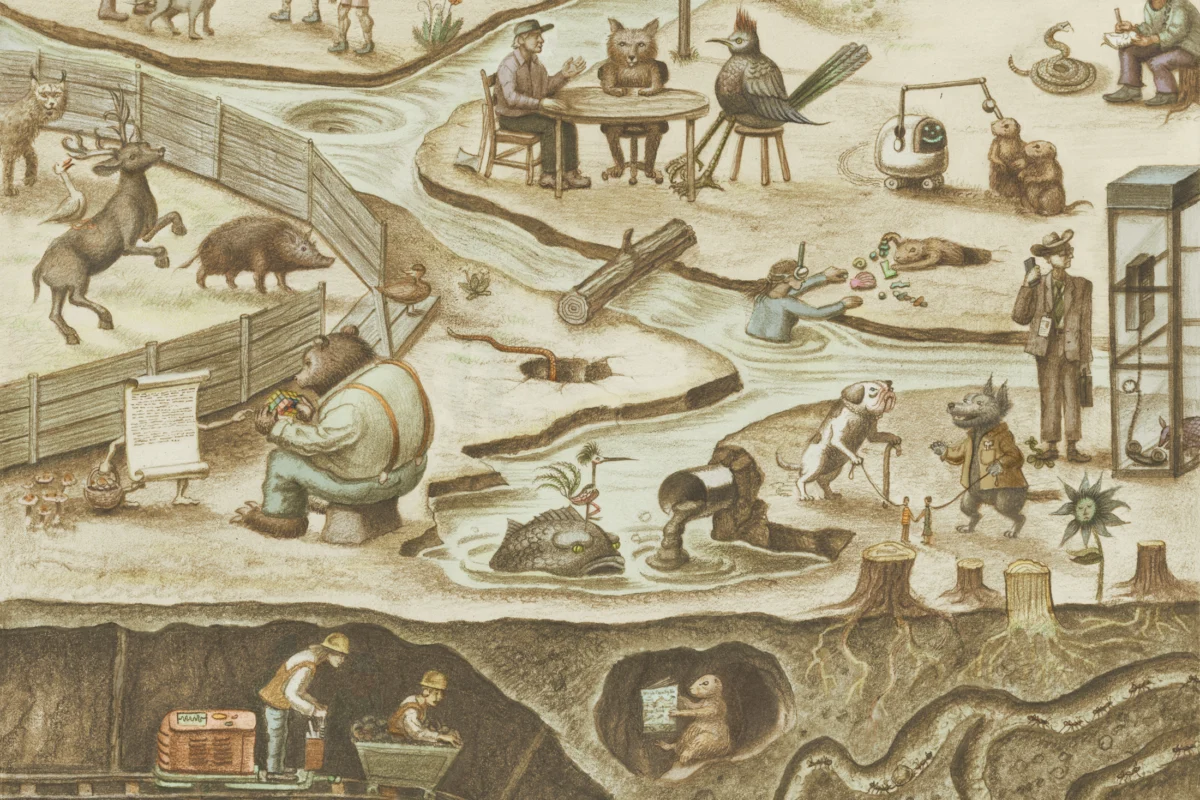
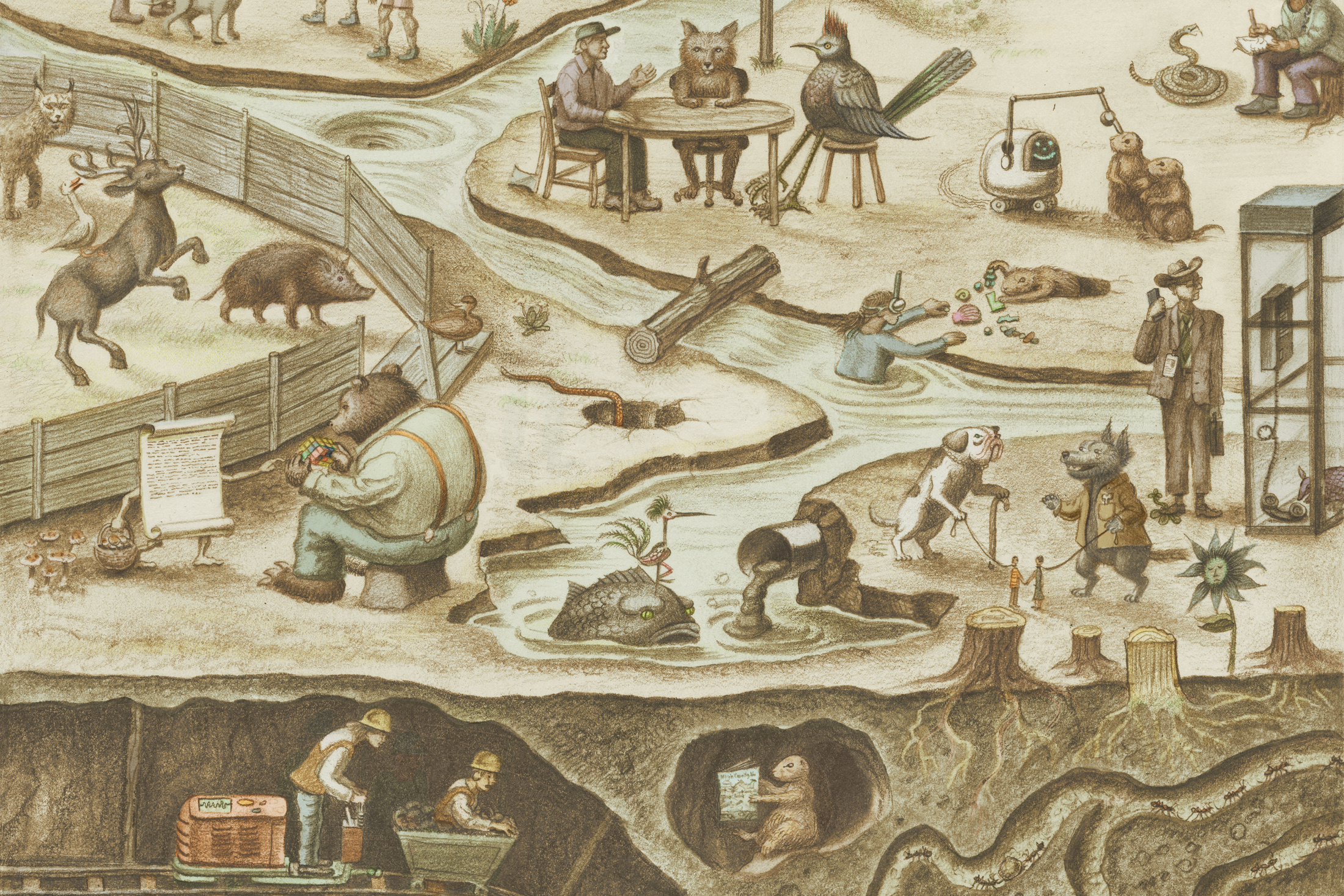
The challenge of visually representing the intricate nature of communication for an August special issue on Conversations was met with the distinct artistry of Armando Veve, a long-time contributor whose work has graced the pages of High Country News. The selection of Veve for the cover art was a deliberate choice by former Visuals Editor Roberto "Bear" Guerra, who, along with others, had long admired the artist’s unique style and sought to feature it on the magazine’s cover. This particular issue, focusing on the multifaceted concept of dialogue, proved to be the opportune moment, coinciding with Bear’s final tenure on the masthead. Veve embraced the assignment with his characteristic enthusiasm, translating the complexities of human interaction into a vibrant and thought-provoking illustration. He masterfully depicted a diverse array of unlikely conversationalists engaged in both tense yet amicable exchanges, while also artfully incorporating elements of convivial silence, thereby mapping the dynamic and often winding path of a meaningful back-and-forth.
Though based in Philadelphia, Pennsylvania, Veve’s artistic journey intersected with the High Country News office in Paonia, Colorado, a couple of years prior during a road trip that included a visit to a Telluride art gallery. His thoughtful engagement with the cover project, offering insights into his creative process and broader artistic philosophy, invites readers to connect with his perspective.
Veve’s artistic methodology is deeply rooted in a meticulous process, often beginning with graphite on paper, a medium he cherishes for its immediacy and its profound connection to the act of writing, viewing drawing as a visual form of storytelling. His works are constructed in layers, akin to sedimentary deposits, building up from graphite to watercolor and colored pencil. For the High Country News cover, digital tools were employed to expedite the coloring process, yet the artist emphasizes that even these digital applications are guided by the hand, ensuring a seamless integration of drawing and color that culminates on the printed page, which he regards as the final realization of the artwork in the context of magazines and newspapers.
In his everyday life, Veve finds constant inspiration, striving to heighten his awareness of his surroundings and to perceive the nuances that often escape casual observation. Drawing serves as his primary mechanism for processing the world, a means of self-centering, making sense of chaos, and giving tangible form to his internal thoughts, allowing him to refine and distill them into something meaningful. His commitment to engaging with the world extends to actively trying to reduce his reliance on digital devices and to foster more direct human interaction. This pursuit of inspiration often involves embarking on extended walks, sometimes with the intent of capturing images, but more frequently as a way to clear his mind and stimulate creative thought. In recent times, he has increasingly leaned on memory rather than solely relying on external reference materials, a shift that has proven invigorating and has unlocked new avenues of expression on the page. Drawing, for Veve, is a continuous dialogue with both the past and the future, an endeavor to encourage deeper observation and novel ways of thinking, but it also possesses a more visceral quality, akin to an insistent urge, a compulsion to peel back layers and delve deeper in search of symbolic meaning or an unfolding narrative.
The spirit of Veve’s long-standing collaboration on the "Heard Around the West" column, where he and the publication’s staff explored a myriad of quirky and compelling stories, is palpably present in the cover art, and astute readers might even recognize familiar figures. Veve fondly recalls his time illustrating for "Heard," a section characterized by its wonderfully peculiar and amusing narratives, such as the tale of a man who famously pushed a peanut up a mountain with his nose, or the story of Ghost, a canine who abandoned his home to live amongst coyotes. Indeed, a closer inspection of the cover reveals several "Heard" easter eggs, including Bo the Bear and Ghost, characters who first made their appearance in that column. Veve enjoys the practice of remixing his previous works, establishing connective threads between them and revitalizing recurring motifs and characters. He also notes that his cat frequently makes appearances in his pieces, a subtle signature for those who pay close attention. He perceives all these elements as part of a singular, evolving universe, where each new story provides fresh subject matter and thematic exploration, yet all are united by a common underlying energy. His visual lexicon, comprising the objects, symbols, and motifs he employs to convey ideas, functions much like a cast of characters in a play, appearing when they best serve the narrative or sometimes simply to inject a personal inside joke. He has a particular fondness for introducing characters that seem out of place, displaced from their original contexts, a recurring theme that he uses to defamiliarize the familiar. This inclination stems from a surrealist impulse, as he finds fragmentation and cross-pollination to be more fitting metaphors for his understanding of the world.
Veve’s distinctive style, characterized by its unique blend of humor and whimsy, is a product of a lifelong fascination with the storytelling power of images, dating back to his childhood experiences with films like Snow White and the Seven Dwarfs and the comic books that were a staple in his home. He recalls the joy of "I Spy" books and the elaborate virtual worlds he constructed in The Sims, which fostered a sense of discovery and allowed for personal narrative creation. This approach, he believes, imbues a certain democracy into his art, enabling viewers to forge their own unique paths through the visual landscape. He likens this to his appreciation for maps and cross-sections, both of which highlight the interconnectedness of all things. Veve often revisits and refines his works, building them in layers and meticulously editing them, much like a writer polishes a manuscript. He is drawn to the profound stillness inherent in a drawing, a quality that stands in striking contrast to the relentless pace of contemporary life. The act of dedicating significant time to a single subject, making marks with the direct, simple, and ancient stroke of a pencil, feels almost profound. It is an elemental practice, literally drawing with the earth’s materials—graphite and clay encased in cedar. This approach connects him to a long tradition of art created by human hands, a tradition he feels is increasingly challenged by artificial intelligence and commercial pressures, tracing its lineage back to the earliest cave paintings, illuminated manuscripts, WPA murals, and the imaginative worlds of pulp science fiction.
The term "style" itself, Veve finds, can be somewhat restrictive, placing undue emphasis on the surface of a piece. He prefers to think of it as a tangible manifestation of voice, akin to speech patterns or a personal gait, reflecting his unique way of understanding and processing the world. Humor is a vital component of his work; if an image elicits laughter, he tends to pursue that creative impulse. Whimsy, in his view, is a potent force that encourages free association and disrupts established structures. The humor in his art is rarely a deliberate imposition but rather emerges organically from the interactions within a piece or from associations that the viewer makes, prompting a particular reminder or connection. The drawing, in essence, becomes a conduit for these moments of levity and insight.
For the special issue’s cover, the concept of conversation was visualized through the metaphor of a map, translating the idea of webs of interaction into a literal "landscape of conversation," a phrase that became the driving force behind the entire composition. Veve drew inspiration from medieval paintings and maps, admiring their stacked perspective and the way they invite viewers to embark on a journey of discovery within the image, charting their own course.
The most challenging aspect of visually depicting conversation, Veve notes, lies in striking a delicate balance between inclusion and omission. Creating sufficient negative space and moments of quietude between visual elements is a perpetual artistic hurdle. Much like a well-paced conversation, a compelling visual narrative requires pauses for meaning to resonate. His initial sketches, he admits, were overly crowded and "loud," prompting him to reduce the scale of individual elements and to open up the composition. This strategic decision not only provides viewers with literal pathways through the artwork but also creates opportunities for contemplative silence, exemplified by poignant details such as a flower mourning fallen tree stumps.
Among the diverse cast of characters populating the cover, Veve expresses a particular fondness for the solitary prairie-chicken, captivated by its seemingly bewildered expression. His work, inviting deeper engagement and contemplation, is accessible for further exploration on Instagram at @armandoveve and through his website at armandoveve.com.