Rocky Georgio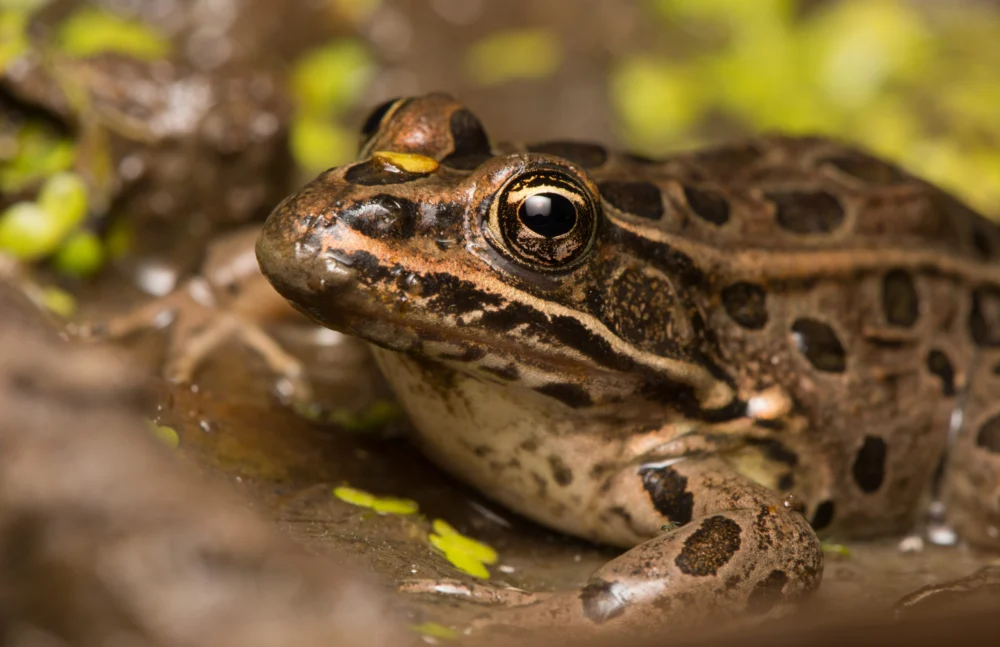
The delicate imprint of a raccoon’s foot pressed into the muddy lakeshore, a killdeer’s cry echoed overhead, and a coyote, its tail a fluffy plume, loped across the nearby grasslands. Yet, the creature wildlife biologist Wendy Hanophy earnestly sought on a sweltering October day remained elusive. Hanophy was searching for northern leopard frogs, amphibians whose moist skin necessitates seeking refuge in the wetlands surrounding the Aurora Reservoir during the peak heat of midday, explaining their absence from the sun-drenched landscape. Their elusiveness, however, highlights the significant stakes involved: scientists widely agree that this amphibian, an indicator species that is notoriously difficult to spot, count, and monitor, faces considerable risk from habitat disturbances.
Now, Hanophy and hundreds of Aurora residents are placing their hopes on this imperiled vertebrate, believing it could bolster their case to persuade state regulators to deny a significant oil and gas development proposal. Crestone Peak Resources Operating LLC seeks to construct one of Colorado’s largest oil and gas pads on a former bombing range, situated less than a mile from the Aurora Reservoir and the residential communities of the Denver suburbs. "Frogs will disperse up to three miles as soon as they’ve bred and hatched," explained Hanophy, a retired Colorado Parks and Wildlife employee, her voice punctuated by the crunch of dry grass beneath her hiking boots. "They have to eat, and they don’t stay in the reservoir for that. They are foraging all up and around these areas."
Indeed, weeks before Hanophy’s unsuccessful search, herpetologists engaged by a dedicated residents’ group discovered three northern leopard frogs located uphill from where she stood, in close proximity to the proposed 35-acre oil and gas site. This discovery came at a critical juncture, shortly after state officials had officially designated "Oil & Gas Exploration & Extraction" as a significant threat to the species in their forthcoming 2025 wildlife action plan. The plan categorizes the amphibian as requiring "conservation interventions most urgently," underscoring the precariousness of its situation.
The diminishing numbers of northern leopard frogs have also prompted the U.S. Fish and Wildlife Service to participate in an ongoing case study focused on restoring the amphibian’s habitat in an area northwest of Denver. Preliminary findings from this study identify the four-inch-long vertebrate as a "species of greatest conservation need in many Western states" and describe it as "considered sensitive, threatened, or endangered."
The proposed 32-well State Sunlight/Long pad represents one of several oil and gas sites slated for development on what is now known as the Lowry Ranch. This picturesque property, located approximately 25 miles southeast of downtown Denver, is increasingly encircled by rapidly expanding suburban communities. The State Land Board, which manages the 26,000-acre ranch, has echoed the U.S. Fish and Wildlife Service’s conclusion regarding the frog’s need for undisturbed habitat, as outlined in their "2050 Stewardship Framework." This planning document further noted that the ranch’s Piedmont grasslands support "several species of conservation concern that require habitat components that are unique and rare." Despite these findings, the land board has entered into a lease agreement with Civitas Resources, Crestone’s parent company, granting them the right to drill on the property, with state regulators tasked with approving the specific well locations.

This situation is not without precedent; imperiled species have previously succeeded in slowing, altering, or even halting industrial projects. The Braken Bat Cave meshweaver spider, for instance, previously halted highway construction in San Antonio, Texas. In West Virginia, the Indiana bat’s presence led to the stalling of a multimillion-dollar wind farm. The endangered snuffbox mussel caused work to cease on a bridge project over the Grand River in Ohio. Furthermore, in California, the delta smelt played a role in preventing an effort by the Trump administration to enhance the state’s water infrastructure.
Northern leopard frogs are known to inhabit the very area where the Sunlight/Long pad is proposed. Surveys conducted by consultants hired by Crestone have identified the amphibians near the site over the past decade, according to a summary the energy company submitted to state regulators prior to a highly anticipated November 19 hearing on the proposed pad. The vertebrates were observed in creek beds adjacent to the proposed project site during surveys conducted between 2012 and 2015, and again in 2018. Subsequent surveys in 2024 and the current year led consultants to conclude that the amphibians may utilize nearby creek beds for overwintering.
Researchers hired by Save the Aurora Reservoir (STAR), a residents’ group comprising 2,400 members, who themselves observed three frogs in the area this past fall, stated in a September 22 report that these repeated sightings "seem to indicate a stable population at this site." The report, authored by researchers with Adaptation LLC, the firm retained by residents, further suggested that "this site is likely part of a larger, and not fully researched, metapopulation for northern leopard frogs which may connect this population to other breeding populations" in the vicinity.
To safeguard this population, state wildlife officials recommended in a September 30 letter to the state’s Energy & Carbon Management Commission that an alternative location for the expansive oil and gas pad would better protect the frog by preserving more of its habitat. However, Colorado Parks and Wildlife biologist Brandon Marette acknowledged in the letter to commission director Julie Murphy that such an alternative is not presently feasible, as it would not comply with Arapahoe County regulations mandating that oil and gas operations be situated at least 3,000 feet from reservoirs. Marette also noted in his letter that "the western U.S. population of [northern leopard frogs] is declining" and that in the region where the pad is proposed, these frog groups are "fragmented and limited and existing threats are likely to significantly increase in scope and/or severity within ten years."
Consequently, Marette proposed mitigation measures designed to divert frogs away from an access road expected to accommodate scores of daily truck trips to and from the proposed oil and gas pad. This byway will be positioned just 500 feet from the reservoir, raising concerns about potential "mortalities resulting from truck and vehicle traffic," he added. The biologist requested that state regulators require the energy firm to schedule construction of the pad and associated road improvements between December 1 and February 28, coinciding with the frogs’ hibernation period. Colorado Parks and Wildlife also requested that the company conduct weekly "windshield surveys" between March and November, when the amphibians are active, to "document any (frog) mortalities on the road." Crestone’s consultants are obligated to report any deceased frogs to Parks and Wildlife.
The frog’s significant role in the upcoming November 19 hearing on the Sunlight/Long pad is underscored by a recommendation from Murphy, the Energy & Carbon Management Commission director, to the five-member commission. Her recommendation proposes approving the oil and gas project, and the amphibian is referenced a notable 90 times within her comprehensive 265-page report. Murphy’s report indicates that Crestone has agreed to time construction of the pad to align with the frog’s hibernation period, to conduct pre-disturbance surveys for frogs, and to construct silt fences designed to guide amphibians towards culverts that will pass under the road.

Crestone acknowledged concerns regarding the frogs in a prehearing statement filed with state regulators before the November 19 hearing. The company referenced the Adaptation report, noting that wildlife officials incorporated "aspects" of its findings into the mitigation measures that the company has agreed to implement. Jamie Jost, an attorney representing Crestone before the commission, stated in the prehearing statement, "The [Parks and Wildlife] consultation letter speaks for itself on the issue of Crestone’s extensive protection of wildlife resources and should be relied upon by the commission."
Habitat disturbance is already in progress on other sections of the Lowry Ranch. Earlier this year, state energy regulators approved several multiwell pads as part of a comprehensive area plan for drilling across a 50-square-mile zone. This development, outlined in a comprehensive area plan, could ultimately include up to 166 wells at eight distinct locations, with construction scheduled through 2030.
Residents in neighborhoods bordering the ranch’s southern edge organized STAR to protest drilling near their communities when Crestone first submitted the plan to state regulators in 2022. The group’s concerns regarding pollution, induced seismic activity, noise, and traffic drew national attention to a significant 2019 policy shift that mandates Colorado’s energy agency prioritize public health, safety, and environmental protection over the profits of fossil fuel companies. State officials subsequently promulgated 426 pages of regulations, developed through 17 distinct rulemaking periods, to implement this directive. STAR’s activism has demonstrably influenced how the five-member energy commission considers neighborhood concerns, with its members submitting thousands of comments opposing the Sunlight/Long pad. This outcry prompted the commission to schedule a rare public hearing in the affected community in September. STAR, represented by legal counsel, also became the first residents’ organization to formally present its case before the commission during a 2024 hearing and is scheduled to testify again on November 19. The nonprofit organization continues to test the boundaries of the state’s new oil and gas regulations in its prehearing statements by challenging how Crestone has complied with requirements to develop wildlife protection plans for new and amended project locations.
"Wildlife resources are to be protected to the same extent as people and the environment," wrote STAR’s attorney, Mike Foote. "Neither Crestone’s wildlife mitigation plan, nor (Parks and Wildlife’s) consultation report gave any serious consideration to placing Sunlight Long in a location that could avoid adverse impacts to the (frogs) in the first place." Even with the mitigation measures agreed upon by Crestone and state wildlife and oil and gas officials in advance of the hearing, Hanophy, the retired biologist, remains apprehensive that pollution, noise, and vibrations—which she contends could disrupt breeding—along with land disturbance and increased traffic, will ultimately prove detrimental to the amphibians. "If they can’t get from point A to point B, that’s one population that could crash," stated the STAR wildlife advisor, standing on a bike path encircling the Aurora Reservoir. "Extinction usually isn’t immediate—it happens slowly, and then quickly, and you get to a point where a population can’t take care of itself."