

 Roger Danuarta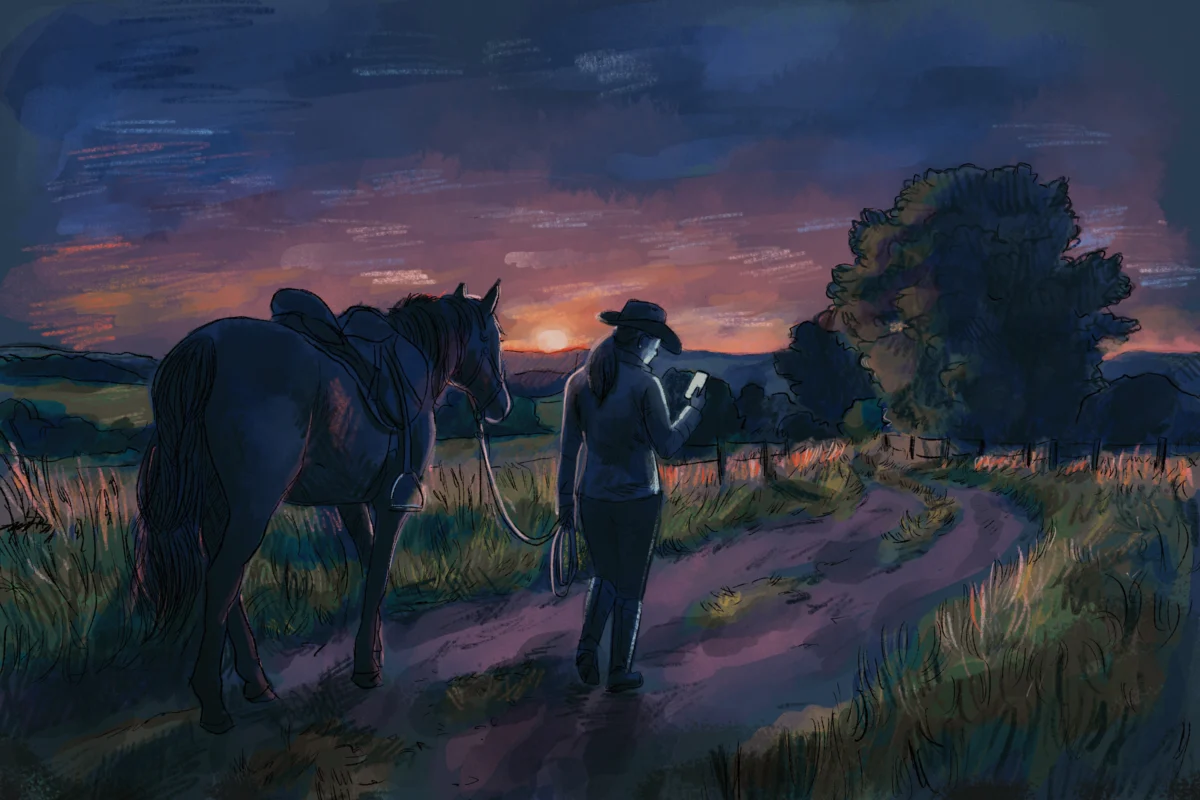
Across the vast, interconnected expanse of the internet, a compelling figure rides, her journey unfolding through the lens of a smartphone nestled in her breast pocket. From her vantage point atop a buckskin gelding, followers are transported into the heart of a cattle drive, experiencing the subtle art of herding as the horse nudges a recalcitrant calf. When a gentle prod proves insufficient, the golden-necked equine stretches to nibble the calf’s back, eliciting a startled "MOO" before the young animal dashes off. The cowgirl’s leather-gloved hand reaches down, a gesture of quiet appreciation for her mount, as she leans back, allowing the boundless Montana sky to bloom before a million mesmerized eyeballs, its ethereal glow transformed into the flickering blue light of digital screens.
The internet’s undeniable fascination with the cowgirl archetype stems from a potent combination of visual appeal and deeply rooted symbolism. Her curated online presence often features endearing animals, breathtaking landscapes, a celebration of rugged beauty, and iconic Western fashion, from meticulously crafted boots to flowing manes against a wild backdrop. In an increasingly visual digital landscape, such compelling content readily captures attention, offering a potent blend of escapism and aspirational lifestyle. This aesthetic resonance taps into a global yearning for authenticity and connection to nature, themes that transcend geographical boundaries and speak to a collective desire for simpler, more grounded existences.
Crucially, the cowgirl embodies a nuanced and often more widely acceptable symbol of the American West compared to her male counterpart. While the cowboy often conjures the formidable, sometimes jingoistic, image of figures like John Wayne—a symbol frequently co-opted for oversimplified, whitewashed narratives of a complex historical period—the cowgirl possesses an inherent political ambiguity. By virtue of her gender, she carries a subtle subversion, challenging traditional masculine dominance while simultaneously representing strength, independence, and a deep connection to the land. This allows for a broader interpretation, appealing to diverse audiences who might find the traditional cowboy persona too rigid or politically charged. Her image suggests a reclaiming of agency, a redefinition of pioneering spirit that resonates with modern sensibilities advocating for empowerment and breaking stereotypes.
In an era marked by pervasive global anxieties—from volatile economies and political fragmentation to the existential threat of artificial intelligence displacing livelihoods—the digital cowgirl offers a powerful, almost primal, beckoning. She represents an idealized retreat, an escape from the relentless churn of modern life into a realm of self-sufficiency and tangible labor. For many, the prospect of an “AI” that still signifies "artificial insemination"—a practical, hands-on process in livestock management—serves as a refreshing counterpoint to the abstract and often intimidating advancements in digital technology. This yearning for a life where effort yields visible, immediate results, where one’s existence is intrinsically tied to the land and its rhythms, becomes a potent antidote to the uncertainties of the digital age.

The digital cowgirl thus navigates a precarious and often uneven terrain between idealized fantasy and a disappearing, yet stubbornly real, way of life. Her online presence serves as a bridge, reminding viewers that such lives persist in pockets of the world, even as the global trend leans towards urbanization and digitalization. For those who, like the Montana rancher observing this phenomenon, genuinely inhabit this existence, the tension between lived reality and its curated online portrayal becomes a daily negotiation. While real, quiet evenings unfold against vast, open vistas, enveloped in the haze of a life many only dream of, the very individual living that life often finds themselves, like anyone else, scrolling through similar content on their couch, drawn into the digital current.
The omnipresent algorithms of social media platforms actively reinforce this engagement. Identifying users interested in rural living, the feed becomes a carefully curated stream of cowgirl videos, ranching tips, and advertisements for instant solutions to previously unrecognized problems—from cortisol-reducing jaw massages to posture-correcting equestrian guides. This constant influx of tailored content creates a powerful feedback loop: as users consume, they are subtly compelled to create, to contribute their own slice of "authentic" life. While the mundane realities of ranching—paying bills or mucking out manure-filled trailers—rarely make it to the feed, the moments of genuine beauty, a cattle herd rambling through flowering sage, spark an almost irresistible urge to share. With a click, these fleeting instances are beamed across the globe, reaching a diverse audience of past acquaintances, distant friends, and complete strangers, generating a potent "dopamine hit" of online approval. This validation fosters a rush of affection, not just for the curated life on screen, but for the self performing it, albeit in its most flattering, carefully lit iteration.
However, this constant self-narration under a semi-public eye breeds a profound discomfort. The underlying truth, often obscured by the convenient narratives we construct to justify our online existence—be it sharing beauty, staying connected, or building virtual communities—is that the pervasive influence of social media fundamentally alters how we perceive and experience our own world. Neil Postman, in his seminal 1985 work Amusing Ourselves to Death, argued that a culture’s dominant form of communication invariably shapes its modes of thought. Postman’s concern centered on America’s shift from a literate society to one dominated by television, a medium whose embedded idea was that all content must be aesthetically pleasing or entertaining, ensuring constant engagement through rapid channel changes.
One can only imagine Postman’s apprehension in the age of TikTok and its progeny, where attention spans have become even more fragmented, and the dominant communication tools are meticulously designed to ensnare users in an endless loop of engagement. The constant connectivity, the relentless notifications, and the algorithms that prioritize novelty over depth cultivate a culture where sustained, deep engagement with a single subject becomes increasingly difficult. The very act of living, of experiencing the world, is transformed into potential content. Filming cattle amidst the sagebrush, for instance, extracts the individual from the immediate sensory experience, turning a moment of simple appreciation into an implicit advertisement for one’s own existence, a performance rather than a pure presence.
The inherent ambivalence towards this way of life is often profound. Ranching, far from its romanticized online portrayal, is arduous, complex work, a constant cycle of challenges that frequently humble even the most experienced. Days can be fraught with doubt, questions of personal suitability for such a demanding life. The allure of urban comforts—the ease of social interaction, simpler dating, and professions less intimately tied to one’s sense of self—often resurfaces during moments of loneliness and anxiety. In these vulnerable states, the phone becomes a default refuge, its feed an eclectic mix of relationship advice mingling with tips for managing difficult horses. The digital realm also exposes one to unsettling interactions, like an ex-partner’s suggestion to monetize ranch chores through an OnlyFans account, a bizarre commodification of one’s identity and labor that blurs the lines between flirtation and exploitation, leaving one to envision the absurdity of troubleshooting QuickBooks in a bikini.

Meanwhile, a stream of confident, capable cowgirl influencers continues to populate the digital sphere. One might showcase her daily chores, expertly lifting bales, her vintage-jeans-clad silhouette often strategically angled for the camera. Her face, though, betrays a quiet exhaustion, a testament to the ceaseless demands of a small Montana homestead: storm clean-up, caring for ailing animals, feeding, video editing, and negotiating partnership offers from brands like Wrangler. Another might share evocative poetry in a voice that invites solace, paired with footage of her skillfully operating tractors and tending to horses. Her gaze, directed into the camera, emanates a warmth and a palpable desire that creates an illusion of direct connection, reflecting back the viewer’s own unspoken longings. These curated portrayals, while seemingly authentic, are themselves products of immense labor and strategic self-presentation, blurring the lines between inspiration and aspiration.
Yet, a contrasting reality exists in the world of genuinely experienced cowgirls, those whose wisdom is gleaned from years of unmediated engagement with the land and livestock. These are the women who offer practical advice, tempered with the understanding that every individual must find their own path. They are brave, kind, and, crucially, blessedly offline, too deeply engrossed in the tangible demands of living and ranching to engage with the fleeting currents of social media. They would never be approached to endorse an anti-wrinkle serum, except perhaps as a "before" image, and even then, they would likely eschew such attention, finding it incongruous with their ethos. Their lives stand as a testament to an existence lived outside the digital imperative, where validation comes from the rhythm of the seasons, the health of the herd, and the quiet satisfaction of hard work.
People still live like this, deeply immersed in the tactile, demanding reality of rural life. And for those caught in the delicate balance, the option to live this way, unburdened by digital performance, remains. For now, the Western aspirational feed continues to refresh, offering a constant invitation to contribute one’s own world to the unending internet stream. The cowgirls, both real and digital, remain caught between an aching fantasy and a rapidly receding reality. Social media, in its relentless pull, often distances individuals from the very hardness and beauty that define this life. In the twilight of our digital age, one can visualize these individuals scattered beneath a vast, dark sky, their smartphones glowing like the only campfires for miles, each a solitary point of light in a world increasingly connected yet paradoxically, more isolated.








