Rocky Georgio
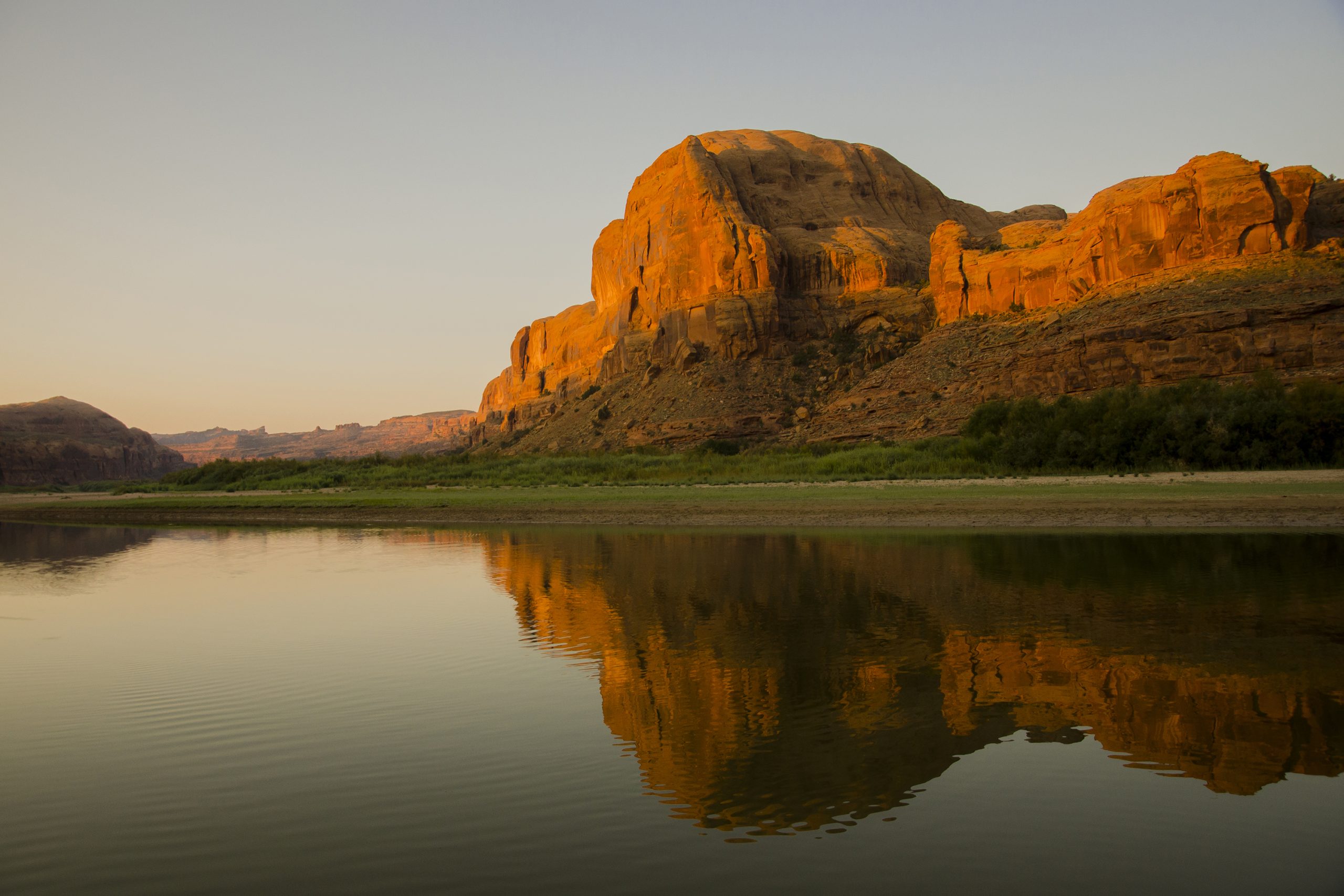
In the stark beauty of Moab, Utah, surrounded by the towering red rock canyons carved by the Colorado River, 20-year-old Aniston Hanks, a citizen of the Diné people, stood immersed in the cool water, while her friend Shauna Belone, 21, sat by its edge. Both young women spent part of their summer immersed in learning about water, land, plants, and conservation across the vast Colorado Plateau through The Nature Conservancy’s NATURE Program, an initiative focused on Native American Tribes Upholding Restoration and Education. For Hanks, the sensation of the river flowing around her knees evoked profound connections to her home near Cameron, Arizona, and the Little Colorado River, a waterway held in deep reverence by her family. "We think of it as a relative," Hanks explained, extending her sentiment to the broader network of tributaries feeding the Colorado River, adding, "We’re born for water."
Despite their shared Diné heritage and proximity to the same vital river system, Hanks and Belone inhabit different legal realities dictated by the Colorado River’s division into upper and lower basins. Hanks resides in the Lower Basin in Arizona, while Belone, hailing from Naschitti, New Mexico, lives within the Upper Basin. Their ancestral homeland, the Navajo Nation, sprawls across 27,000 square miles, extending into both these distinct hydrological and administrative regions. These basin boundaries carry significant weight as the federal government implements new operational guidelines for the Colorado River’s two largest reservoirs, Lake Powell and Lake Mead, amidst a relentless 26-year megadrought that has severely depleted water supplies.
The Bureau of Reclamation concluded its extensive environmental review on July 31, paving the way for Interior Secretary Doug Burgum to sign a record of decision on August 21, outlining the initial operating guidelines for the 2027 and 2028 water years, with new rules taking effect on October 1. This decision establishes a framework for managing the reservoirs but does not resolve the ongoing dispute among the seven basin states—Arizona, California, Colorado, Nevada, New Mexico, Utah, and Wyoming—who have yet to agree on a long-term formula for sharing water during periods of scarcity. The Interior Department’s decision introduces a framework extending through 2036, allowing federal managers to reassess operations at more frequent intervals as reservoir levels, anticipated snowmelt runoff, and interstate negotiations evolve.
Celene Hawkins, Colorado River Program Director for The Nature Conservancy, characterized the Bureau of Reclamation’s environmental review as a crucial planning analysis for future decisions, noting, "They’ve essentially developed a 10-year framework for the basin." She further explained that operating plans are expected every two years unless the basin states reach a consensus on a negotiated solution. This adaptable approach is immediately being tested by the dire hydrological conditions. According to Interior, after 26 years of persistent drought, Lake Powell and Lake Mead combined hold less water than at any point since Lake Powell began filling in 1963. For the initial operating period, Reclamation intends to modulate water releases through Glen Canyon Dam to maintain Lake Powell at or above 3,510 feet, an elevation deemed critical for the dam’s continued operational reliability.
Under the new directives, Arizona, California, and Nevada are collectively required to reduce their water diversions from the river by 1.25 million acre-feet annually for the next two years. The proposed allocation of this burden among these three states anticipates Arizona taking a reduction of 760,000 acre-feet, California 440,000 acre-feet, and Nevada 50,000 acre-feet, contingent on their agreement. The Lower Basin plan also encourages water users to voluntarily conserve and store an additional 700,000 acre-feet during this two-year period. Notably, the Upper Basin states were not assigned a comparable fixed reduction. Instead, the framework allows for the Upper Basin states and tribes to negotiate coordinated operations at Flaming Gorge, Aspinall, and Navajo reservoirs, in consultation with Lower Basin states and tribes, should additional water be needed to safeguard Glen Canyon Dam’s operational capacity.

A less visible but significant aspect of the decision involves a federally controlled pool of water, which Reclamation states can be utilized to fulfill federal delivery or firming obligations outlined in congressionally approved Indian water-rights settlements, partially offset certain tribal shortages, or protect federal infrastructure. The record of decision specifies that this tribal-firming provision applies to a select group of Lower Basin tribes whose settlements include federal firming commitments, such as the Gila River Indian Community. However, the Navajo Nation is not among the tribes explicitly listed for this provision. Hawkins emphasized that the impacts of the post-2026 framework will vary significantly among tribal nations due to their diverse water settlements, legal standings, and water supply portfolios across the basin.
When questioned about the potential effects on tribal nations, Hawkins cautioned against a singular answer, stating, "I don’t think there’s an easy or a single answer because I think different tribal nations in the basin are going to be affected differently." She highlighted that some Arizona tribes depend on the Central Arizona Project for their water, while others draw from the Colorado River’s main stem, and that tribal water settlements and legal positions differ considerably. This distinction is fundamental to understanding the framework’s varied impacts. Some tribes possess quantified, senior water rights directly from the Colorado River, while others rely on water delivered through federal infrastructure established by settlement agreements. A third group holds unquantified rights or legally recognized water allocations that remain largely untapped due to a lack of necessary infrastructure. The Interior Department’s record of decision establishes initial operating rules but does not resolve the complex legal, infrastructure, and water-access challenges that tribal officials raised during the federal environmental review process.
For Crystal Tulley-Cordova, principal hydrologist with the Navajo Nation Department of Water Resources and a Diné citizen, the core issue boils down to a fundamental imbalance: "There is an imbalance between paper water versus wet water." She described visible impacts across the Navajo Nation, including diminished snowpack and reduced snowmelt runoff affecting local creeks. Those who gather traditional plants, like green thread for tea, have observed changes in plant growth, while monsoon rainfall patterns have shifted, leading to fewer predictable summer showers and, at times, intense downpours that cause flooding. "Ultimately, Mother Nature is in charge here," remarked Bidtah Becker, chief legal counsel for the Navajo Nation Office of the President and Vice President and a member of the Navajo Nation Water Rights Commission, an entity tasked with settling the Nation’s water-rights claims.

Despite nature’s ultimate control, human efforts over the past century have shaped the rules governing the division of its resources. The landmark 1922 Colorado River Compact, which divided the river into Upper and Lower Basins, became a cornerstone of the intricate legal framework known as the Law of the River. Crucially, tribal nations were not sovereignly consulted during the negotiation of this compact. "The Indians were not at the table 100 years ago," observed Peter Ortego, president of Acadian Desert Consulting and a former longtime general counsel for the Ute Mountain Ute Tribe, adding pointedly, "They weren’t invited." The Navajo Nation’s situation exemplifies the complex implications of these century-old boundaries under the new post-2026 rules. Under the proposed Northeastern Arizona Indian Water Rights Settlement Act of 2025, the Navajo Nation is slated to receive approximately 47,000 acre-feet of Upper Basin Colorado River water for communities in Arizona. However, some communities designated to receive this water lie south of the legal boundary separating the basins. "We didn’t draw those lines," Becker stated, underscoring the imposed nature of the system, "We didn’t impose the system on ourselves."
The distinction between quantified and unquantified water rights further complicates the issue. The post-2026 rules do not directly alter the Navajo Nation’s water rights under the proposed settlement, as the Nation’s Colorado River settlement in Arizona remains unapproved by Congress. Until congressional ratification, the 47,000 acre-feet allocation for the Navajo Nation exists more as a plan than as assured "wet water," according to Becker. Tulley-Cordova explained that quantified and decreed rights allow a specific volume of tribal water to be accounted for within a state’s overall Colorado River allocation. Unquantified rights, she noted, "are not really included into the management framework." This situation does not imply that the post-2026 framework resolves these outstanding claims or dictates the future of ongoing projects like the Navajo-Gallup Water Supply Project. This federally funded project, largely managed by Reclamation, aims to provide a long-term water supply to over 250,000 people in New Mexico by utilizing San Juan River water secured through the Navajo Nation San Juan River Basin Water Rights Settlement. Tulley-Cordova clarified that the framework’s primary focus is on the operational management of the reservoir system, including decisions about water storage and release.
The assertion that there is no single tribal experience with the Colorado River is a recurring theme. "We are not a monolith," stated Becker, emphasizing that the impacts of Colorado River management decisions vary widely among tribes, depending on whether their water rights are quantified and how they utilize their water resources. For the Ute Mountain Ute Tribe, the current situation highlights the critical difference between possessing a water right and having the necessary infrastructure to fully exercise it. The tribe has successfully settled its water rights in Colorado. Ortego pointed to water stored in Lake Nighthorse near Durango, Colorado, a portion of which must flow through New Mexico before reaching only a small segment of the reservation. Approximately 16,000 acre-feet of water that the tribe currently cannot utilize bypasses the reservation annually. This presents a complex dilemma during times of scarcity: developing this water would allow the tribe to assert its rights, yet leaving it in the system could offer some relief to the already stressed Colorado River. Ortego proposed that the tribe should either receive the infrastructure needed to access its water or be compensated for deferring its development. "None of us is in the exact same situation," Ortego remarked, speaking for tribes within the Upper Basin.

The Colorado River Indian Tribes (CRIT), a federally recognized tribe whose reservation straddles Arizona and California along the Colorado River, approaches the current situation from a distinct legal standpoint. CRIT’s water rights are governed by a 1963 U.S. Supreme Court decree in Arizona v. California. CRIT Chairwoman Amelia Flores described these rights as the most senior tribal water rights in the Lower Basin, dating back to 1865. CRIT had previously opposed language in earlier federal proposals that tribal leaders believed could have imposed inequitable reductions on their allocation. In a statement released on August 21, CRIT acknowledged that Reclamation had affirmed its commitment to adhering to the court decree and would not impose such reductions. "The efforts of CRIT have made a difference," Flores stated in the release, adding, "The numerous meetings and discussions between CRIT’s Tribal Council and the Bureau of Reclamation have clearly had an impact."
The record of decision also mandates the formal inclusion of tribal nations, including CRIT, in a basin-wide consultation structure. CRIT leaders welcomed this commitment but indicated they would remain actively involved as Reclamation develops subsequent two-year operating guidelines, particularly if worsening reservoir conditions necessitate further reductions in water supplies for central Arizona. "Given the critical status of the river, tribal consultation is mandatory in every discussion and decision regarding the Colorado River," CRIT Councilmember Raeanne Patch stated. Celene Hawkins of The Nature Conservancy noted that tribal nations are contributing innovative solutions to discussions about the Colorado River’s future, though she observed that they "don’t have the same level of access to decision-making tables as their state and federal counterparts." Peter Ortego suggested that increased tribal participation in the post-2026 framework could bolster tribal sovereignty and enhance their influence over future operational decisions. "When the tribes have the power and the ability to put their perspective on the table, and other people actually listen to it and actually respond to it in a positive way," he said, "that’s the best way tribes can exercise their sovereignty."
Back along the Colorado River near Moab, far upstream of Lee Ferry, Arizona, the legal dividing line between the Upper and Lower Basins was an invisible abstraction. For Aniston Hanks, the fundamental question of how humanity coexists with a diminishing river returned to a core principle. "There has to be a balance," she reflected, standing knee-deep in the river, a vital artery supplying resources to over 40 million people. "You walk with beauty, with nature, not against it."