

 Rocky Gerung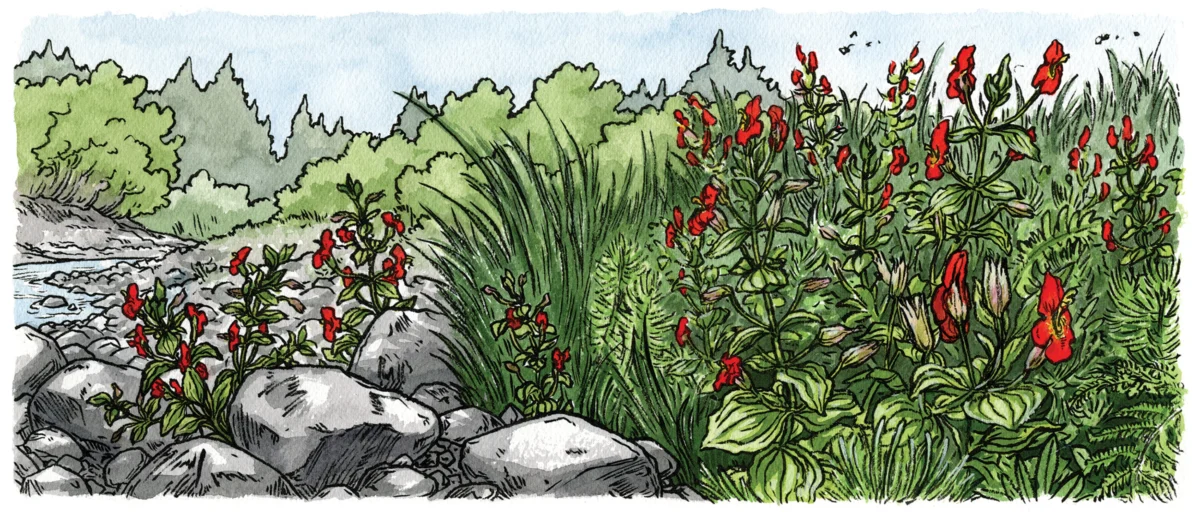
All summer long, a vibrant splash of scarlet along streambanks from Washington to Northern Mexico signals the extraordinary adaptability of the scarlet monkeyflower (Mimulus cardinalis), a plant that has evolved intricate partnerships with hummingbirds and, as recent research demonstrates, possesses a remarkable capacity to adapt to environmental pressures. As the season wanes, these eye-catching blooms yield to dry capsules filled with thousands of microscopic seeds, but for scientists, these seeds represent not an end, but a crucial beginning for unlocking secrets of evolutionary biology and understanding how Western ecosystems will weather the intensifying impacts of climate change.

A landmark study, spearheaded by University of British Columbia ecologist Amy Angert and published earlier this year, has provided compelling evidence that certain plant species can indeed evolve rapidly enough in natural settings to counteract the detrimental effects of a changing climate. This groundbreaking discovery, centered on the scarlet monkeyflower, adds to a growing body of research highlighting the profound influence of pollinators on speciation, the geographical variability in plants’ evolutionary potential, and the fascinating phenomenon of transgenerational adaptation, where plants can adjust to climatic shifts without necessarily undergoing genetic mutations. Angert’s laboratory is now leveraging these insights to develop predictive models for other species, aiming to forecast their ability to adapt or evolve in response to escalating drought, heat, wildfires, and other climate-related threats, thereby guiding conservation efforts toward the most vulnerable populations.
The journey from delicate wildflower to a critical subject of scientific inquiry began decades ago, with early observations dating back to the 1800s. However, it was the persistent efforts of researchers like Angert, beginning in 2010, that have transformed our understanding of this seemingly unassuming plant. Her team embarks on annual expeditions, visiting numerous monkeyflower habitats to meticulously record observations and collect seeds for laboratory cultivation. Through carefully controlled greenhouse experiments, where multiple generations of seeds from diverse origins are "resurrected" and subjected to varying environmental conditions, Angert’s research has conclusively shown that lineages exposed to drought stress have developed significant drought-tolerant traits, including altered leaf morphology and modified blooming schedules. The plant’s distinctive fuzzy leaves, coated in a sticky resin that emits a unique, subtly sweet and pungent aroma, transport Angert back to the field with each whiff, a testament to its sensory appeal and her deep connection to its study.

Scarlet monkeyflowers typically thrive in the transitional zone between fast-flowing water and established meadow grasses, sprouting between rocks along streambanks and creeks. Their growth habit is as varied as their environment; in arid, harsh conditions, they may reach only six inches in height, while in wetter, more hospitable areas, their stems can extend up to three feet, culminating in sprays of brilliant red flowers. This plasticity in form is a visual indicator of their inherent adaptability, a characteristic that makes them exceptionally valuable as "model species" in evolutionary biology. Their suitability stems from several factors: a long history of scientific study, a relatively short life cycle, ease of cultivation in laboratory settings, and the prolific production of seeds—often exceeding 2,000 per capsule—which facilitates efficient data collection and propagation. While their compact genome was once a significant advantage, advances in gene sequencing technology and computational analysis have lessened the unique importance of this trait, though it still contributes to their scientific utility.
The scarlet monkeyflower serves as a vital component of the climate adaptation toolkit, offering insights with broad ecological implications. Research emanating from Angert’s lab has revealed a significant disparity in adaptive genetic variation between southern and northern populations of the scarlet monkeyflower, with southern populations exhibiting a greater capacity for rapid evolution in response to similar environmental stressors. This finding underscores a critical caveat for conservationists and researchers: generalizations about species-level adaptation cannot be reliably drawn from studies of isolated populations. The geographic distribution of adaptive potential is a crucial factor in understanding how species will fare under future climate scenarios.

Furthermore, many plant species possess a form of "stress memory," an epigenetic mechanism whereby compounds or markers influence gene expression without altering the underlying DNA sequence. These modifications can be inherited across generations, from grandparents to parents to offspring, and this inherited plasticity may also vary significantly across a species’ geographic range. Angert’s team hypothesizes that even populations lacking the genetic wherewithal for rapid evolutionary adaptation might still leverage this stress memory to adjust to a rapidly changing climate, offering a potential buffer against environmental upheaval.
The scarlet monkeyflower’s "house special" is its highly specialized relationship with hummingbirds, a co-evolutionary dance perfected over millennia. Its vibrant red, tubular corolla is rich in nectar, and its long stamen is precisely positioned to dust the forehead of visiting hummingbirds with pollen. This intricate specialization stands in contrast to its close relative, the Lewis’s monkeyflower (Mimulus lewisii), which has adapted to suit bumblebees. Lewis’s monkeyflower features pink blossoms that yield less nectar and possesses broader petals that serve as a convenient landing platform for bumblebee pollinators. Despite their overlapping geographical ranges, these two species rarely hybridize, a testament to the strong selective pressures imposed by their distinct pollinators. Evolutionary biologists have demonstrated that these floral divergences are driven by alterations in just a few key genomic regions, suggesting that the evolution of specialized traits, such as adaptation to a new pollinator, can occur relatively swiftly on geological timescales, spanning millennia.

The ongoing research into the scarlet monkeyflower not only illuminates the intricate mechanisms of plant evolution but also provides a crucial lens through which to view the broader ecological challenges posed by climate change. By understanding how species like the scarlet monkeyflower are responding, scientists and conservationists can develop more effective strategies to protect biodiversity and ensure the resilience of natural landscapes in a rapidly warming world. The lessons learned from this humble, yet remarkably adaptive, wildflower offer hope and actionable insights for navigating the complex environmental future.








