Joko Susilo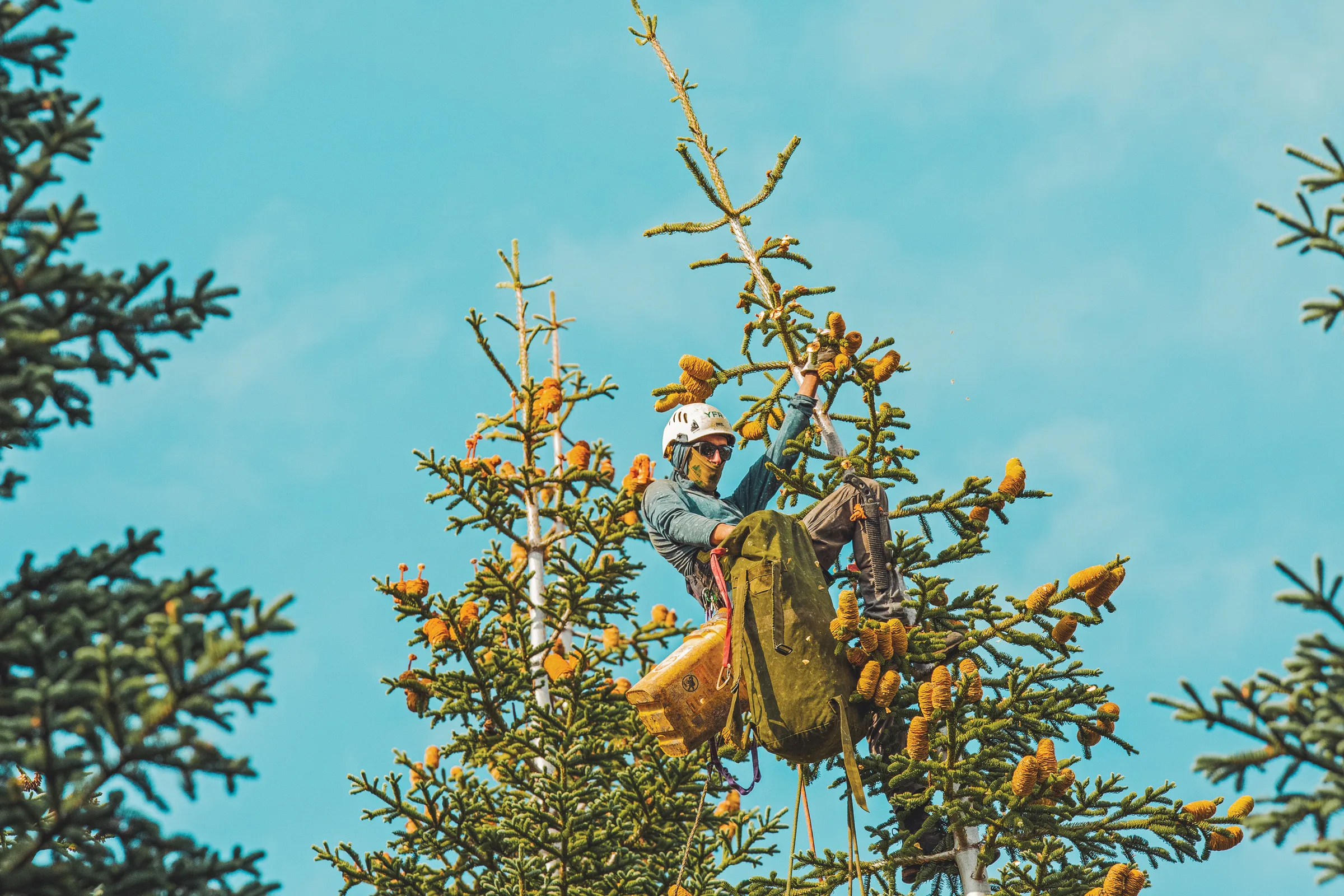
High in the majestic crown of a giant sequoia, the world transforms into a verdant cathedral, hushed save for the ancient timber’s creak and the rhythmic snap of cones being expertly detached from boughs. Dan Keeley, a lean, tanned 31-year-old, moves with a practiced, almost balletic economy, suspended by high-tensile ropes 200 feet above the forest floor on the western edge of California’s Sequoia National Park. To his left, the sequoia’s iconic cinnamon-hued bark offers a reassuring anchor as he navigates the precarious space between colossal branches. "There is a lot of trust that goes into this work," Keeley states, his voice carrying over the wind, as he carefully eyes a cluster of green, egg-sized cones. "Trust in the trees, predominantly, but also trust in the system — that I’m being sent to the right trees, at the right time, and for the right reason, not all of which are always the case."
Keeley is part of a specialized, increasingly vital workforce known informally as "pinecone cowboys," freelance contractors tasked with harvesting the genetic future of Western forests. A former rock climber and arborist, he scales trees of critical or threatened species, meticulously collecting ripe cones containing seeds destined for reforestation efforts across landscapes ravaged by escalating wildfires. This perilous profession, blending extreme athleticism with precise botanical knowledge, represents a frontline defense against the rapid, climate-driven erasure of vital ecosystems.

The urgency of Keeley’s mission is stark. Megafires, exacerbated by a century of aggressive fire suppression and the relentless march of climate change, now incinerate millions of acres annually across the American West. These blazes often manifest as high-intensity crown fires, leaping into the canopy and consuming the very seed sources that historically facilitated natural regeneration. Unlike the low-intensity ground fires that allowed serotinous species, such as some pines and sequoias, to release seeds from heat-opened cones, these infernos leave behind sterilized landscapes. For other species, wind or animal-dispersed seeds, once viable on the forest floor, now contend with thick layers of ash or aggressive invasive shrubs, hindering their ability to take root. A natural relationship between trees and fire, spanning 350 million years, now precariously depends on these rope-suspended climbers, who gather the trees’ potential future, one 45-liter bag at a time.
The specific sequoia Keeley works in stands within a thriving grove, a vibrant testament to resilience. Yet, just beyond the next ridge, lies a chilling panorama of recent megafires: vast, silent expanses where forests have been utterly obliterated. The 2020 Castle Fire and the 2021 KNP Complex fires alone decimated an estimated 13% to 19% of the Sierra Nevada’s mature giant sequoias. In the same year, wildfires across the West consumed over 10 million acres, an area larger than the state of Maryland, underscoring the continental scale of the crisis. Keeley’s precise task is to secure seeds from healthy, genetically robust trees, ensuring that the future seedlings planted on these burn scars possess the inherent blueprint necessary to thrive within their unique soil compositions, elevations, and delicate ecosystems. This critical genetic preservation is paramount for long-term forest health and climate adaptability.
Keeley’s ascent into the canopy is a remarkable fusion of rudimentary physics and advanced arboriculture. From the forest floor, he deploys a retrofitted crossbow, equipped with a fishing reel, to launch a weighted lead line over a sturdy branch high in the tree’s crown. This initial line then serves to hoist a thicker static climbing rope into position. Anchoring himself with a running bowline against the massive trunk, and utilizing mechanical ascenders – cam-based metal handles that grip the rope – Keeley braces his body and pulls himself upward, meter by painstaking meter, until he reaches the tree’s apex. Climbers target these lofty heights because cones are most abundant there, and the chances of self-pollination are lowest, thereby maximizing genetic diversity. Higher cones are more likely to be cross-pollinated by wind-borne pollen from other trees, leading to more robust and adaptable offspring – a crucial factor in building climate-resilient forests.

Perched on a branch, Keeley expertly plucks a cone and, with a utility knife, deftly slices it in half, revealing the hundreds of tiny seeds nestled within its spiraled scales. He then extracts a single seed, resembling an oatmeal flake, lays it on his leather-gloved palm, and slices it again. Through a jeweler’s 10x magnifying loupe, he assesses the embryo – the miniature root and stem that will emerge from the seed casing upon exposure to soil and water. In practice, he often resorts to simply biting the seed in half for a quick visual check. Keeley repeats this evaluation for a dozen or two seeds; if 30% to 50% of the seed cavities contain viable embryos, the seeds hold an acceptable chance of developing into healthy seedlings at the nursery. Only then does he proceed to harvest all available cones from that particular tree. If viability falls below this threshold, he descends and moves on, recognizing that time and effort are too precious to waste on non-viable stock.
While Keeley’s focus in the canopy is intensely microscopic, the problem he confronts is vast, spanning entire geographies. During the previous cone-collecting season, which typically runs from August to November, he logged over 20,000 miles, traversing multiple Western states. This staggering mileage not only highlights the scarcity of his specialized skillset but also underscores the widespread and desperate need for it. After meticulously filling his 45-liter bushel bag with roughly 60 pounds of cones, Keeley skillfully maneuvers the heavy load around a thick limb, attaches it to a static rope, and carefully lowers it to the forest floor. This seemingly slow, methodical process is, in fact, a frantic race against the clock. "Our work is a response," he later explains, "to a quiet crisis of urgency." Keeley and his colleagues battle not only the weather, which dictates cone ripeness, and the various animals that compete for seeds, but also the accelerating pace of climate change, which is eradicating forests far faster than they can naturally regenerate. Compounding this challenge, these dedicated "pinecone cowboys" – among the few individuals possessing the unique skills and knowledge to safeguard future forests – find themselves increasingly unsupported by the very systems that both employ and critically need them.
The historical roots of this reforestation effort are deep. In 1933, President Franklin D. Roosevelt established the Civilian Conservation Corps (CCC), which included the renowned "Tree Army." At its peak, this division of the U.S. Forest Service employed up to 300,000 men, who used boot spikes and waist ropes to climb trees and collect cones for massive reforestation programs. At the time, widespread logging, persistent drought, and unsustainable farming practices had severely depleted the nation’s forests and grasslands, leading to catastrophic erosion. This denuded landscape was also a direct consequence of centuries of forced removal of Indigenous peoples, who for millennia had actively managed the continent’s forests through practices like cultural burning. By lighting frequent, low-intensity fires, these tribes cleared undergrowth, promoted diverse ecosystems, and fostered the growth of healthy, fire-adapted trees. In many ways, the Tree Army sought to mechanically replicate the regenerative work that Indigenous communities had historically achieved through fire. By 1942, the CCC had gathered enough cones to plant over 3 billion trees, a monumental achievement in national restoration.

However, a 1930 law tied federal budgets for reforestation primarily to timber sales. This model proved effective during the post-war housing construction boom, when the Forest Service’s labor structure also shifted towards external contractors, with the agency adopting more of an administrative and management role to meet surging timber demand. But as timber harvesting plummeted in the late 20th century, and unprecedented wildfires emerged as the leading cause of deforestation, funding for reforestation drastically declined. This led to a rapidly growing backlog of unplanted acres, as detailed in a 2022 congressional report and a 2015 Forest Service report. This systemic funding decline, coupled with the escalating priority of firefighting, severely hollowed out the agency’s professional forestry core. Between 1998 and 2015, the Forest Service’s non-fire workforce shrank by nearly 40%, eliminating critical roles such as silviculturists, botanists, hydrologists who monitored forest health, and the forestry scouts and foresters who mapped backcountry stands and identified trees for cone collection.
The 2021 REPLANT Act aimed to address the Forest Service’s then 4-million-acre reforestation backlog, authorizing up to $140 million annually over a decade, supplementary to the agency’s meager annual appropriations-based replanting budget. Yet, a significant flaw emerged: this funding was restricted to project implementation and did not provide the necessary capital for the agency to hire the employees required to manage these projects. Robert Beauchamp, owner of Sierra Cone, one of the largest cone-collection contractors in the West, laments that the agency still lacks sufficient foresters, scouts, and other administrative staff to gather crucial upfront intelligence or effectively administer contracts. A 2026 budget analysis reveals that $337 million of the REPLANT fund remains unused, a stark indicator of this systemic bottleneck. When questioned, the Forest Service issued a written statement asserting that it allocates funding in accordance with agency priorities, "including active forest management and reforestation."
The staffing crisis intensified significantly under the previous administration. In 2025, the agency experienced a 16% loss of its permanent non-fire workforce, according to a report by the USDA Office of the Inspector General, partly attributed to initiatives like the Department of Government Efficiency (DOGE). This exodus included personnel vital for managing cone-collection contracts. Keeley himself reports several of his jobs being canceled due to the departure of key staff, including scientists and administrators who oversee these critical operations. Britta Dyer, formerly the senior director for California and the Pacific Islands at the nonprofit American Forests, which assists agencies like CAL FIRE and the Forest Service in securing reforestation funding and labor, confirms that the entire reforestation pipeline, from initial seed scouting to seedling planting, is severely constricted by this personnel shortage. "There is a workforce sitting there waiting to be deployed that isn’t being deployed," Keeley emphasizes, highlighting a frustrating disconnect.

Adding to the long-term challenges, experienced pinecone cowboys are aging and approaching retirement, yet the profession lacks a robust succession mechanism. There are no formal schools for cone collecting; skills are traditionally passed down through an informal apprenticeship model. However, the inherent instability of seasonal contracts, exacerbated by the agency’s staffing issues, prevents experienced climbers and contractors from offering consistent work to new hires, thereby gutting this vital knowledge transfer. While precise employment statistics are difficult to obtain due to the profession’s small and seasonal nature, cone collectors are part of a broader 38% reduction in forestry employment since 1994, as documented in a 2021 paper in the journal Forests.
The industry also struggles to provide stable, well-paying jobs, as Keeley explains from the tailgate of his truck, which serves as both his mobile headquarters and bedroom. His Toyota’s camper shell, fitted with a wooden sleeping platform, stores his essential gear: a cooler, ropes, climbing equipment, journals, a camp stove, satellite phones, radios, and first aid kits. Cone collection is inherently dangerous work with a short harvesting season and an increasingly unfavorable risk-to-reward ratio. In a truly productive season, an experienced climber might earn up to $60,000 in contracts, Keeley notes, but this figure does not account for the substantial costs of specialized climbing gear, business insurance, fuel, and truck maintenance. While larger companies like Sierra Cone can gross over $1.5 million annually from contracts, both individual contractors and companies face unpredictable delays caused by factors ranging from wildfire smoke to government shutdowns. Such delays, as occurred in 2025 when the fall season was halved, can mean cones overripen, and collectors lose an entire harvest, translating directly to "We don’t get paid," according to Keeley.
Furthermore, the industry suffers from a lack of adequate standards or certifications to differentiate contractors. Robert Beauchamp points out that this makes it challenging for land managers, often young and inexperienced, to properly vet bids. Budget-strapped state and federal agencies frequently accept the lowest bids for cone collection, scouting, and planting. This practice often results in new contractors, lacking essential tree-climbing experience, winning bids only to fail to fulfill their collection contracts, thereby wasting precious ripe cones and critical harvesting windows. For Beauchamp, the frustration isn’t merely the lost income, but the squandered opportunity for the forests. "You can’t just ‘redo’ a harvest after the first guy fails," he emphasizes. "You miss the weeklong window to harvest a tree; you miss the year of replanting." The Forest Service, in a written response, stated that contracts are typically advertised and awarded based on multiple factors, "including but not limited to, cost."

The cumulative effect is an annual reforestation shortfall that is not merely problematic but fundamentally reshaping entire ecosystems. The Forest Service currently produces between 30 million and 50 million seedlings per year, a mere fraction of the 120-million annual seedling goal established by the REPLANT Act. With an average 80% seedling survival rate and an estimated 220 trees needed to reforest each burned acre, the agency meets just 6% of its post-wildfire planting needs annually, according to its 2022 Reforestation Strategy Report. This critical deficit is not limited to Forest Service land; wildfires on both public and private lands have impacted, on average, 7.8 million acres per year over the last decade, as reported by the National Interagency Fire Center. In California alone, current seedling production and planting rates mean it would take 15 to 20 years to reforest what has already been lost, with each additional fire pushing the state "further behind," according to Kuldeep Singh, operations manager of seed production for CAL FIRE. While the Forest Service considers a tract reforested after seedlings survive their first five years, scientific research indicates that a fully functioning ecosystem, comparable to the one destroyed by fire, will not return for several decades.
When a forest fails to regenerate, either due to insufficient replanting or the failure of new seedlings to survive, it often undergoes a permanent ecological shift known as "type conversion," transforming into scrubland. This new brush-based ecosystem creates a more flammable fuel bed, actively resisting the forest’s return and effectively locking the land into a destructive cycle of fire and scrub. In regions like South Lake Tahoe, California, hundreds of acres once dominated by conifers are now covered by fields of eight-foot-tall manzanita and buckbrush. Across Oregon, Washington, Idaho, Wyoming, and throughout the Southwest, Forest Service research indicates that high-severity burn areas – inherently difficult to regenerate even with human intervention – are increasingly repopulated by invasive grasses or flowering plants like Brassicaceae. These species store less carbon and actively impede the establishment of native conifers, fundamentally altering the hydrology, fire cycle, and vital carbon-sequestration capacity of the entire Western landscape. This represents not just a local loss, but a significant blow to global climate mitigation efforts.
During a recent video call, Kayla Herriman, a national seed specialist with the Forest Service, outlined the agency’s current strategy to bridge reforestation funding and staffing gaps. This three-pronged approach involves training existing employees across various agency roles, including recreation and wildlife staff, to climb trees; borrowing labor from other agencies, even those not formally trained in seed collection; and selectively hiring private contractors. Herriman noted that the acres reforested by the Forest Service have indeed increased since 2023, stating, "Small collections, repeated annually, may not seem impactful, but they’re pretty mighty once they add up."

Red fir cones are meticulously prepared for transportation by Sierra Cone. Inside the CAL FIRE L.A. Moran Reforestation Center in Davis, California, more than 60 distinct seed types are preserved for decades within sub-zero freezers, representing a critical genetic library for future forest restoration. The facility, nestled between a babbling creek and agricultural fields, emits the sharp, tannic aroma of fresh pine resin mingling with woodsmoke and manure. Before their return to the forest, the cones collected by Keeley undergo an industrial journey. Within the center, massive metal tumblers hum continuously for 24 to 72 hours, shaking seeds loose from the cones. Workers then meticulously clean these seeds before either sealing them in precisely labeled bags—detailing species, stand origin, and elevation (a critical factor, as planting a tree from a 2,000-foot elevation at 7,000 feet often proves fatal)—for storage in sub-zero freezers, or dispatching them directly to nurseries. In the facility’s extensive greenhouses, hundreds of thousands of conifer seedlings, inoculated with the requested seeds, sprout from trays, growing for one to two years until they reach planting size, roughly the length of a pencil. These young trees are then carefully loaded onto trucks and transported to the burn scars awaiting their restoration.
The final, physically demanding link in this reforestation pipeline is the planting of these delicate seedlings. Keeley describes the grueling intensity of this phase, recounting month-long projects in Sequoia National Park where specialized forestry technicians carried 40-pound bags, each filled with dozens of seedlings, across treacherous charred logs and up steep, ash-covered slopes. The work demands not only immense stamina but also meticulous conscientiousness. "You have to place each tree perfectly," Keeley explains. "If you tuck the roots wrong, that tree is dead in a year." While planting could theoretically provide year-round income for tree climbers beyond the short three-to-four-month harvesting season, such opportunities are rare, making a sustainable living wage elusive. Inflation-adjusted earnings for today’s professionally trained domestic tree planters are 15% to 30% lower than they were in the 1970s, a decline detailed in the 2012 book Pineros: Latino Labour and the Changing Face of Forestry in the Pacific Northwest. This downward pressure on wages stems partly from the demise of worker cooperatives like the Hoedads, which once negotiated better terms before modern federal contract regulations began prioritizing lowest-bid contracts, as argued in the book Of Forests and Fields: Mexican Labor in the Pacific Northwest.
Today, a staggering 85% or more of the planting on private timberlands and national forests is performed by migrant laborers on H-2B visas, according to the Forest Resources Association. These workers, often subcontracted by forestry companies, reportedly face exploitation and abuse, earning as little as 16 cents for every seedling planted, according to the Southern Poverty Law Center. The Forest Service asserts that its contract officers and representatives in the field work to ensure contract provisions comply with laws and regulations. However, this dynamic creates a profound disparity in the reforestation process: specialized climbers like Keeley can earn up to $1,000 a day for their highly skilled and dangerous work, while the equally critical and physically arduous final stage of restoration is performed by low-wage labor. This situation is problematic not only ethically but also practically, as planting mistakes, which can easily occur under pressure for high volumes, can undo the careful, costly collection efforts of the "cowboys" in the canopy. "Planting mistakes do happen," Dyer confirms, highlighting the vulnerability of the entire process.

Advocacy groups, including The Nature Conservancy and American Forests, are actively lobbying for the Post-Disaster Reforestation and Restoration Act (H.R. 528), introduced by Democratic Representative Brittany Pettersen in January 2025. If passed, this legislation could theoretically expand opportunities for pinecone cowboys by mandating that the Department of the Interior, which oversees the Bureau of Land Management and National Park Service, prioritize reforestation projects similar to the Forest Service. However, every expert consulted, from veteran cone collectors to government foresters, agrees that resolving the profound reforestation bottleneck ultimately requires a significant rebuilding of the appropriate agency workforce – a prospect that appears increasingly dim under the current administrative climate. In the wake of a recent exodus of federal employees and a perceived lack of robust support for reforestation and other climate-adjacent initiatives, Dyer anticipates less federal work this season. "Contractors should, and are, bracing for chaos," she warns.
Meanwhile, some agencies are attempting to professionalize the cone-collection trade. In 2022, CAL FIRE, in partnership with American Forests, initiated pilot two-day "cone camps." These camps aim to train workers at all levels of the reforestation pipeline, from scouting to climbing and planting, imparting essential skills such as estimating bushel volumes, rigging ropes, and conducting cone-cut tests. CAL FIRE has also implemented formal cone-collection standards to ensure participants meet rigorous contract requirements. Despite over 300 individuals completing the program, few have pursued long-term careers in the industry, Singh notes. "Climbing trees," he concedes, "is still a declining profession." A certificate alone cannot fundamentally alter the seasonal, hazardous, and unpredictable nature of the job, nor the reality that working as a private contractor like Keeley often struggles to provide a consistent living wage.
Keeley, for his part, remains primarily motivated by his profound enjoyment of the work and his deep love for the forest. His unwavering focus, he states, is "the genetic preservation of threatened species." It is this profound sense of purpose that, despite the daunting challenges and the immense weight of responsibility, anchors his commitment to this unique career – a dedication that becomes powerfully apparent as one observes him perform the difficult, delicate work of cone collecting.

As Keeley finally descends at sunset in Sequoia National Park, covered in sticky pine resin, his muscles ache from eight hours spent suspended in the harness. The seeds he has painstakingly gathered will take at least three years to mature into seedlings and reach blackened slopes like those just a mile or two away. The majestic forest, in its full grandeur, will likely not return to its previous state within his lifetime. Yet, as he tosses the bushel bags into his truck bed, a note of quiet hope resonates in his voice. "It seems like a slow progression towards a solution," he acknowledges, pulling the truck door shut, "but to a forest’s timeline, we’re making a difference." With that, he begins the long drive toward the next stand, a solitary sentinel in the urgent battle for environmental restoration.