

 Rocky Gerung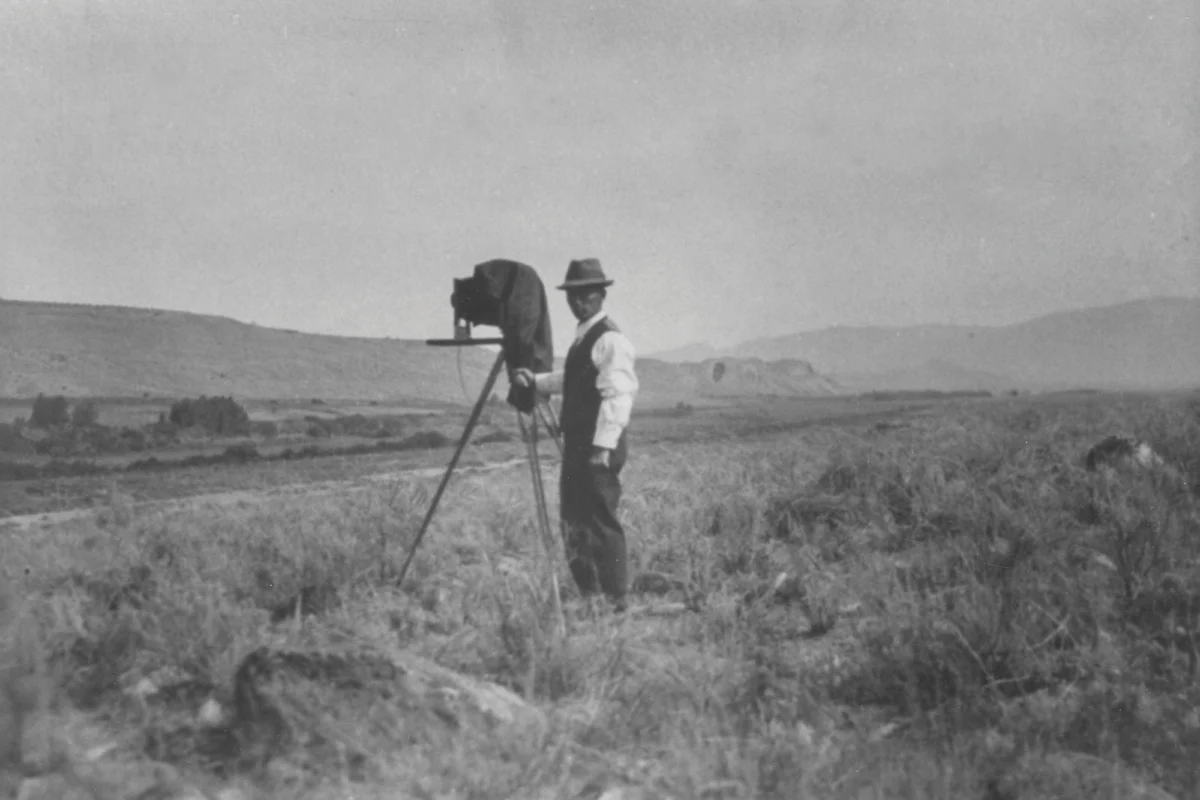
Harrington, who relocated to the Pacific Northwest from Boston in the early 2000s, spent nearly two decades exploring Matsura’s enigmatic legacy before completing her feature-length documentary, Our Mr. Matsura, in 2025. The film’s title reflects the filmmaker’s belief that "everybody has a point of entry" into understanding Matsura, suggesting that his work offers collective impressions that form a shared sense of his identity. The enduring impact of Matsura’s photography was palpable at a screening of the film at the restored Omak Theater, where an audience of approximately 300 gathered, including Douglas Woodrow, a lifelong resident of Okanogan.

Woodrow’s childhood memories are intertwined with Matsura’s images, which frequently graced the pages of the local newspaper. As a boy in the late 1950s, he would cycle to the very locations depicted in these historical photographs, struck by the dramatic transformations over time and imagining the grandeur of the now-demolished Bureau Hotel, a symbol of elegance in his perception of the once-sleepy town. His reconnection with "Frank"—as Matsura is affectionately known by those who cherish his work—occurred decades later while volunteering with the Okanogan County Historical Society. It was there that Woodrow unearthed a "literal shoebox" filled with unprocessed Matsura photographs. These images, when sequenced, chronicled the 1910 construction of the Conconully Dam, an early project by the Bureau of Reclamation on Salmon Creek, an endeavor that deeply inspired him. Presenting these photographs to community groups became Woodrow’s initial foray into preserving Matsura’s legacy.
This dedication led Woodrow to Japan, where he visited Matsura’s birthplace alongside his friend and fellow enthusiast, Tetsuo Kurihara, a Japanese photographer he had met during Kurihara’s research trip to Okanogan. Back in Washington, Woodrow spearheaded efforts to honor Matsura, establishing an interpretive site near the photographer’s former studio and organizing a walking tour featuring mural-sized reproductions of his work. Woodrow highlights Matsura’s "extraordinary social mobility," noting his ability to be included in nearly every significant event in Okanogan, bridging the divides between tribal members, newly arrived businessmen, miners, and saloon patrons across all social strata.

Randy Lewis, a Wenatchi (P’Squosa) elder and member of the Confederated Tribes of the Colville Reservation, is among the many descendants of Matsura’s subjects featured in Our Mr. Matsura. Lewis has actively participated in regional screenings of the film, including a memorable "barn screening" in Winthrop, Washington, followed by a salmon bake. His family history, as captured by Matsura, exemplifies the continuity of the world the photographer documented. The film includes a poignant photograph of Lewis’s great-uncle, Sam George, with his family in a buckboard wagon, which Lewis describes as the "F-250 of the time." This photograph hung in his family home during his years as caretaker for George in his final years.
"He’d be sitting there staring at that picture," Lewis recounted, explaining that George used the photograph to recall the names and birthdays of everyone in the wagon, a testament to the image’s power to preserve memory and connection. Sam George, who died at the age of 108, was born in 1860, predating the establishment of the Colville Indian Reservation in 1872. His long life spanned periods of significant change, including the reservation’s reduction, the allotment era, and the influx of prospectors and homesteaders. His family, including Lewis, continued ancestral traditions, such as seasonal fishing, maintaining a platform at Celilo Falls until its inundation by The Dalles Dam in 1957, which submerged one of the continent’s most vital fishing grounds.

Matsura’s arrival in the region coincided with a pivotal cultural shift, a time when, as Lewis observes, "both cultures," Native and settler, were in flux. "We were into a new century, and he was capturing that. It wasn’t the death toll of the Indians. It was life going on." Our Mr. Matsura extends beyond its subject to encompass the broader narrative of Okanogan County, illustrating the isolated and rugged beauty of a landscape that has remained remarkably consistent since Matsura’s time.
Jean Berney, a seasoned rancher and farmer near Conconully, a community she describes as "off the beaten track for a lot of people," speaks to the enduring allure of this country. An enrolled member of the Colville Confederated Tribes, Berney married into a non-Native cattle-ranching family and subsequently built her own successful herd, earning national recognition for her conservation-focused ranching practices and dedication to the 4-H program. Her land once hosted The Conconully Naturpathy Institute, commonly known as Casselmann’s Sanitarium, where Dr. Casselmann, a German immigrant, treated tuberculosis patients from 1906 onwards. Many speculate that Matsura, drawn to the region’s dry climate, may have been among these patients.

Berney often contemplates Matsura’s journeys across the rugged terrain and ponders the unspoken aspects of his life. "Did he ever talk to Dr. Casselmann about his condition? How long was he sick? We wonder about Frank and everything that happened a long time ago, and we can’t ask," she mused, highlighting the inherent mystery that surrounds the photographer’s personal story.
Harrington’s documentary contributes to a growing body of work dedicated to Matsura, joining the diligent efforts of volunteers at the Okanogan County Historical Society and the academic contributions of Michael Holloman, a tenured art professor at Washington State University. Holloman, an enrolled member of the Confederated Tribes of the Colville Indian Reservation, co-curated a significant exhibition of Matsura’s work at Spokane’s Northwest Museum of Arts and Culture in 2023 and published the book Frank S. Matsura: Iconoclast Photographer of the American West in 2025. Holloman emphasizes the contemporary relevance of Matsura’s approach, stating, "We need people to be like Frank right now, to engage multiple communities and be able to find life, vibrancy, in a world that is in transformation and change."

The planned wide release of Our Mr. Matsura on The American Experience was unexpectedly impacted by federal funding cuts that ended the long-running PBS program last summer. Despite this setback, Harrington remains optimistic that the film will find its audience through film festivals, streaming platforms, and continued special screenings, much like the one held in Omak last fall, acknowledging that the path forward will present greater challenges. "There’s a lot of worthy things that we can’t put a dollar value to," Harrington reflected, "These stories…we’re poorer for them when we don’t have them."
During the Omak screening, Harrington received heartfelt thanks for "mirroring" the trust and rapport that Matsura cultivated with his subjects over a century ago. However, the filmmaker was quick to reciprocate the sentiment. "The story is not just about Frank and his charisma and his incredible body of work," she asserted, "It’s about the way people uphold his memory and still talk about him 112 years after his death." This enduring connection, fostered by Matsura’s lens and perpetuated by the community’s dedication, ensures that his legacy continues to illuminate the rich tapestry of the American West.







