

 Roger Danuarta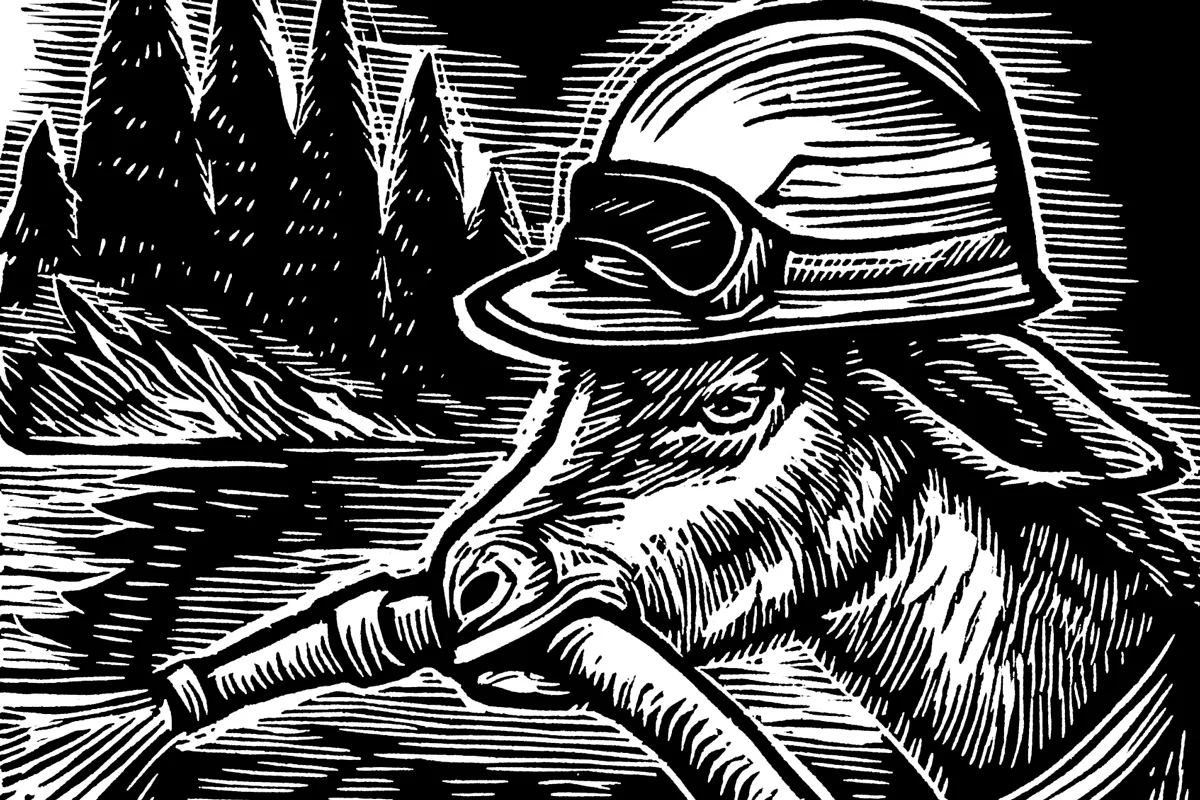
Colorado, a state often grappling with intensifying wildfires, found an unexpected and heartwarming ally this past July during the Rock Creek Fire. In the rugged terrain west of Cheyenne Mountain State Park near Colorado Springs, a diminutive four-year-old Nigerian dwarf goat named Goldie emerged as an unlikely beacon of morale and practical assistance for the firefighters battling the blaze. As the conflagration rapidly consumed approximately five acres, Goldie, whose owner Pete Glader is a seasoned firefighter, became an unofficial, yet highly effective, member of the incident command team. The Rock Creek Fire, like many wildfires across the Western United States, presented significant challenges, including steep slopes, dense vegetation, and unpredictable wind patterns. Firefighters, including the Southern Colorado Interagency Wildland Fire Team, deployed quickly, digging critical containment lines and using chainsaws to clear fuel breaks, while a helicopter made precision water drops. Amidst the intense and often dangerous work, Goldie, with her characteristic spunky demeanor, not only provided much-needed comic relief but also demonstrated an uncanny aptitude for navigating the treacherous landscape. Shane Coyne, superintendent of the Southern Colorado Interagency Wildland Fire Team, recounted how Goldie would lead crews through the most challenging sections, pausing occasionally to bleat out what firefighters interpreted as encouragement to her slower, two-legged companions. "She wanted to make sure she knew all the humans got to the fire," Coyne remarked, highlighting the goat’s apparent sense of responsibility and awareness. Beyond her role as a four-legged project manager and motivator, Goldie’s involvement underscored a growing appreciation for the ecological benefits of targeted grazing in fire mitigation. Goats, with their voracious appetites, are increasingly utilized in wildfire-prone areas to clear away flammable underbrush, creating natural firebreaks and reducing fuel loads. This practice, known as prescribed grazing, offers an environmentally friendly alternative to mechanical clearing or controlled burns, aligning with sustainable land management strategies to reduce blaze frequency and severity. Goldie herself had contributed to these mitigation efforts, helpfully munching down on the very type of fire-prone vegetation that fuels such infernos. Her innate understanding of the terrain, combined with her unique contribution to both morale and prevention, cemented her status among the firefighting community. As Coyne aptly put it, "She knew her area, and she understood the assignment." In a season marked by relentless natural challenges, Goldie’s story serves as a poignant reminder of the unexpected heroism that can emerge, rightfully earning her the affectionate title of the GOAT (Greatest Of All Time) among her human comrades. Her tale resonates with communities worldwide exploring nature-based solutions to environmental crises, demonstrating how even small creatures can play a significant role in safeguarding landscapes and livelihoods.

Further west, in California’s Siskiyou County, a distinct mystery captivated residents near Weed, drawing global attention through viral social media. For weeks, an eerie, static-filled sound, described by many as resembling "distant screams," emanated from a remote hillside. The unsettling auditory phenomenon sparked a frenzy of online speculation, from covert government experiments and cult rituals to fantastical theories of extraterrestrial activity or cryptids near Mount Shasta. The sounds fueled public unease, transforming a quiet mountain community into the epicenter of a bizarre auditory enigma. The enigma was finally unraveled by Mount Shasta resident Karrie Ann Snure and her daughter, Jordan, during a horseback ride off Highway 97. Their investigation led them to the surprising source: up to 200 solar-powered Bluetooth speakers, strategically scattered across the hillside. From a distance, the collective audio blurred into the unsettling white noise that had initially alarmed the community. However, upon closer inspection, the individual speakers were found to be broadcasting religious sermons, delivering messages of faith across the seemingly deserted landscape. Snure’s videos of the "buzzing static-filled slope" quickly gained traction online, turning a local curiosity into an international sensation and highlighting citizen journalism’s power in solving modern mysteries. Following the viral spread of her discovery, Snure successfully tracked down the individual responsible for installing the elaborate sound system. The installer, whose identity Snure agreed to keep anonymous, revealed a motive far gentler and more idealistic than the internet’s darkest imaginings: a desire to promote "peace, compassion, and veganism in an effort to elevate consciousness." This revelation starkly contrasted the widespread fear and wild theories, showcasing the human tendency to conjure sensational narratives without clear information. While broadcasting spiritual messages across public lands is unconventional and raises questions about noise pollution and land use ethics, it offered a uniquely "Mount Shasta" resolution. The region has long been steeped in a rich tapestry of folklore and spiritual beliefs, serving as a magnet for diverse fringe communities and attracting legends of Lemurian civilizations, frequent UFO sightings, and a vibrant array of New Age spiritual practices. As Active NorCal aptly summarized, "For a mountain with a century-long reputation for Lemurian legends, UFO sightings, and fringe spiritual communities, a field of talking speakers preaching kindness fits right in." At the latest report, the audio transmissions continued, maintaining the area’s peculiar charm and ensuring that even with the mystery solved, a distinctive layer of local "weirdness" remained delightfully intact. This episode serves as a modern parable, illustrating how quickly local oddities become global curiosities, shaped by the internet’s collective imagination.
In Montana’s vast plains, a profound historical commemoration intertwined with an unexpected tale of canine loyalty. The summer marked the 150-year anniversary of the Battle of the Little Bighorn, a pivotal conflict from June 25, 1876. On that fateful day, Lakota, Northern Cheyenne, and Arapaho warriors achieved a decisive victory over the United States 7th Cavalry, led by Lt. Col. George Armstrong Custer, near the Bighorn River in present-day Crow Agency. This battle, often called Custer’s Last Stand, holds immense historical and cultural significance for Indigenous peoples, symbolizing a fierce stand for sovereignty and ancestral lands against expansion. To honor this anniversary, the Real Bird Family hosted the 34th Annual Battle of the Little Bighorn Re-enactment along the sacred Bighorn River, also known as Greasy Grass. The three-day









