

 Roger Danuarta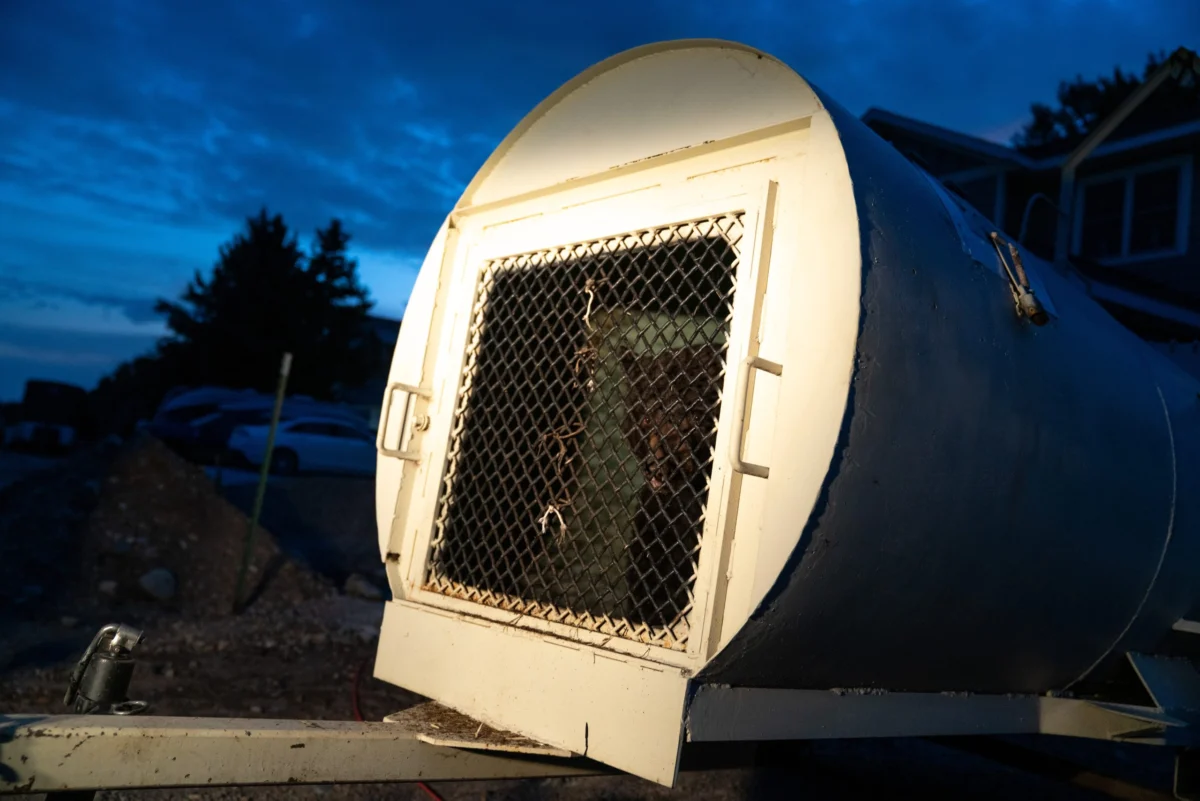
Daniel McHugh, a bear management specialist with Montana Fish, Wildlife and Parks, finds himself increasingly weary of the grim duty of euthanizing bears. With a tall stature, a weathered beard, and hair the color of sun-baked earth, McHugh initially dedicated his career to bear biology driven by a profound desire to study and conserve these magnificent animals, not to end their lives. Yet, in a late August community meeting held in the Red Lodge Senior Center, he stood before a standing-room-only crowd, his frustration palpable as he recounted a year of relentless and tragic human-bear encounters.
By the time of that pivotal meeting, the state game agency had been forced to kill six bears within the small, less-than-three-square-mile Montana city, two of them critically endangered grizzlies. "There’s a problem," McHugh stated plainly, his voice resonating with a mix of exhaustion and urgency. "There’s something going on." Since the bruins emerged from their winter dens last spring, McHugh and his dedicated team had responded to over 200 conflict reports within a 15-mile radius of Red Lodge, a stark increase, with most incidents involving far more serious infractions than bears merely rummaging through garbage.
This alarming surge in ursine activity extends far beyond Red Lodge, gripping communities across the entire Rocky Mountain region. A particularly dry winter, compounded by an unseasonably late spring freeze in Montana, has decimated natural food sources crucial for bears, such as protein-rich whitebark pine nuts, succulent huckleberries, and tart chokecherries. As these powerful omnivores approach the critical hyperphagia stage – a period of intense feeding to build fat reserves for winter hibernation – their desperation for calories has driven them increasingly closer to human settlements. They are aggressively seeking out readily available human garbage, compost, pet food, and even breaking into vehicles and homes in search of sustenance. This escalating pattern of behavior underscores a long-held axiom in bear country: "A fed bear is a dead bear."

Indeed, wildlife managers across the Western United States have been forced into the agonizing position of euthanizing a significant number of bears this year. Colorado alone reported nearly 300 bear fatalities by the end of August due to conflicts with humans and property. Wyoming is grappling with an "unprecedented" rate of such encounters, a situation mirrored in Utah, New Mexico, and Idaho. However, Red Lodge, nestled at the base of the dramatic Beartooth Mountains and serving as a scenic gateway to Yellowstone National Park, has faced a uniquely severe and emotionally charged crisis.
The relentless spate of bear conflicts has ignited heated public forums and exacerbated existing tensions within this tight-knit community. Red Lodge residents have long held divergent views on how best to coexist with and manage their wild neighbors. While a segment of the local population advocates for greater tolerance and a "live and let live" philosophy, wildlife professionals like McHugh are increasingly convinced that deliberate human choices, both intentional and unintentional, are directly fueling these dangerous encounters. These choices, he argues, leave officials with no alternative but to employ lethal measures. "The community loads the gun," McHugh asserted bluntly at the meeting, laying bare the shared responsibility. "When you’re mad at us for killing the bears, we all have a hand in it. They’re all of our bears. We all own them, and we all own the responsibility of what happens in our communities."
The meeting itself was a testament to the community’s deep concern, drawing approximately 140 attendees – a remarkable turnout for a city of just 2,500 people situated less than 40 miles northeast of the Yellowstone ecosystem boundary. Local law enforcement, several Montana Fish, Wildlife and Parks employees, and even the mayor were present, reflecting the gravity of the situation. Shawn Stewart, a state wildlife biologist with over five decades of experience, remarked on the unusual attendance: "Normally, when Fish, Wildlife and Parks has a meeting, we outnumber the attendees."
Stewart offered a sobering historical parallel, recalling one of the last times bear conflicts reached such dire levels in the Treasure State. It was 1986, a year, much like the present, when whitebark pine and chokecherry crops failed, leaving bears hungry. "We lost 30% of our black bear population in the Beartooths that year," Stewart recounted, referring to the rugged range straddling the Montana-Wyoming border. That year saw 10 to 15 black bears nightly raiding alleys, leading to state-sanctioned killings, increased hunting pressure, and bears starving to death. Then, as now, Red Lodge struggled with unsecured trash, accessible birdseed, and pet food, drawing bears into urban areas. However, Stewart noted a deeply troubling shift in bear behavior over his long career, a change that now causes him profound worry.

Just days before the public meeting, a black bear unsettlingly followed a woman walking near the local middle school. A quick-thinking driver intervened, swerving their vehicle between the woman and the accelerating bear. When the walker sought refuge inside the car, the bear placed its paws on the vehicle, clacking its jaws in a display of aggressive habituation. This was an eerily close call, yet it was not an isolated incident. Fish, Wildlife and Parks biologists observed Red Lodge bears walking city streets in broad daylight, exhibiting an alarming lack of fear towards humans. "We’ve never had bears approaching people," Stewart emphasized, his voice tinged with disbelief. "We’ve never had bears stalking. We’ve never had bears chasing people. We’ve seen all those behaviors escalate alarmingly."
The underlying cause of this dramatic behavioral shift became a central point of contention. Matt Heaton, a local game warden, offered a stark, direct accusation: "People are intentionally feeding these bears." A collective gasp rippled through the audience. Heaton continued, "They’re contributing to the death of those animals, and they are going to contribute to the death of people."
McHugh’s lifelong connection to the wild began with a profound childhood experience in northwest Montana’s Cabinet-Yaak wilderness, where his father revealed a bear den within a massive, hollowed-out tree. "It was this weird mixture of fear and awe and just the most beautiful feeling," he reminisced, "It’s something we have a hard time capturing in our lives now." This early encounter cemented his passion. In 2021, he began his career as a state grizzly bear technician along the Rocky Mountain Front, a 150-mile stretch east of the Continental Divide, south of Glacier National Park, where grizzly populations were rebounding. Despite the resurgence, conflicts were relatively rare in the sparsely populated area. However, his transfer to Red Lodge in 2023 presented a starkly different reality, one characterized by an unusually high, and ultimately dangerous, tolerance for bears among residents.
"It was bears living in town with no regard for people, just generation after generation," McHugh observed, shocked by the entrenched patterns. His role was meant to balance conflict prevention with response. In typical years, this involved community outreach, educating residents, and helping them implement solutions to deter bears. This year, however, the sheer volume of conflicts and the overwhelming response required had completely overshadowed his preventive work. "We’re pretty much just chasing our tail," he conceded.

The visible and frequent euthanasia of bears in Red Lodge, sometimes occurring in public view, has deeply distressed some residents. "Are you euthanizing them because they are getting into people’s garbages?" one resident demanded at the meeting, even before the formal presentation began. "I’ve never seen an aggressive black bear," she added, questioning whether officials truly investigated conflicts or simply acted on anecdotal reports. McHugh patiently clarified that Fish, Wildlife and Parks staff do not euthanize bears solely for accessing trash. However, a bear that initially seeks out garbage can quickly "spin out" – escalating its behavior to breaking into cars and homes, becoming a significant public safety threat. At this critical juncture, when a bear poses a clear danger, euthanasia becomes a necessary, albeit painful, decision.
Wildlife managers, McHugh and his colleagues explained, tolerate a certain level of risk inherent in living alongside wild animals; a startled bear bluff-charging a hiker in the wilderness, for instance, is not automatically deemed a "problem bear." But within town limits, the risk calculus shifts dramatically. Bears are given numerous chances: Fish, Wildlife and Parks personnel employ hazing techniques, educate property owners on securing attractants, meticulously measure tracks, and conduct thorough interviews with witnesses and neighbors after conflicts, much like law enforcement investigations. They often track individual animals for months or even years, monitoring behavioral changes. Euthanasia is almost never the first response.
"What people see is just that snapshot," bear technician Oliver Thomi explained at the meeting – the moment a wildlife manager shoots a bear that, for example, has gotten into campers’ garbage. "What they don’t see is that we’ve been trying for two years, more or less, to keep this bear out of trouble." Relocating bears, while sometimes effective, often proves futile for habituated animals who frequently return to their original conflict zones, drawn by familiar food rewards. Limited road access and a scarcity of suitable, unoccupied habitat further complicate relocation efforts, often leading a "spun-out" bear back to the difficult choice of euthanasia.
In Red Lodge, where a significant portion of the community exhibits a high degree of tolerance for bears – inadvertently and, some suspect, intentionally feeding them – animals frequently become habituated to human presence. Wildlife managers contend that this "love" for bears has, in many cases, gone beyond healthy coexistence. "There’s a fine line between tolerating and accepting bears, versus saying, ‘This is just too much,’" Warden Heaton articulated at the meeting. "And what we’re saying right now is we’re being too tolerant, too much." His statement was met with a chorus of questions, murmurs, and eventually, applause, highlighting the deep divisions within the community.

Intentional bear feeding represents only one facet of Red Lodge’s complex bear problem, McHugh acknowledged. Incidental feeding is rampant, occurring when residents overfill bird feeders and then marvel as bears consume the fallen seeds, or when they feed deer, only to have passing bruins capitalize on the easy meal. This issue is not unique to Red Lodge; wildlife managers throughout the West consistently warn against feeding bears, often with mixed results. Five years prior, the U.S. Fish and Wildlife Service investigated a Jackson Hole resident suspected of feeding grizzly bears for years, though no charges were filed, as wildlife feeding is not illegal in Wyoming. In contrast, Montana explicitly bans feeding game animals and predators like bears and mountain lions, though officials admit it is a challenging crime to prove, typically carrying only a modest $135 fine.
Beyond incidental feeding, there is growing suspicion that intentional feeding has been occurring since the spring of 2025. At a community forum that year, a resident advocated for the controversial "diversionary feeding" theories of Lynn Rogers, a Minnesota bear biologist known for hand-feeding and walking with bears. Rogers posits that providing supplemental food near populated areas can keep bears out of trouble. McHugh and his colleagues dismissed Rogers’ decades-old science as thoroughly debunked, asserting that feeding bears invariably leads to dangerous habituation. Other scientists overwhelmingly concur.
As time progressed, the wildlife officials observed increasingly aberrant bear behavior. In 2024, a black bear bit a child’s head inside a tent. This year, another black bear stalked and attacked individuals, and bluff-charged a city officer three times on a single night. Officials are certain this bear had been fed. By the late August meeting, McHugh and his team had spent considerable time tracking a particularly trap-savvy grizzly, known for appearing in broad daylight and approaching people as if expecting food. Many of the problem bears, officials noted, originated from the same drainage, where they strongly suspect deliberate feeding. "I do know there is feeding in that area," McHugh confirmed. "That is no mystery."
Game warden Matt Heaton typically handled one to ten calls annually regarding illegal deer feeding. "This year and last year," he stated, "I had more where (callers) were saying, ‘I believe this person is also feeding bears.’" Heaton possesses photographic and video evidence of bears frequenting bait sites on both private and public land, a practice explicitly illegal in Montana. While declining to identify informants or suspects, Heaton indicated his preference for education over immediate enforcement, opting for dialogue rather than attempting to build a criminal case.

Over a Pepsi and a BLT in downtown Red Lodge, Bo Ewald, a retired high-speed computing executive in his late 70s, mused on his perceived kinship with black bears. He described himself as an introvert – intelligent and curious, much like the bruins he admires. Ewald was the resident who championed Lynn Rogers’ diversionary feeding theories at the 2025 community forum. He resides in the very drainage identified as the origin point for many problem bears, leading some locals to suspect him of taking bear management into his own hands – an accusation he vehemently denies.
Ewald explained that his fascination with bears led him to Rogers’ work. Like Rogers, Ewald believes black bears are not inherently terrifying or dangerous. He has never owned bear spray, asserting, "I know they’re not gonna hurt me, and I’m not gonna hurt them. We’ve gotten along fine." Rogers’ studies, particularly one from 1984 to 1991 where he captured, radio-collared, and deliberately fed bears beef fat, greatly influenced Ewald. Rogers concluded that habituated bears encountered fewer conflicts, preferred natural foods, and did not exhibit increased aggression. "Our data indicate that hunger – not habituation or food-conditioning – is the driving force behind nuisance behavior," Rogers wrote.
However, many contemporary bear experts widely dismiss Rogers’ work as scientifically flawed. Dave Garshelis, co-chair of the bear specialist group of the International Union for Conservation of Nature (IUCN), had numerous professional disagreements with Rogers during his 27 years at the Minnesota Department of Natural Resources. In 2017, Garshelis co-authored an academic paper reviewing global case studies of diversionary feeding. He noted a severe lack of rigorous scientific evidence supporting the practice. In Rogers’ specific case, Garshelis pointed to too many uncontrolled variables to definitively evaluate the method’s efficacy. He highlighted that very few bears actually utilized the diversionary feeding site. Furthermore, Rogers simultaneously advised local communities not to report problem bears, which Garshelis argues artificially suppressed conflict statistics. "Reporting of conflicts dropped off," Garshelis stated, "But it had nothing to do with baiting. It had to do with his talking to the public."
Despite the scientific consensus, Ewald maintains that Rogers’ studies align with his own three decades of experience living in bear country. He estimates 100 to 200 bears have passed through his property without any notable change in their behavior. He believes wildlife managers are killing too many bears. "For people that have been in Red Lodge for a long time, it’s ‘live and let live,’ rather than ‘a fed bear is a dead bear,’" he argued, calling the latter a "self-fulfilling prophecy." Ewald contends that as Montana and Red Lodge have experienced growth, newcomers have lost the understanding of how to coexist respectfully with wildlife. "I honestly think it’s a people problem, not a bear problem," he stated.

Ewald presented Rogers’ ideas at the community forum as an alternative approach to bear management, but felt his views were attacked and dismissed. It was the first and last community bear meeting he attended. When directly asked if he was feeding bears on his property, Ewald firmly denied it. He confirmed that Warden Heaton had recently posed the same question. Ewald explained to Heaton, as he did during the interview, that his property offers approximately 20 food sources for bears, ranging from natural sedges and grasses to human-introduced elements like apple trees, berries, and seed from bird feeders, which he claims to clean up when "it gets out of hand." "Do bears eat here? Yeah, bears eat here," he conceded. "But I’m not feeding them."
Even if intentional feeding were to cease overnight, McHugh and other wildlife officials believe that while "predatory" bear behavior might decrease, the overarching conflict in Red Lodge would persist. "Our main concern is that the feeding stops," McHugh reiterated, "But it is the story of the West. The broader problems are beyond someone intentionally feeding." He emphasized that the majority of the town’s issues stem from ubiquitous attractants – unsecured trash, bird feeders, and other human-derived food sources common in communities like Missoula, Jackson, Wyoming, or Boulder, Colorado. "But intentionally teaching bears to associate people with food is a major, major issue and probably leads to a disproportionate amount of bear death," he stressed. Lasting solutions, he suggested, will not emerge from legal enforcement alone but must originate from a fundamental shift in community-wide behavior and attitudes.
"When you feed a bear intentionally, I would say that’s just downright evil, and that’s stupid," McHugh declared. "And we’re probably not going to convince many people, but maybe the community can." The complex dynamics within Red Lodge make the job of bear management exceptionally challenging. When a bear must be euthanized, McHugh asserts it is rarely the animal’s fault; Red Lodge, he says, is a veritable minefield of bear attractants. Echoing Ewald, he believes the true root of the problem lies with people, not bears. The act of putting down a bear, especially one intentionally fed, is an emotionally harrowing experience for him. "I get yelled at for it. I get the nasty calls," he shared. "And then I have to live my life with it on my conscience that I killed it. It sucks. And you want some justice, but you know you’re not gonna get it. And you just have to keep doing what you’re doing. But it’s brutal."
The morning after the tense public meeting, before dawn broke, McHugh, Thomi, and Myles Steinmetz, a bear technician hired on an emergency basis, responded to a call about a trapped bear. Fish, Wildlife and Parks had set a culvert trap in a resident’s backyard, strategically placed near a creek that winds through town. Approaching with bear spray at the ready, the air was thick with the scent of decaying deer bait, a potential lure for other bruins in this known high-activity corridor. "You don’t get much sleep these years," Thomi remarked, already 30 hours into his work week by Tuesday morning, reflecting on the toll it takes on personal lives.

The trapped animal was a small male black bear, healthy in appearance despite the stress of hours confined in the cylindrical enclosure. It occasionally huffed and charged the cage as Thomi conducted his initial assessment. The team towed the culvert trap to a gravel parking lot just outside town – a makeshift euthanasia site due to the absence of a dedicated facility. "A lot of bears have died here," McHugh said somberly, the words hanging heavy in the pre-dawn air. Thomi cross-referenced images from social media and news reports, confirming the bear in the trap was likely the same one that had chased the woman near the middle school just days earlier, its rap sheet long and concerning.
"Hopefully, it will be a very long time until the next time we have to do this," McHugh stated, cleaning a syringe to be attached to a long pole for sedation. "But in reality, it’ll probably be two days, if we make it that long." He plunged the needle into the bear’s shoulder, but the bear, in a final act of defiance, ripped out the metal with its teeth. They waited anxiously to see if enough Telazol, the sedative, had entered its bloodstream. Within minutes, the bear succumbed to the tranquilizer, its powerful body still. They carefully moved the sedated animal to the ground as the eastern horizon began to blush with the rising sun. "How are you feeling?" the reporter asked. "Annoyed," McHugh replied, his voice flat.
Thomi then readied his .22-caliber revolver, which McHugh explained is considered the quickest and most humane method of euthanasia for bears. Lethal injection, while an option, carries the risk of residual poison contaminating the carcass, potentially harming scavengers, or rendering it unsuitable for composting. Donning noise-blocking headphones, Thomi knelt beside the bear, steadying it with one hand while placing the barrel of the gun beneath its ear. This would be the seventh bear officials had killed in Red Lodge this year. "Another wasted bear," McHugh murmured, almost to himself. "This town sure likes to waste their bears." Thomi squeezed the trigger. The deafening report was followed by an abrupt, profound silence, broken only by the distant hum of passing cars. As the sun climbed higher, Thomi lowered his weapon, then tenderly caressed the fur of the now lifeless bear, a silent acknowledgment of a tragedy born of conflicting worlds.








