Roger Danuarta
The Biden administration’s Bureau of Land Management granted final approval in May 2023 to Pattern Energy for its ambitious SunZia transmission line, a crucial infrastructure project poised to deliver vast quantities of wind power from eastern New Mexico to a significant grid hub near Phoenix, Arizona, from where it can then be distributed across the burgeoning Southwestern United States. This decision, following nearly two decades of complex federal review processes, was hailed by clean energy proponents as a monumental step towards decarbonizing the regional power grid, enabling states to bridge the nocturnal energy gap with renewable sources rather than relying on carbon-intensive natural gas, thereby significantly reducing the carbon footprint of electricity generation.
The path to approval for SunZia proved extraordinarily protracted, spanning 17 years and encompassing numerous evaluations by various federal agencies. Notably, an earlier 2015 BLM approval faced significant challenges and was ultimately rescinded, sending the project back to the drawing board after New Mexico state regulators raised substantial concerns regarding its potential adverse impacts on vital migratory bird populations. This extended delay, coupled with the escalating urgency of the climate crisis, galvanized advocates who argued that the nation could not afford to allow critical clean energy infrastructure projects to languish in bureaucratic quagmires for another decade, only to face potential post-approval legal challenges. The SunZia case became a potent symbol and a prime example underscoring the pressing need for comprehensive permitting reform to accelerate the deployment of such vital projects, prompting fervent calls for congressional action to streamline regulatory hurdles.

Responding to these persistent calls, a bipartisan coalition of senators, including New Mexico Democrat Martin Heinrich, a figure previously recognized for his advocacy on public lands, and Utah Republican Mike Lee, known for his conservative stance, introduced the Bipartisan American Affordability and Jobs Act in September. This legislative initiative aims to significantly streamline and accelerate federal environmental reviews and the permitting process for major infrastructure projects across the nation. The proposed bill garnered support from an unusually diverse spectrum of organizations, ranging from clean energy advocacy groups like Americans for a Clean Energy Grid and climate-focused organizations such as the Breakthrough Institute, which champions technological solutions to environmental challenges, to the powerful American Petroleum Institute, representing the fossil fuel industry. The Natural Resources Defense Council (NRDC), a prominent environmental organization, specifically praised the bill’s provisions related to transmission infrastructure, which the Columbia Center on Global Energy Policy estimated could slash the average permitting timeline by an extraordinary 96 months. This acceleration, according to the NRDC, represents an "essential component" for achieving the ambitious goal of decarbonizing the national power grid, while also mandating that burgeoning data centers, known for their immense energy consumption, bear the financial responsibility for any necessary grid upgrades their operations might necessitate.
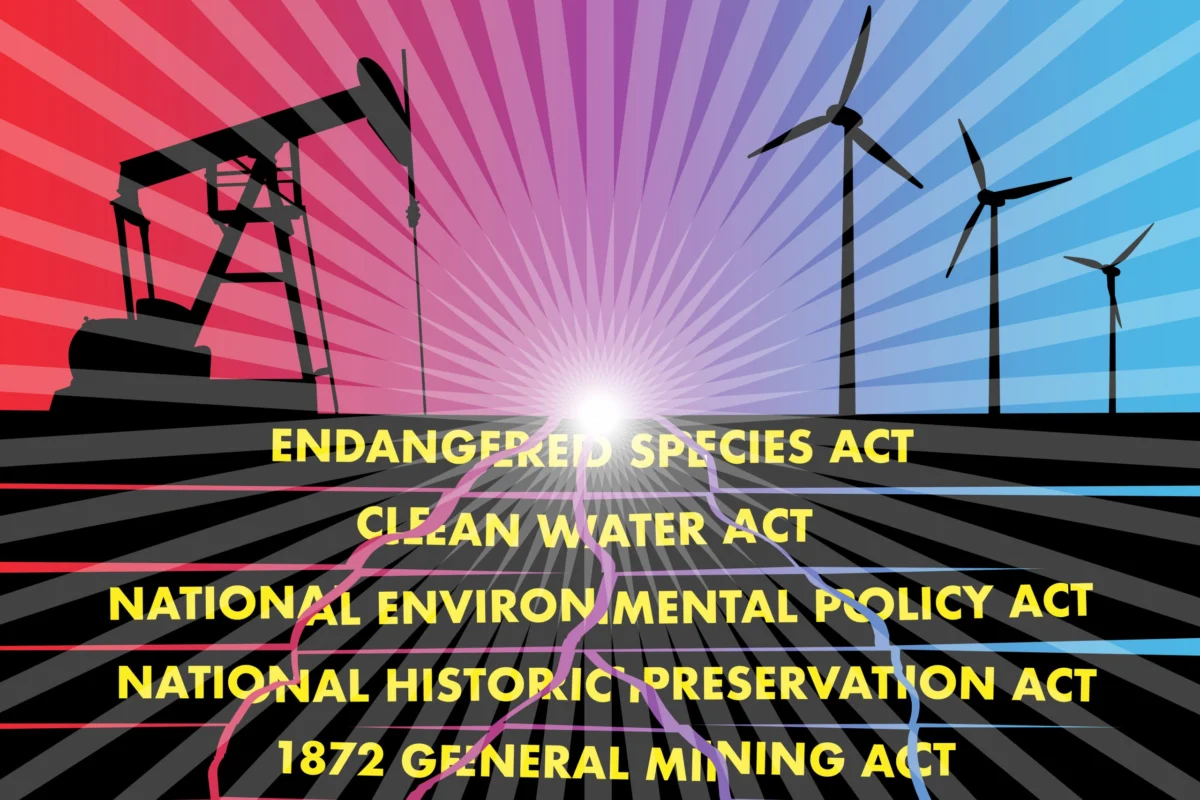
However, the consensus around expedited permitting quickly dissolved when scrutinizing the bill’s broader implications. What one faction perceives as "red tape" hindering progress, another views as indispensable "environmental safeguards." To achieve its ambitious goal of accelerating both clean energy and, crucially, fossil fuel projects, the Bipartisan American Affordability and Jobs Act proposes significant alterations to foundational environmental statutes. These bedrock laws, including the National Environmental Policy Act (NEPA), the Endangered Species Act (ESA), the Clean Water Act (CWA), and the National Historic Preservation Act (NHPA), were meticulously designed to protect human health and the environment, while also ensuring robust public participation in decisions affecting public lands and natural resources. The inclusion of fossil fuel projects within the bill’s scope, a key concession to secure Republican support, further intensified concerns among environmental groups.
A broad coalition of ecology-minded green organizations, the wider conservation community, Indigenous tribal nations, and progressive federal lawmakers issued stark warnings that "gutting" these crucial laws could lead to severe and irreversible consequences for vulnerable communities, pristine landscapes, and invaluable cultural sites. Erik Schlenker-Goodrich of the Western Environmental Law Center, for instance, publicly characterized the bill as a "turd grenade," reflecting the visceral opposition from many environmental advocates. Even the NRDC, while supporting certain transmission-related provisions, described the environmental weakening clauses as "deeply flawed" and pledged to actively work towards their amendment. As Congress reconvenes on November 9, the Senate Committee on Energy and Natural Resources is slated to begin its consideration of this contentious legislation, setting the stage for a critical debate over the future of environmental protection and infrastructure development in the United States.

The proposed legislation introduces several significant changes that could fundamentally alter the application and enforcement of major environmental laws. One of the most impactful targets is the National Environmental Policy Act (NEPA), enacted in 1970, which mandates that federal agencies rigorously assess the potential environmental impacts of significant federal actions through comprehensive Environmental Impact Statements (EISes) or less extensive Environmental Analyses (EAs). While NEPA stands as a cornerstone of American environmental law, it is also frequently cited as a primary cause of project delays. Currently, the median time required to complete an EIS and issue a final decision hovers around 4.5 years. Although the 2023 Fiscal Responsibility Act imposed a two-year limit for the EIS portion, it conspicuously omitted a timeline for the final decision itself. The current draft of the permitting reform bill seeks to dramatically accelerate federal authorization from all participating agencies, including the lead agency. For instance, under the proposed changes, the Bureau of Land Management would be compelled to issue a decision within a mere 45 days following the completion of an EIS for projects such as a solar farm or data center on its managed lands. This expedited timeline would drastically compress project schedules and significantly curtail the period allotted for post-EIS public input, potentially marginalizing community voices.
Beyond accelerating the initial review phase, the proposed legislation also severely restricts the avenues for legal challenges once a decision is rendered. It shortens the statute of limitations for lawsuits and significantly raises the bar for who possesses "standing" to bring a suit, effectively narrowing the pool of potential litigants. Even if a project were to navigate these more stringent conditions and proceed to court, the legislation stipulates that the court would be prohibited from pausing or halting construction. This means that a project could continue its development—and any associated environmental, human health, or cultural impacts could materialize—even while a lawsuit contesting its legality remains pending. Furthermore, should a court ultimately rule against the agency and find a violation of NEPA, it would merely remand the EIS or EA back to the agency for revisions, rather than vacating the approval. This provision implies that development could persist unabated, fundamentally stripping NEPA of its most potent enforcement mechanism: the ability of a court order to block a project, as noted by Michael B. Gerrard, an environmental law professor at Columbia Law School, who described these changes as "pull[ing] NEPA’s principal teeth." Moreover, numerous projects currently subject to NEPA review, including energy storage facilities built "at or near" transmission lines, as well as the replacement, upgrading, rebuilding, or modification of existing transmission or distribution lines, would be entirely exempted from its purview.
The Clean Water Act (CWA) also faces substantial revisions under the proposed bill. Section 401 of the CWA currently mandates that any pipeline, transmission line, or other infrastructure project impacting a body of water under federal jurisdiction must receive certification from the relevant states or tribal nations to ensure water quality protection. This authority has historically empowered states and tribes to block projects, such as the proposed Millennium coal export terminal in Washington, or to compel developers to reroute or redesign projects to mitigate their environmental impacts. The permitting reform legislation, however, would narrowly redefine the types of water-quality impacts that could trigger a state or tribal nation’s denial, effectively shifting the burden of proof from the developer to the state or tribe. Additionally, the bill curtails the timeframe within which the Environmental Protection Agency (EPA) can veto Clean Water Act permits issued by the Army Corps of Engineers for major projects. This EPA veto power was notably exercised in January 2023 to halt the controversial Pebble Mine project in Alaska. Shortening this critical timeframe could prevent future administrations from blocking projects that received approval under preceding ones, regardless of evolving environmental priorities or new scientific understanding.

Changes to the Endangered Species Act (ESA) are equally contentious. The permitting reform bill would severely hamper judicial review by imposing tighter timelines for lawsuits alleging ESA violations. Such lawsuits would be fast-tracked directly to the D.C. Circuit Court of Appeals, bypassing initial district court proceedings. This procedural shift would disadvantage plaintiffs by significantly reducing the time available for gathering evidence and preparing for trial, thereby diminishing their capacity to mount effective legal challenges. Concurrently, the Fish and Wildlife Service’s (FWS) consultation time limit under the ESA would be cut from 90 days to a mere 60 days, drastically truncating its crucial analysis of how a proposed project could impact imperiled species and their habitats. Furthermore, certain projects would be entirely exempted from federal ESA reviews, with the consultation process instead devolved to individual states. This devolution risks creating a patchwork of inconsistent protections across states, even for segments of the same project, and could gravely imperil endangered species in states with weaker environmental regulations or those less inclined to prioritize conservation.
Even the antiquated General Mining Law of 1872, which has long been criticized for allowing mining companies expansive access to public lands with minimal oversight, faces changes that would further benefit industry. In recent years, environmental advocates and courts have successfully challenged major mining projects by leveraging a provision in the law related to mill site mining claims, which limits the amount of public land that can be appropriated for storing waste materials. The permitting reform bill, however, would effectively dismantle this safeguard by allowing corporations to stake an unlimited number of mill sites. This change would open the door for mining operations to appropriate hundreds, or even thousands, of additional acres of public land specifically for waste disposal and storage, exacerbating the environmental footprint of mining activities.
The SunZia project, despite its eventual approval, vividly illustrates both the potential benefits and the inherent limitations of the existing permitting system, even before the proposed reforms. In New Mexico, the arduous NEPA process proved instrumental, enabling conservationists and state officials to successfully advocate for a rerouting of the transmission line. This modification skillfully avoided critical migratory bird flyways, a compromise that earned the project—and the permitting process itself—the endorsement of Audubon Southwest as a case study in effective collaboration. Yet, this success story stands in stark contrast to the situation in Arizona. There, Indigenous nations and conservation groups pleaded for SunZia to reroute the line away from the ecologically fragile and biodiverse San Pedro River Valley, a vital corridor for birds and other wildlife, and a landscape rich with culturally significant sites. Arizona regulators, however, largely disregarded these objections, demonstrating a greater amenability to such large-scale projects and a comparatively diminished responsiveness to environmental concerns than their New Mexican counterparts.

Consequently, when Arizona regulators unanimously approved the project in November 2022, they effectively removed any incentive for SunZia to replicate the rerouting efforts undertaken in New Mexico. The Bureau of Land Management’s preferred route continued to run alongside the San Pedro River, despite the vehement objections of tribal nations and conservationists. An ensuing lawsuit, though ongoing, has thus far failed to halt or even pause construction, underscoring that even under the current, supposedly more rigorous permitting regime, projects can advance in the face of significant environmental and cultural opposition. This scenario now casts a long shadow over another proposed development: the Desert Southwest natural gas pipeline. This project aims to transport methane from the Permian Basin to Arizona, cutting directly through the sensitive San Pedro River Valley north of Tucson. Under the existing permitting framework, this pipeline would be subject to rigorous NEPA and National Historic Preservation Act reviews, while tribes and states would retain more substantial authority under the Clean Water Act to protect their resources. However, if the Bipartisan American Affordability and Jobs Act becomes law, the Desert Southwest project, along with countless others, could be entirely exempted from these vital reviews, effectively removing critical protections for people and places across the nation. The outcome of this legislative debate will profoundly shape the future of environmental protection and infrastructure development, balancing the imperative for rapid energy transition with the enduring commitment to safeguarding natural and cultural heritage.