Roger Danuarta
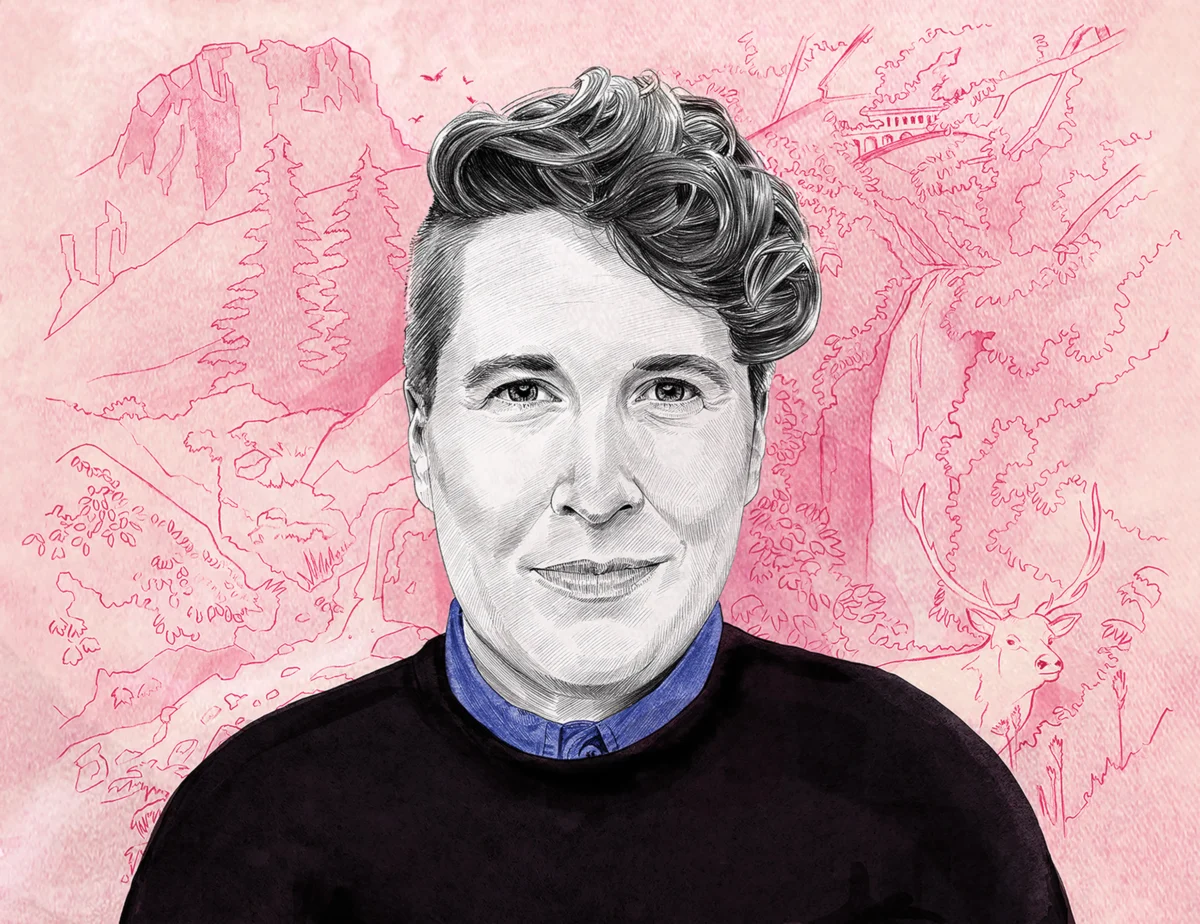
In a literary landscape often polarized between stark realism and escapist fantasy, Portland poet Aileen Keown Vaux masterfully navigates the nuanced terrain of human experience, offering a collection that juxtaposes the mundane with the profound, the lighthearted with the deeply bleak. Her latest work, "Sad Man Happy Hour," invites readers into a richly textured world where the sizzle of breakfast hashbrowns coexists with the chilling specter of nuclear proliferation, and the tender act of holding hands unfolds against the backdrop of a warming planet. This unapologetic collection, deeply rooted in the majestic yet volatile landscapes of the Pacific Northwest—from its roiling oceans and dusty high deserts to its dense, ancient forests—serves as a poignant meditation on the myriad "little deaths" that punctuate life. These range from the seemingly insignificant, like parents flushing a childhood goldfish down the drain, to the stark, natural encounters with mortality, such as children proudly displaying wild animal carcasses. Yet, even in the face of overwhelming global challenges—wildfires ravaging beloved landscapes, tsunamis threatening coastal communities, the isolating grip of pandemics, and the intimate pain of failed relationships—Keown Vaux’s poetic voice consistently offers a profound sense of hope, an unwavering quest for redemption, and a testament to a life truly lived. Her work resonates with an authenticity that compels trust, urging us, through its compelling rhythm and imagery, to persist, to keep trying, and to find meaning in a world constantly teetering on the edge of crisis.
The profound influence of the Pacific Northwest on Keown Vaux’s creative spirit is a cornerstone of "Sad Man Happy Hour." Having traversed various locales within the region before her family settled in Yakima, Washington, Keown Vaux reveals that this particular corner of the world became more than just a home; it transformed into a central preoccupation and the very genesis of her poetic journey. The initial section of her book, drawing inspiration from the idiosyncratic themes of the Central Washington State Fair, became the crucible in which she forged her distinctive writing voice—a unique tonal balance that seamlessly blends the sincere with the absurd. Her literary endeavor, she explains, is fundamentally about honoring and interrogating the very place from which she originates, seeking to understand its complex identity and how it has shaped her own.
This regional diversity, she argues, directly translates into her concept of "expansive writing," a stylistic approach that mirrors the vast and varied tapestry of the Pacific Northwest itself. The sheer scale and astonishing variety of the landscape—from the intricate networks of bays and the boundless expanse of the ocean to the whispering pine forests, the stark desert terrain of Yakima, and the rolling wheat fields stretching across Walla Walla and the Palouse—have instilled in her an appreciation for multiplicity, a principle she applies directly to her personal and artistic identity. Driving through the majestic Columbia Gorge, for instance, evokes a profound sense of geological time, a cataclysmic experience that sculpted this iconic feature through ancient floods and volcanic activity. This palpable sense of deep history and powerful natural forces provides a crucial anchor for her understanding of the world. After a period of disorientation living in the comparatively flat Midwest, Keown Vaux returned to the Pacific Northwest with a renewed clarity, realizing, "I need volcanoes to look at to understand where I’m at." This speaks to a primal connection to a landscape defined by its dynamic, often volatile, geological character, where the towering presence of dormant or active peaks like Mount St. Helens offers a constant, humbling reminder of nature’s raw power and humanity’s delicate position within it.
When delving into the nature of her poetic creations, Keown Vaux clarifies that her poems, while deeply personal, do not function as "persona poems" in the traditional sense of adopting a distinct human character or archetype. Instead, her process involves accessing "flashpoints of interest"—moments, images, or observations that ignite her curiosity—and then allowing her mind to follow its own intricate, often winding, "through-thread." This approach liberates her from the strictures of literal autobiography, leveraging one of poetry’s most "sneaky pleasures": the freedom to begin with a kernel of truth but not to remain slavishly faithful to it. She finds profound satisfaction in poetry’s inherent paradox: its rich tradition of structure and form, which simultaneously offers boundless opportunities for creative subversion and breakage. This creative tension allows her to contain multitudes within her verses, much like, as she whimsically puts it, "700 raccoons in a trenchcoat" or a "clown car"—a vibrant, unpredictable energy packed within a defined space.

A hallmark of Keown Vaux’s work is her strategic deployment of dark humor, a literary device she employs not merely for comic relief, but as a potent "Trojan horse" to deliver challenging and often uncomfortable truths. She understands that difficult topics are more readily accepted and processed when cushioned by a touch of the absurd or the genuinely funny. Her public readings, she notes, often adopt a jocular, lighthearted tone, which subtly disarms audiences, allowing the gravity of her themes to penetrate more deeply. She recounts an instance with her poem "Trust Fall," which features a co-worker flushing a child’s goldfish down the toilet—a seemingly cruel act that surprisingly elicited chuckles from the audience. Her initial reaction, "Oh, man, you guys are sick! This is not funny," quickly evolved into an affirmation that the humor had indeed served its intended purpose, making the underlying discomfort accessible.
For Keown Vaux, death is not a topic to be shied away from but an integral, "vital and vibrant" aspect of life itself. Her close observation of mortality, particularly in a region defined by its geological instability and wild natural cycles, informs much of her work. Living within sight of Mount St. Helens, she acknowledges a constant, visceral awareness of her own vulnerability: "I’m not in charge here. I could go at any second." This profound sense of precarity, rather than leading to despair, becomes an artistic imperative—a need to externalize these pervasive thoughts and to connect with others who might share similar existential anxieties. This artistic "tic" evolved into a conscious practice, informed by her understanding of the physiological role of laughter in survival. Drawing from studies on professionals in high-stress environments, such as morgue workers or alpine rescue teams, Keown Vaux highlights the importance of gallows humor and its impact on the vasovagal nervous system. This insight reinforces her conviction: "If I’m going to talk about death, it better be funny." It is a coping mechanism, a way to process the overwhelming, and ultimately, a path to resilience.
This unflinching engagement with mortality extends to her interactions with children, who often approach her with an intuitive sense that she is willing to truly listen. In her poem "Boa Constrictors are Addicted to Hugs," she recounts a memorable encounter where children, with their characteristic unvarnished curiosity, shared their fascinating, if somewhat morbid, observations. They eagerly asked, "Do you wanna tour everything dead in the yard?"—a request to which Keown Vaux enthusiastically responded. Exploring her friends’ wild backyard, they examined various deceased creatures. Far from being scary or upsetting, the experience was profoundly "fascinating," underscoring her belief that both children and adults possess a fundamental need to process the reality of death. She positions herself as someone unafraid to stand at that "precipice" with others, guiding them through the uncomfortable yet essential contemplation of life’s ultimate end.
Ultimately, "Sad Man Happy Hour" transcends mere observation, evolving into a nuanced guide for navigating what often feels like the precipice of global catastrophe. The book confronts a spectrum of tragedies, from the intensely personal to the globally encompassing, yet steadfastly maintains an attitude of defiant hope. Keown Vaux acknowledges the brutality of contemporary existence, but, as she eloquently writes in "Zero Gravity": "still, I plan; / a garden plot rented for the summer / where my seeds will grow." This simple, profound declaration encapsulates the book’s core philosophy: even as the world seemingly unravels, the human spirit’s capacity for planning, for creating, and for nurturing life persists. Her poems are replete with such poignant examples of continuing to live vibrantly despite overwhelming odds. In "Fair Fever, Catch It!," for instance, amidst the escalating anxieties of global warming, people engage in quintessentially human acts of creation and community—carving intricate butter sculptures and witnessing the birth of calves at a state fair. These acts are not presented as naive ignorance but as essential expressions of humanity, a refusal to succumb to despair. "We need a reminder," Keown Vaux asserts, "that we should not lose our humanity when we think we are losing our world." Her poetry serves as a vital testament to resilience, urging readers to find beauty, humor, and connection even as they confront the most challenging realities of their time.