Rocky Gerung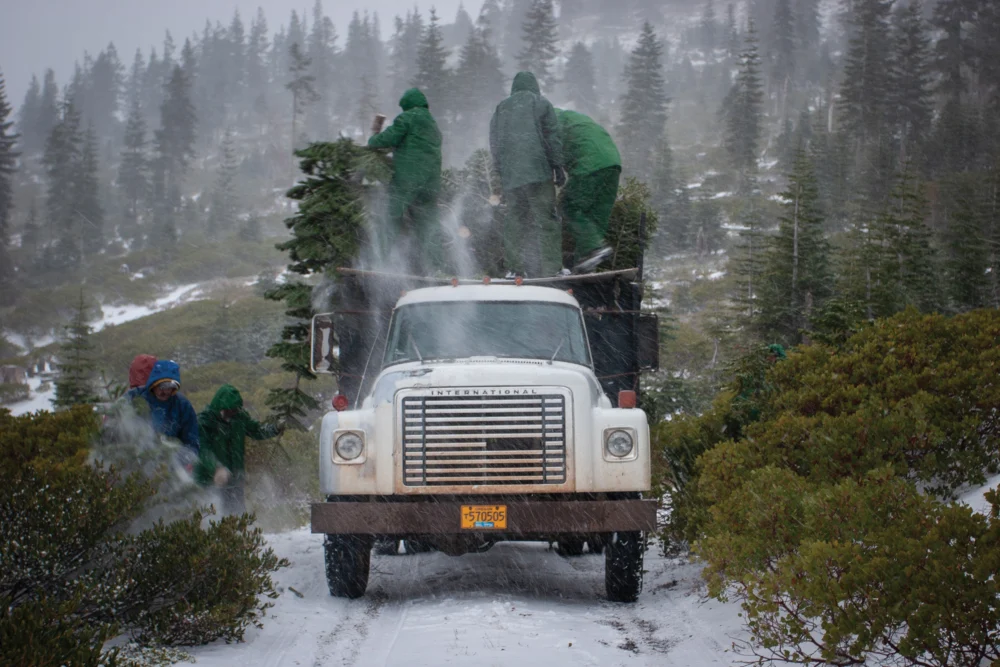
The season is unforgivingly short, often lasting a mere two to three weeks. “You only get a few weeks,” explains John Wayne Strauch, known affectionately as Bambi, a veteran wild Christmas tree harvester with five decades of experience. He holds timber rights on over 300 acres of Worley Mountain, a rugged expanse between Eagle Lake and Susanville, California. The success of the harvest hinges on precise environmental conditions. “If the ground doesn’t freeze, the needles won’t set,” Strauch notes, referring to the crucial process that ensures the needles remain vibrant long after cutting. “If it snows early, you’re done.” It’s a relentless race against the elements, a challenge that has defined his career and the lives of the crews he employs. Despite the precarious nature of the work, a sense of commitment persists. “Guys are barely breaking even… but we just keep doing it,” Strauch admits, a sentiment that underscores the deep-rooted connection many feel to this vanishing rural tradition.

Strauch’s own journey into this demanding profession began in the early 1970s alongside his godfather, Joe McNally. New to the business and seeking adventure, they learned through trial and error, facing the formidable challenges of impassable roads, sudden blizzards, and the constant threat of equipment failure. Each winter, they returned, driven by a shared desire to bring a piece of the wild, untamed forest into homes across the country. Today, Strauch’s operation relies heavily on a workforce of mostly migrant Mexican laborers who travel north each winter, often transitioning from agricultural work in orchards and vineyards. However, this year, like many in recent times, has brought new layers of uncertainty. According to Dan Barker, who assists in managing the harvest, shifts in immigration policies and heightened enforcement by Immigration and Customs Enforcement (ICE) raids have introduced significant anxieties for both the workers and the employers.

The harvesting process itself is a testament to skill and respect for the forest. A skilled cutter fells a towering 40-foot red fir with remarkable precision, employing wedge and relief cuts to guide the tree gently to the ground, thus preserving its branches. These cuts are strategically made above the tree’s base, leaving several whorls of branches intact. This practice, known as stump culturing or coppicing, is a cornerstone of sustainable harvesting. It allows the tree’s base to regenerate, with one of the remaining branches eventually adapting to become a new leader, growing towards the sun and developing into a harvestable tree within a few years. “We’re not clear-cutting,” Strauch emphasizes. “The better we take care of the trees, the better they take care of us. Some, we’ll get five, 10 harvests. Those are the mothers.” This method ensures a continuous yield from the same trees, forming a simple yet effective cycle of regeneration that has sustained these forests for decades, eliminating the need for replanting, tilling, or chemical treatments.

The operation on Worley Mountain typically involves two crews, comprising about 18 men in total. This core team includes essential roles such as a cook, drivers, cutters, and a bail operator, with the remaining members tasked with the physically demanding job of hauling trees from the deeper parts of the forest. They work with an efficient rotation, moving swiftly to slice and drag the silvertips down steep slopes. Once at a central point, the trees undergo a meticulous grading process, evaluated on their shape, symmetry, and color. They are categorized into grades such as 2s, 1s, primos, and double primos, with prices varying significantly according to these distinctions. For instance, an 8-to-9-foot red fir that achieves the highest grade, a double primo, might command around $250 at a retail lot, while a grade 2 of the same size would fetch approximately half that amount. This intricate system connects the remote high-country forests to living rooms hundreds of miles away.

The impact of climate change is an increasingly pressing concern for both the forest and those who depend on it. Extreme heat events, such as those experienced in May and June, have scorched thousands of young trees, hindering their growth before they could mature. These environmental shifts add another layer of unpredictability to an already challenging industry.

Strauch’s Worley Mountain operation yields approximately 7,000 trees annually, positioning it as one of the nation’s last remaining commercial wild Christmas tree harvests. While significantly smaller in scale compared to the vast operations of farmed Christmas tree plantations, its value lies in the unique attributes of the silvertip: its natural beauty, its sustainable harvesting method, and the profound connection between the land and the labor involved. “These are beautiful trees with a beautiful story,” says Barker, expressing a sentiment shared by many involved. “We don’t just want people to accept them – we want them to love them like we do.” This dedication to preserving a legacy, while navigating the complexities of modern challenges, defines the enduring spirit of the wild Christmas tree harvest. The freshly cut red firs, known for their exceptional needle retention that lasts well into March, are loaded onto trucks within days, marking the end of another brief, arduous season in the high country, and beginning their journey to spread holiday cheer across the West.