Roger Danuarta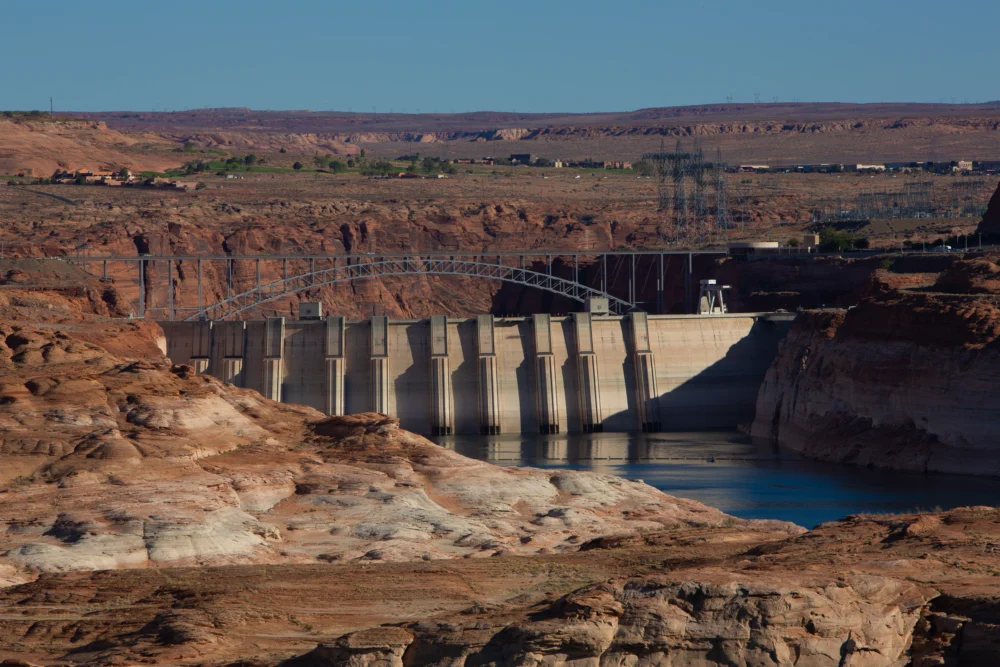
The majestic Colorado River, a lifeline for over 40 million people and a sprawling agricultural empire across seven U.S. states and Mexico, is confronting an existential threat as decades of over-allocation, persistent drought, and accelerating climate change push its vital reservoirs to critically low levels. At the heart of this unfolding catastrophe lies Glen Canyon Dam, a monumental structure completed in 1963 under the ambitious vision of then-Bureau of Reclamation Commissioner Floyd Dominy. While Dominy and his engineers, brimming with post-World War II confidence, could not have precisely foretold the current climate reality of dwindling snowpack, soaring temperatures, and relentlessly falling water levels in Lake Powell, the dam’s inflexible design left perilously little margin for error in the face of the water-supply crisis now gripping the entire basin.
For decades, the crisis has steadily escalated, even as the sovereign states and numerous Indigenous tribes holding claims to the river’s waters engage in fraught negotiations over how to divide its rapidly diminishing flows. The situation recently entered a new and perilous phase, underscored by a critical deadline on November 11 for the Basin states—California, Arizona, Nevada, Utah, New Mexico, Colorado, and Wyoming—to forge a new, consensual management plan. Failure to reach an agreement would trigger federal intervention, a prospect none of the parties welcomed. Crucially, the 30 federally recognized tribes with historical and legal rights to the river have largely been excluded from these pivotal discussions, perpetuating a historical injustice and complicating any comprehensive, equitable resolution.

Predictably, the November 11 deadline passed without consensus, prompting the federal government to punt the decision to February 14. This deferral surprised few; unmet deadlines and empty ultimatums have become business as usual along the Colorado. Despite decades of plunging reservoir levels and increasingly dire warnings from climate scientists about global warming and persistent drought conditions, concrete, permanent changes to water usage within the Colorado River Basin have remained largely elusive, often replaced by temporary conservation measures and considerable hand-wringing. This inertia persists even as the region’s population continues to swell, placing ever greater demands on a shrinking resource.
The fundamental flaw in the system dates back to the 1922 Colorado River Compact, the foundational agreement allocating the river’s water. This landmark compact was predicated on an overestimation of the river’s average annual flow, based on an unusually wet period. Consequently, the “paper water” allocated to the states—their legal entitlements—has always exceeded the river’s actual long-term supply, creating a structural deficit. For years, states managed this imbalance by drawing on vast surpluses banked in Lake Mead and Lake Powell during the exceptionally wet decades of the 1980s and 1990s. This savings account, however, has now been drained. Both Lake Mead and Lake Powell currently hover below 30% of their full capacity, with a disheartening downward trend that shows no signs of abating. Anthropogenic global warming has accelerated this decline dramatically; since the turn of the century, the river’s flow has plummeted by 20% compared to its long-term annual averages, with scientific models forecasting further reductions as the climate continues to warm. This megadrought, intensified by rising temperatures that increase evaporation and reduce snowpack efficiency, is pushing the entire basin towards a reckoning.
Beyond the hydrological crisis, the physical infrastructure underpinning Colorado River water management teeters on the brink of its own potentially catastrophic failure. While the Bureau of Reclamation has offered only oblique references to this looming threat in technical memoranda, the implications are profound. Glen Canyon Dam, a 710-foot-tall concrete arch structure, was engineered for a "Goldilocks world"—a paradigm where water levels would remain consistently ideal, neither too high nor too low. This design philosophy persisted despite the well-established fact that the Colorado is North America’s most variable river, notorious for its dramatic floods and prolonged droughts. The Bureau, perhaps swayed by Cold War-era confidence, downplayed these inherent threats. A stark reminder of this vulnerability occurred during the record-breaking El Niño winter of 1983, when the dam nearly succumbed to overtopping due to a combination of design flaws and mismanagement. Only the emergency installation of plywood sheets along its crest and a fortuitous cooling trend that slowed snowmelt prevented a catastrophic breach.

Today, the dam faces the opposite, equally perilous threat: too little water. In March 2023, Lake Powell’s surface elevation dropped to within a mere 30 feet of "minimum power pool" (3,490 feet above sea level). This critical threshold is 20 feet above the actual intakes, or penstocks, for the dam’s eight hydroelectric turbines. Reaching minimum power pool necessitates shutting down these turbines to prevent cavitation—a destructive phenomenon where air is drawn into the penstocks, forming explosive bubbles that can cause severe damage and lead to massive internal structural failure within the dam’s power generation system. The loss of hydropower from Glen Canyon Dam would not only eliminate a significant source of renewable energy for millions but also destabilize the Western power grid, forcing reliance on more carbon-intensive alternatives.
Even more alarming is the operational challenge that would emerge if the penstocks were to close. The only remaining conduits for releasing water downstream would be the river outlet works (ROWs): two intakes situated in the dam’s rear face, feeding four 96-inch-diameter steel pipes with a combined maximum discharge capacity of 15,000 cubic feet per second. However, the ROWs, also known as bypass tubes, suffer from a critical design flaw: they are not safe for extended use, particularly when the reservoir is low, as they are prone to erosion and cavitation. Indeed, during a high-flow release into the Grand Canyon in 2023, conducted at low reservoir levels, damaging cavitation was observed within the ROWs. The Bureau of Reclamation itself has warned that prolonged reliance on these tubes would almost certainly lead to further, potentially crippling, cavitation. In a worst-case scenario, this could mean that safe downstream releases would be a mere fraction of their stated capacity, or even necessitate a complete cessation of flows.
Such an outcome would have devastating consequences, compromising the dam’s legal obligations to deliver water downstream to the 25 million people who depend on it—including major metropolitan areas like Phoenix, Las Vegas, and Los Angeles—as well as the multi-billion-dollar agricultural industry that sustains regional and national food supplies. In essence, Lake Powell, and by extension the entire meticulously interconnected Colorado River system, stands perilously close to operational failure.

The ultimate grim prospect is "dead pool," which would occur if reservoir levels drop to the ROWs’ elevation of 3,370 feet above sea level. At this point, water would only pass through the dam if the river’s inflow exceeded the immense amount lost to evaporation from the remaining reservoir surface. Critically, no other intakes or spillways exist below the ROWs. There is no “drain plug” for the significant volume of water—approximately 1.7 million acre-feet—that would be trapped below this level, effectively reverting to the old riverbed. This substantial impoundment would become stagnant, heating under the desert sun, highly susceptible to toxic algal blooms and deadly anoxia. Furthermore, the "martini-glass" shape of Lake Powell’s vertical cross-section means that at these low levels, the lake’s surface elevation would fluctuate wildly, potentially by as much as 100 feet in a single season, further destabilizing the ecosystem and rendering any remaining access points unusable.
The implications of insufficient or entirely absent flows through Glen Canyon Dam would trigger a disaster of unprecedented magnitude. It would ripple through vast population centers, disrupt some of the largest economies in the world, and irrevocably alter ecosystems stretching all the way to the Gulf of California in Mexico, where the river’s delta, already severely degraded, would face final collapse. Recognizing the gravity of this impending crisis, the Lower Basin states of California, Arizona, and Nevada recently dispatched a letter to Interior Secretary Doug Burgum, asserting that Reclamation’s conspicuous failure to address the dam’s critical plumbing problems in its current environmental impact statement for post-2026 operations constitutes a violation of federal law. Their letter explicitly stated, “Addressing the infrastructure limitations may be the one long-term measure that would best achieve operation and management improvements to the Glen Canyon Dam.” To date, the Bureau of Reclamation has offered no formal response to these urgent concerns.
One inescapable conclusion emerges: Glen Canyon Dam fundamentally requires modification to fulfill its legal and operational mandates in a climate-altered world. Any such re-engineering must also prioritize the health of the ecosystems both above the dam in Glen Canyon and below it in the Grand Canyon, which have been profoundly impacted by altered flow regimes and the cessation of natural sediment transport. The most effective strategy to avert operational failure and the ensuing economic and ecological devastation is to re-engineer the dam to allow the Colorado River to flow through or around it at river level, thus restoring its natural sediment load to the Grand Canyon and partially dewatering Lake Powell.

Intriguingly, the very architect of Glen Canyon Dam, Floyd Dominy, inadvertently provided a potential blueprint for such a solution. In 1997, the former commissioner famously sketched on a cocktail napkin a simple yet elegant plan: new bypass tunnels could be drilled through the soft sandstone flanking the dam, equipped with waterproof valves to control both water flow and the vital transport of sediment. This vision, which Dominy signed and entrusted to Richard Ingebretsen, founder of the Glen Canyon Institute, is effectively a radical prescription—a "full bypass" surgery for the Colorado River, now on life support.
However, the window for action to prevent the catastrophic descent into dead pool is dauntingly narrow and closing rapidly, particularly given the substantial time required for governmental agencies to study, design, fund, and implement such a monumental engineering undertaking. The erosion of federal agency expertise and capacity over recent years further compounds this urgency. Whatever decisions, or lack thereof, may emerge from the February 14 discussions, the federal government and the Basin states must transcend their long-standing water wars. They must instead embrace innovative, collaborative, and bold solutions to construct a lasting, sustainable future for the Colorado River and the diverse communities and ecosystems that depend on its life-giving waters, recognizing that this regional crisis holds lessons for river basins globally grappling with similar pressures.