Rocky Gerung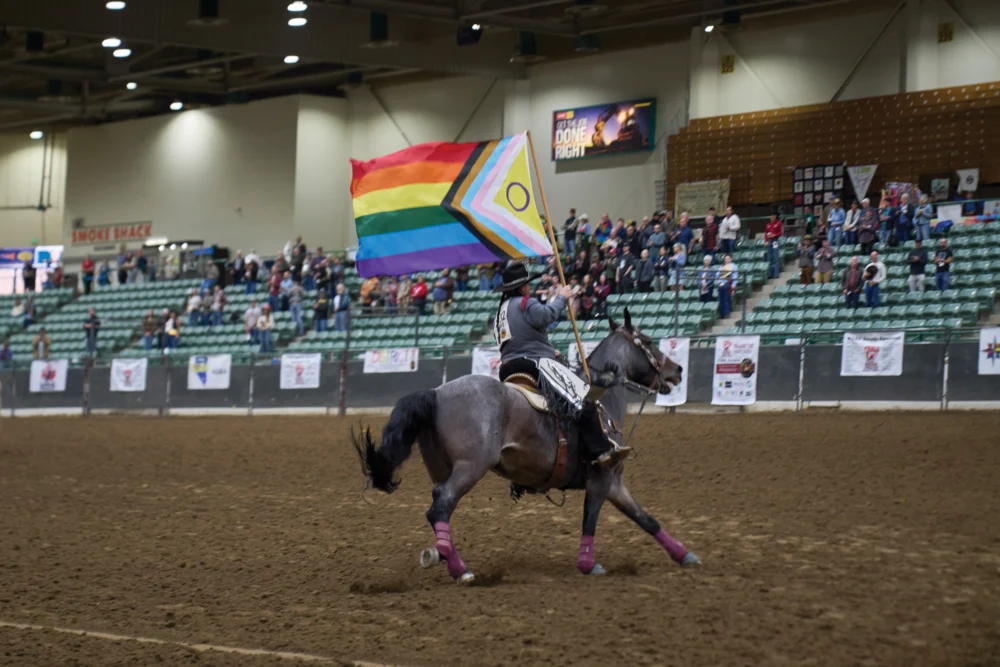
Fifty miles east of Reno, Nevada, on the dusty outskirts of Fallon, John King stood at the edge of a highway, his gaze fixed on a distant ranch. It was the same ranch that, 37 years prior, had become the site of a profound injustice: the denial of entry to contestants and organizers of the 1988 Gay Rodeo Finals. Sheriff Bill Lawry, citing an injunction, had personally blocked their access, his shotgun a stark symbol of the palpable animosity. "It was the first time I’d seen raw, undeniable hate," King recounted, recalling the tense hours where protestors and rodeo participants faced off, met with threats of violence until participants were ultimately forced to load their horses and depart. King later described the incident as "our Stonewall," a pivotal moment that galvanized the International Gay Rodeo Association (IGRA).
The 1988 standoff in Fallon was the culmination of a protracted struggle between the IGRA and anti-gay activists who had successfully lobbied to prevent the Gay Rodeo Finals from being held in Reno, the city where gay rodeo was born. Forced to relocate to private land in Fallon, the event was again met with resistance, preventing its staging. While the finals were subsequently dispersed across multiple cities, the incident cast a long shadow over northern Nevada, leaving an indelible mark on the community.
This past October, coinciding with the 50th anniversary of the first Gay Rodeo, the finals returned to Reno, marking a significant homecoming. A few days prior to the main event, attendees embarked on a poignant bus tour to Fallon, visiting the very site of the 1988 confrontation. Among them was Andy Siekkinen, the rodeo’s press representative and a competitor, whose tall stature and distinctive handlebar mustache were as much a part of the rodeo’s image as his commitment to the sport. He stood with IGRA President Brian Helander, who, in a gesture of reconciliation and forward momentum, extended his hand for a handshake. "We’re not out here in anger," Helander stated, emphasizing the event’s purpose: "It’s about understanding… and closure." Siekkinen, with a subtle smile, added, "And triumph," a sentiment Helander readily echoed, proclaiming, "We’re still here."

On the roadside opposite the ranch gate, organizer Brian Rodgers unfurled a poster-sized printout of the injunction that had thwarted the 1988 rodeo. A gathering of approximately 50 individuals joined him in a resonant chant: "We remember, we honor, we continue." Rodgers then proceeded to roll up the symbol of past bigotry and pain, sealing it shut with rainbow-print duct tape, an act signifying the closure of that painful chapter. As the group re-boarded the bus, refreshments were distributed, and Rodgers offered a toast, "Thanks to everybody who came. Drink your beers. Let’s rodeo!" The air filled with the upbeat strains of the Georgia Satellites’ "Keep Your Hands to Yourself" as the bus departed for Reno.
Two days later, the Reno Livestock Events Center buzzed with anticipation as hundreds gathered for the start of the rodeo. The arena, beneath its high metal ceiling, echoed with excited conversations as the calf-roping on foot event commenced. Many attendees embraced Western attire, from classic blue jeans and snap-button shirts to more flamboyant ensembles featuring fringe, bolo ties, and elaborately stitched denim jackets. The distinct aromas of fresh arena dirt and horses mingled with the tempting scent of fried food and coffee from the concession stands.
Competitors in calf roping lined up near the chute, their lassos swinging with practiced ease as they awaited the opening of the gate. Murmur Tuckness, a seasoned rodeo veteran who had witnessed the 1988 standoff and competed in bull riding as early as 1981, demonstrated her skill by securing the fastest time in the women’s category, lassoing her calf in a near-instantaneous motion. The Grand Entry, a ceremonial parade, saw riders on horseback proudly carrying the Canadian, U.S., and Nevada state flags, joined by the vibrant inclusivity of the Pride flag. Rodeo royalty and representatives from various regional gay rodeo associations paraded with distinction.
Individual events were thoughtfully organized by gender, with self-identification guiding registration, a progressive approach that welcomed nonbinary and trans athletes to compete in their chosen categories. This inclusivity stands in contrast to many traditional sporting organizations, positioning gay rodeo as a leader in promoting trans participation. Notably, women were permitted to compete in bronc, steer, and bull riding, while roping events featured mixed-gender teams, fostering an environment of shared competition and camaraderie, with cisgender and straight individuals participating alongside the LGBTQ+ community.

The atmosphere behind the chutes, often characterized by steely resolve and nervous energy in traditional rodeos, was palpably different here. Instead of anxious glances, there were shared smiles, words of encouragement, and an infectious display of flamboyance and machismo. "It’s a level playing field," affirmed Mark Allen Smith, an athlete and rodeo royalty contestant in the nonbinary category, sporting a casual denim shirt and a neatly trimmed goatee. "I can walk out there with my rodeo partner Jen and compete on the same events." That day, Smith experienced the full spectrum of rodeo, including a formidable encounter with a spirited steer in the steer-decorating event, before heading to the Silver Legacy casino downtown for the second part of the Gay Rodeo: a Western dance competition and a royalty contest to crown the International Gay Rodeo Association’s Ms., Miss, Mr., Mx., and MsTer royalty.
The carpeted basement of the casino transformed into a vibrant hub, packed with a diverse crowd including burly men in cowboy hats, assertive cowgirls, drag queens, and individuals of all walks of life, all cheering enthusiastically for their friends on stage. Smith, making a striking entrance in full makeup, a brunette wig, a flowing skirt, and a black sash, ultimately claimed the title of Mx. International Gay Rodeo Association, a distinction they will hold for the coming year. As the clock struck midnight, the festivities continued with teams of line dancers, cloggers, and two-steppers filling the ballroom floor, dancing late into the night.
The genesis of gay rodeo dates back to 1976 in Reno, when Phil Ragsdale, a prominent figure in the local chapter of the Imperial Court System, a grassroots LGBTQ+ organization, organized the first event. His aim was to raise funds for the Senior Citizens Thanksgiving Feed, and in true Nevada fashion, he opted for a rodeo. What began with 125 attendees in 1976 blossomed into an event drawing 10,000 participants by 1980.
By 1988, the IGRA had established chapters nationwide, and the Gay Rodeo Finals were slated for the Lawlor Events Center at the University of Nevada, Reno. This was a period marked by the devastating AIDS crisis, which profoundly impacted the LGBTQ+ community, and a concurrent surge in conservative Christian activism that propagated harmful stereotypes about the disease. In Reno, local activists exerted pressure on politicians, leading to the university citing contractual issues as grounds to withdraw from hosting the event. Despite efforts by the ACLU to challenge this decision, the IGRA ultimately opted for an alternative venue: a private rodeo arena in Fallon.

However, the challenges persisted. District Court Judge Archie E. Blake issued an injunction, ostensibly because the private venue lacked proper permits for a rodeo, even though, according to Rodgers, it had previously hosted similar events without incident. This sequence of events effectively ended Reno’s claim as the home of the Gay Rodeo. The author, growing up in Reno, was largely unaware of this significant part of the city’s history, noting how it had been "wiped from the map." The city, in 1988, missed an opportunity to embrace and champion something unique and creative, ultimately driving away a vibrant community.
Reno, a city the author cherishes, can exhibit a self-destructive tendency, often succumbing to grand promises of wealth or influence, akin to a gambler betting the house on a long shot. This can lead to the overlooking or even undermining of its intrinsic, homegrown strengths in pursuit of elusive, distant opportunities.
On the final Sunday, the crisp air and sharp sunlight painted a quintessential Nevada landscape, a familiar comfort for those who have lived through its scorching summers. Gay rodeo shares many similarities with its traditional counterpart, but distinguishes itself with the addition of "camp events." Goat dressing, a crowd favorite, involves contestants racing to dress a goat in underwear, while steer decorating sees teams adorning a steer with ribbons.
The Wild Drag Race stands out as particularly chaotic and entertaining. Each team comprises one man, one woman, and one drag performer. The drag performer begins at a designated chalk line 70 feet from the chutes. A steer is released, and the other two team members work to guide it past the chalk line and halt its progress. Once stopped, the drag performer mounts the steer and must ride it back across the line to secure victory. This event is a source of immense amusement, often resulting in spectacular dismounts and teammates being dragged across the dirt while clinging to the rope.

During intermissions, attendees browsed the concourse, where booths offered Western wear, cowboy boots, tie-dyed apparel, and novelty items. One exhibit meticulously chronicled the history of Gay Rodeo, showcasing posters, plaques, medals, ropes, and photo albums that traced the sport’s evolution. Reflecting on the entire experience, the author envisioned an alternate reality where the annual Reno Gay Rodeo had become an integral part of the city’s identity—a celebrated and anticipated spectacle that stood as a testament against external judgment. Reno, a city known for its resilience, might still have an opportunity to reclaim this part of its heritage.
The rodeo concluded with a final bull ride, set to the energetic anthem "Turn Down For What" by Lil Jon. The rider successfully maintained their seat for the requisite six seconds. As the arena lights dimmed, announcers offered their thanks, and the classic strains of Roy Rogers and Dale Evans’ "Happy Trails" filled the air, signaling the end of the event. The stadium emptied into the twilight, while back inside, an organizer carefully placed the rolled-up injunction into a box, archiving it as a relic of the past.