Rocky Gerung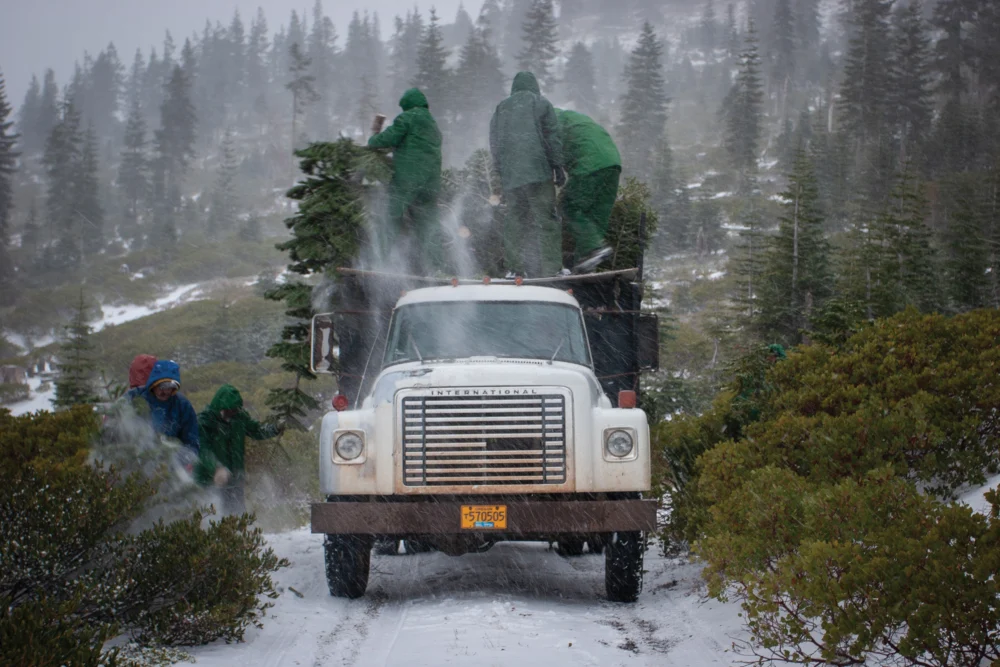
High on the volcanic slopes of Northern California’s Cascade Range, where the air grows crisp and thin, a critical harvest unfolds for a mere two to three weeks each year. Between the mid-October freeze and the first heavy snows of November, the resonant hum of chainsaws cuts through the dense, resin-scented air. In the dim morning light, crews work with a focused intensity, felling and preparing wild red firs, known scientifically as Abies magnifica and more commonly as silvertips for their distinctive, silver-tinged needles. These majestic trees, prized for their ideal conical shape and fragrant boughs, thrive at elevations between 6,500 and 8,000 feet. Their growth pattern, characterized by striking concentric branching, is shaped by the harsh environment they inhabit—prone to intense summer heat and deep winter freezes. This challenging climate, however, is precisely what allows the silvertips to develop the dense, full foliage that makes them sought after for Christmas trees across the nation.

"You only get a few weeks," explained John Wayne Strauch, a veteran wild Christmas tree harvester with five decades of experience. Known affectionately as "Bambi" by his colleagues, Strauch owns more than 300 acres of timber rights on Worley Mountain, situated between the expansive Eagle Lake and the town of Susanville, California. The arduous nature of this work is compounded by a narrow window of opportunity dictated by the weather. "If the ground doesn’t freeze, the needles won’t set," Strauch elaborated, referring to a crucial physiological process for the trees’ longevity after cutting. "If it snows early, you’re done." This inherent time constraint transforms the harvest into a relentless race against the elements, with crews battling the clock before winter’s inevitable snows seal off the mountain roads, forcing them to abandon their efforts. Despite the significant challenges, Strauch voiced a sentiment shared by many in this niche industry: "Guys are barely breaking even… but we just keep doing it."

Strauch’s own journey into this tradition began in the early 1970s, alongside his godfather, Joe McNally. Both were new to the business and seeking both adventure and a livelihood. Their early years were marked by a steep learning curve, filled with costly setbacks: hauling disabled trucks from snowdrifts, witnessing valuable harvests vanish under sudden storms, and enduring the biting cold that stiffened fingers and tested resolve. Yet, through these trials, they honed their skills, driven by a shared mission to bring a tangible piece of the wild forest into homes across the country for the holiday season.

Today, the operation relies heavily on a workforce composed primarily of migrant Mexican laborers who travel north each winter, many transitioning from seasonal work in orchards and vineyards. However, this year’s harvest is shadowed by a new layer of uncertainty. According to Dan Barker, who assists in overseeing the operation, significant shifts in immigration policies and the escalating risks associated with Immigration and Customs Enforcement (ICE) raids have introduced considerable anxiety and potential disruption for the workers and the overall efficiency of the harvest.

The harvesting process itself is a testament to a sustainable forestry practice known as coppicing, or more specifically, "stump culturing." This meticulous method involves making precise cuts above the base of the tree, leaving several whorls of branches intact. This approach allows the stump to regenerate, with one of the remaining branches eventually receiving hormonal signals to pivot towards the sun and grow into a new, future harvestable tree. "We’re not clear-cutting," Strauch emphasized, highlighting the ecological advantage of this technique. "The better we take care of the trees, the better they take care of us. Some, we’ll get five, 10 harvests. Those are the mothers." This regenerative cycle ensures the forest continues to produce without the need for replanting, tilling, or chemical treatments, maintaining a sustainable rhythm that has sustained these slopes for generations.

Strauch’s operation on Worley Mountain yields approximately 7,000 trees annually, positioning it as one of the nation’s last significant commercial wild Christmas tree harvests. While the scale is modest compared to the vast plantations dedicated to farmed Christmas trees, the value of wild silvertips lies in their inherent rarity, their demonstrably sustainable origin, and the deep, symbiotic relationship cultivated between the land and the labor force. "These are beautiful trees with a beautiful story," Barker remarked, underscoring the emotional and cultural significance of their work. "We don’t just want people to accept them—we want them to love them like we do." This sentiment encapsulates the passion and dedication that fuels this challenging, yet deeply rewarding, tradition.

The logistical effort involved in bringing these trees to market is substantial. Typically, two crews, totaling around 18 men, form the core of the operation. This team includes essential roles such as a cook, drivers, cutters, and a bail operator, with the remaining members focused on transporting trees from the deeper, more remote sections of the forest. They work with an agile, rotating system, efficiently felling and dragging the silvertips down steep ridgelines. Once at the collection points, the trees undergo a rigorous grading process. Each tree is meticulously assessed for its shape, symmetry, and color, categorized into grades such as "2s," "1s," "primos," and "double primos," with prices reflecting their quality. For instance, an 8-to-9-foot red fir designated as a "double primo" might command a retail price of around $250, while a "2" of the same size could fetch approximately half that amount. This detailed grading system is crucial for connecting the high-country forests to living rooms hundreds of miles away, ensuring each tree’s value is accurately represented.

The impact of climate change is also increasingly felt in this high-altitude ecosystem. Extreme early-season heatwaves, such as those experienced in May and June, have scorched thousands of young trees, hindering their growth before their needles could fully mature. This environmental instability adds another layer of unpredictability to an already precarious industry, where success hinges on a delicate balance of natural conditions and human effort.

The wild harvest is not merely an economic endeavor; it represents a cultural heritage, a connection to the land, and a testament to the resilience of both nature and the people who depend on it. As these carefully selected trees embark on their journey from remote mountain slopes to urban and suburban homes, they carry with them the spirit of the Cascade Range and the enduring legacy of a tradition that continues to thrive against the odds. The silvertips, known for their needle retention that can last well into March, are a symbol of this fleeting, yet cherished, annual ritual, marking the end of another short, demanding season in the wild heart of Northern California.