Rocky Gerung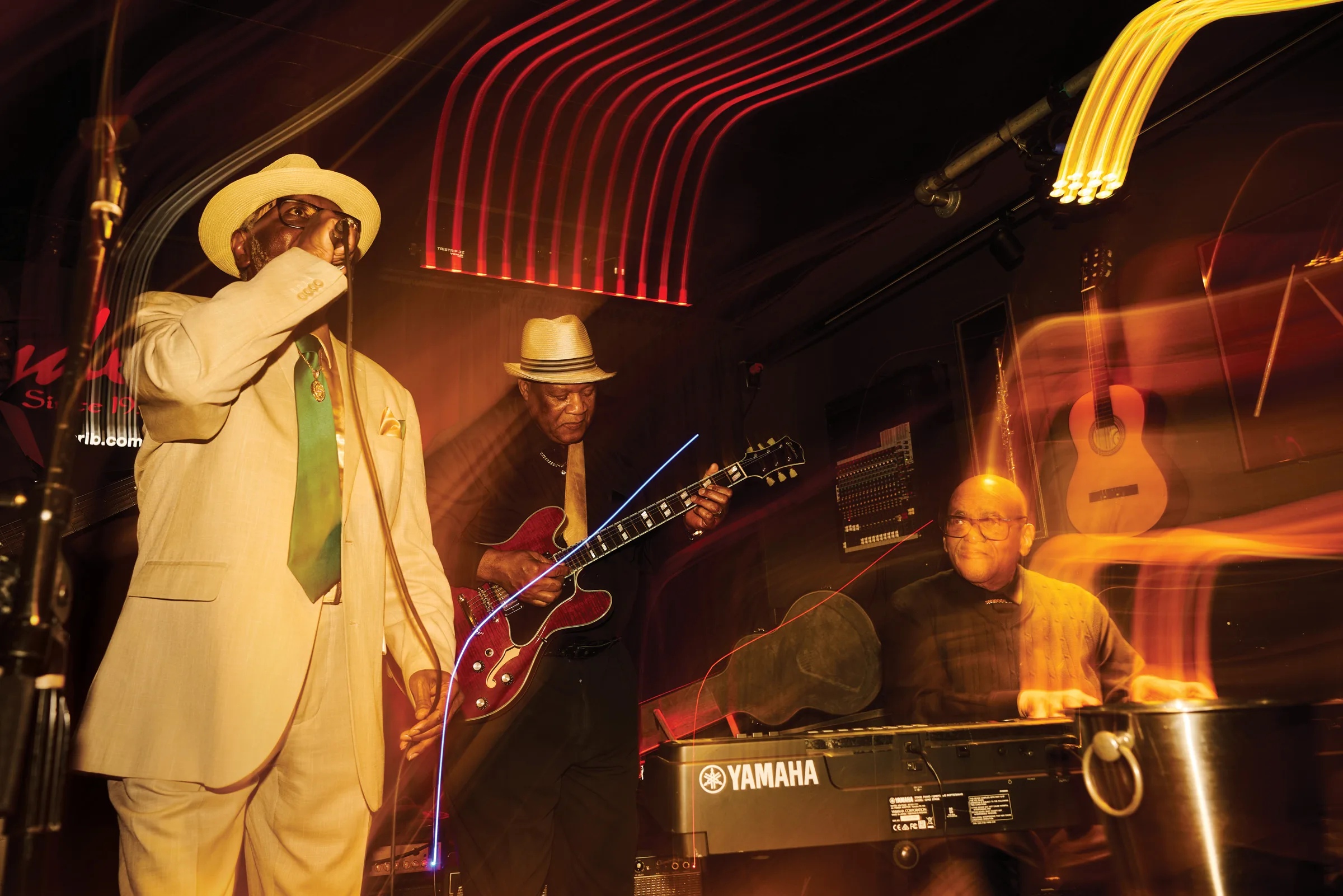
At the tender age of 12, long before he was known as "The Boogie Cat" or graced the stage alongside blues legend B.B. King, Norman Sylvester boarded a train in rural Louisiana, embarking on a journey westward to Portland, Oregon. His early life was steeped in the idyllic rhythms of the South: savoring wild muscadine grapes from his family’s farm, casting lines into bayou waters, and the comforting churn of butter at the kitchen table, all underscored by his grandmother’s resonant gospel hymns. When his father, seeking better employment opportunities, sent for him in Portland, Sylvester felt a profound sense of leaving paradise.

It was the autumn of 1957, a period when Oregon harbored a notorious reputation for its unwelcoming stance towards Black families. From 1844 to 1926, the state enacted a series of exclusionary laws designed to prevent Black individuals from settling within its borders. The Oregon Donation Land Act of 1850, for instance, generously granted up to 640 acres of free land to white settlers while explicitly prohibiting Black people from claiming any property. Oregon’s resistance extended to declining ratification of the 15th Amendment, and by 1917, the state’s Supreme Court had sanctioned racial discrimination in public accommodations. The pervasive influence of the Ku Klux Klan was evident, with Oregon hosting the largest chapter in the Western United States by the 1920s.
Despite this inhospitable climate, Black pioneers were among Oregon’s earliest settlers, diligently carving out lives and striving for equality amidst systemic hostilities. The Portland chapter of the NAACP, established in 1914, stands as the oldest continuously operating chapter west of the Mississippi River. However, the state’s anti-Black policies served as powerful deterrents; by the time Sylvester arrived, African Americans constituted less than 1% of Oregon’s population, and Portland’s Black community was the smallest among major West Coast cities. This stark contrast to his Southern upbringing deeply impacted Sylvester as he stepped off the train at Portland’s Union Station, facing profound culture shock.

Sylvester was set to begin seventh grade at his first integrated school, and a haircut was a pressing need. His first destination in this new city was a barbershop near the bustling intersection of North Williams Avenue and North Russell Street in North Portland. Upon arrival, he found the intersection alive with activity. A handsome brick building crowned with an onion-shaped cupola stood on one corner, while homes and businesses – a cafe, a drugstore, a produce market – lined the others. To his astonishment, he saw a scene reminiscent of the Louisiana he had left behind: "African American people – in charge of businesses, driving nice cars up and down the street, strutting their stuff." He would later compare this vibrant atmosphere to that of Harlem, but on that particular day, it simply reminded him of home. Despite the thousands of miles separating him from the muscadine vines on his grandmother’s fence, standing on that corner, Sylvester felt an immediate sense of belonging. Even the air seemed familiar, carrying the comforting scents of Southern cooking and the lively strains of gospel and jazz music. "The place just embraced me," Sylvester recalled recently. "Everybody was singing the same song, if you know what I mean."
This intersection was, in fact, the heart of a thriving neighborhood known as Albina. In the early 20th century, Black Portlanders, many of whom worked as railcar attendants, began to settle here due to its proximity to Union Station. Over the ensuing decades, landlord discrimination and institutionalized policies, such as a 1919 Portland Realty Board ruling that deemed it unethical to sell homes in white neighborhoods to non-white buyers, systematically excluded Black residents from other parts of the city, further concentrating the community in Albina. By 1940, over half of Portland’s Black population, then numbering just under 2,000 individuals, resided in Albina.

The onset of World War II brought a significant influx of over a hundred thousand newcomers to the city, including approximately 20,000 African Americans drawn by the booming shipbuilding industry. Among these migrants were Sylvester’s parents, aunt, and uncle, who settled in a defense housing development called Vanport. Constructed behind a railroad embankment in the floodplain of the Columbia River, Vanport was the largest wartime housing project in the nation. Roughly a quarter of its over 40,000 residents were African American, making it by far the largest Black community in Oregon.
Following the war, many residents began leaving Vanport. Sylvester’s mother returned to Louisiana, but his uncle secured employment at a local hospital, and the rest of the family decided to remain in the area, continuing to reside in Vanport due to racial restrictions in most other neighborhoods. It was there, on Memorial Day in 1948, that the Columbia River, swollen from spring rains and snowmelt, breached its embankment and inundated the burgeoning city. Within a mere 40 minutes, Vanport was submerged. The disaster claimed at least 15 lives and left more than 18,000 individuals, a third of them Black, homeless.

Sylvester’s family, like most African Americans displaced by the flood, found refuge in the only Portland neighborhood that welcomed them: Albina. By the time Sylvester settled in the city, four out of every five Black Portlanders lived in this district. While redlining, a lack of public investment, and negligent landlords sometimes resulted in overcrowded and dilapidated housing, the neighborhood itself was characterized by a strong sense of community and vibrant cultural life. Black-owned businesses, churches, and gathering spaces flourished. "Everything you needed in a community was right there," Sylvester recalled.
Central to this community, he noted, was music. And in Albina, during the decades following Sylvester’s arrival, music was abundant. Gospel choirs filled churches with soaring harmonies, while soul bands packed the Cotton Club, which had become the Pacific Northwest’s premier destination for soul music. Nearly every night, jazz, blues, and funk ensembles could be heard in the neighborhood’s numerous venues, including teen clubs and all-ages spaces. Bands frequently formed in basements, backyards, schoolrooms, and churches, a testament to the pervasive musical spirit.

When Sylvester was 13, his father, working two demanding jobs – the hospital by day and the foundry at night – saved enough to purchase him a guitar. It wasn’t the coveted shiny red electric he dreamed of, but an $11.95 pawnshop acoustic. His father promised that if Sylvester learned three songs, he would buy him the electric guitar. Finding music instruction in Albina was not difficult; Sylvester learned his initial guitar licks from an elderly Creole man who owned the house his family rented. Later, a fellow high school student mentored him in the blues. A quick study, Sylvester soon found that the guitar became a source of profound empowerment. As a shy country kid from the South, he often felt overwhelmed by Portland’s urban youth, and he struggled with a stutter. "But with my guitar in front of me, I could express myself," he explained.
Now 80 years old, Sylvester has continued to express himself through music ever since. His first band, Rated "X," was among Portland’s pioneering soul groups. They recorded a 45 single in 1972, and local success was building when a graveyard shift at the trucking company where Sylvester worked forced him to leave the band. He continued playing, however, and before long, he established himself as a distinguished blues musician. The Norman Sylvester Blues Band has now been performing for four decades. He has shared stages with musical giants like B.B. King, Buddy Guy, and Mavis Staples, and in 2011, he was honored with induction into the Oregon Music Hall of Fame.

Sylvester’s accomplishments are significant, yet he is far from the only remarkable musician to emerge from Albina. He is part of a broad and deeply interconnected community of Black musicians, educators, and arts advocates who converged in this neighborhood during the latter half of the 20th century, transforming the region into a vital hub for music in the West and forging a legacy that endures today. Until recently, however, the rich narrative of Albina’s musical history resided primarily within the memories—and often, the personal archives—of those who experienced it firsthand, a generation of artists now nearing the twilight of their lives.
By the time Bobby Smith moved to Albina in the early 2000s, the neighborhood bore little resemblance to the predominantly Black community of Sylvester’s youth. Smith, a young white schoolteacher who occasionally worked as a freelance music journalist, was aware of a vibrant jazz scene that had existed in Albina during the 1940s and 1950s, a period chronicled in Robert Dietsche’s 2005 book Jumptown. Yet, the public narrative of Black music in Portland seemed to abruptly end in 1957, leaving Smith to ponder: What happened next? As an avid record collector, Smith began searching for albums that might answer his question. For years, he scoured used record stores and consignment shops, but commercial recordings by Portland’s Black musicians from the 1960s, 1970s, and 1980s were remarkably scarce. One day, he discovered the 45 single Sylvester had recorded with Rated "X" in the early 1970s, one of the few records he could find from those decades. Simultaneously, he engaged with his neighbors, frequented local parks whenever he heard music, and spent time at Clyde’s Prime Rib, one of the city’s few venues that regularly featured elder Black performers.

In 2014, Smith began DJing for XRAY-FM, a newly established community radio station broadcasting from Albina. By then, he had amassed a modest collection of recordings from the region’s musical past and started inviting local musicians to the station to discuss them on air. One of his earliest guests was Calvin Walker, a drummer, bandleader, and self-proclaimed "child of Albina." Walker arrived for a scheduled 30-minute interview but ended up staying for three hours, sharing his life story and, in doing so, mapping out an entire ecosystem of musicians and educators who had shaped, and been shaped by, Albina. "If you’re really curious about this, here’s a list of people you need to start talking to," Walker told Smith, "And I’ll help you."
Soon, Smith’s weekly radio show transformed into a vital hub where elder Black musicians came to share their experiences. Despite the systemic barriers that had limited their access to the recording industry, Albina’s musicians had diligently documented their own work. A wealth of unreleased recordings survived in their possession: demos, reel-to-reels, cassettes, and VCR tapes. This ever-growing trove of music and memorabilia pouring into the station revealed an extraordinary legacy of Black arts and culture in Portland and an untold chapter of Oregon’s history.

In 2015, Walker, Smith, and Ken Berry—another prominent local musician and community leader—founded the Albina Music Trust (AMT) with an ambitious mission: to preserve thousands of obsolete and decaying media items and make them accessible to all. Elder engineers generously donated equipment and trained volunteers in the operation of archaic machinery. Each item was meticulously digitized and uploaded into a categorized database. After a decade of dedicated effort, in 2024, AMT publicly launched the Albina Community Archive, believed to be the only community archive in the United States specifically devoted to the restoration of a Black community’s music culture.
The online repository now houses over 13,000 items sourced from 180 contributors. The collection includes not only music—live recordings, out-of-circulation albums, and unreleased demos—but also film, newsprint, posters, handbills, and oral histories. This vast collection forms the backbone of the archive, functioning more like a seedbank than a traditional museum, providing safekeeping for historical artifacts that are then brought to life through projects extending far beyond the website. An art installation titled Wall to Wall Soul combines restored and recolored posters and photography into striking images that have been exhibited around the city and now hang permanently in the dining room of Clyde’s Prime Rib. Under a record label bearing the same name, AMT releases vinyl albums featuring never-before-heard music from Albina’s past, as well as new work from contemporary community artists. An audio tour, The Albina Soul Walk, guides listeners on a mile-long, music-infused journey through Albina, visiting the sites of former venues and gathering places while a chorus of musicians and club owners recount the neighborhood’s history. Listening to the tour feels akin to donning 3D glasses, bringing an unseen dimension into sharp focus. Even after removing the earbuds and being enveloped by the present-day sounds of the city—the rustling of maple leaves, the distant whir of cyclists—the voices from the tour lingered, imprinting a new perspective on the familiar landscape.

One morning last summer, I met with Smith, Walker, and Berry at AMT’s modest office in northeast Portland. The space, barely a few hundred square feet, felt akin to a walk-in closet, with shelves lined with neatly labeled boxes and audio equipment spanning various eras—turntables, reel-to-reel machines, cassette players, and CD drives—crammed under and atop desks. A grid of framed record sleeves adorned a lime-green wall, and the warm sounds of jazz drifted through the room. Settling into one of the four mismatched chairs arranged in this compact space felt more like joining a family around a cozy kitchen table than attending a board meeting. That day, I experienced something akin to Smith’s first encounter with Walker: I anticipated a one-hour conversation, but one story led to another, stretching well past lunchtime, compelling us to seek sustenance at a taqueria across the street where we indeed sat around a table and shared a meal together.
Ken Berry arrived in Oregon from Kansas in 1953 at the age of 4. His family settled in a house in southeast Portland near Laurelhurst Elementary, where he became the school’s first Black student. However, two years later, following complaints from anti-integration neighbors, their landlord demolished the house, and the Berry family relocated to Albina. There, he began playing piano during Sunday school at the New Hope Missionary Baptist Church, earning 75 cents a day. He joined the choir at Jefferson High, and after graduation, he started playing a Hammond B3 organ at what was then Albina’s most prominent jazz club, The Upstairs Lounge, where he met the late Thara Memory. Memory, a trumpeter from Florida who had played with artists like James Brown, was traveling with his band en route to Seattle when they stopped in Portland to perform at The Upstairs Lounge. However, Albina—with its grand trees and lively community—captivated him, and he remained after his band continued north. Memory and Berry later formed a group called Shades Of Brown, one of several collaborations that would profoundly shape Albina’s music culture for decades to come.

Around the same time, and not far from The Upstairs Lounge, Walker encountered Memory at another of Albina’s vital community hubs, the Albina Arts Center. As a teenager, Walker frequently performed there with his jazz-infused funk band, The Gangsters. "Thara comes in one night and says, ‘Can I play your trumpet?’" Walker recalled. He handed over the instrument and listened, utterly astounded. "I never played trumpet again!" Instead, Walker continued on drums, and Memory joined him on trumpet. In the summer of 1970, the American Legion held its annual convention in Portland. Seeking to divert potential war protesters from disrupting the event, the city organized the nation’s only state-sponsored rock concert: Vortex 1. The Gangsters were not officially invited to perform, but they loaded their gear onto the Albina Arts Center truck and drove to the festival, parking right up to the stage. When the manager informed them that all the bands had already been booked, Memory retorted, "But you don’t have any all-Black bands." Thirty minutes later, they were on stage. "We played for an hour and a half, and I think they even paid us!" Walker said, a grin spreading across his face.
Despite its significance, most retrospective accounts of Vortex 1, including a book and a television documentary, omitted this pivotal moment. When AMT inquired about the oversight, the explanation was simple: the researchers were unaware of the event. Like much of Albina’s history, this story was held within the community, not in formal institutions. "The public library and the Oregon Historical Society have existed for over a hundred years," Smith told me. "But in the 10 years we’ve been around, we’ve become the largest digital repository of Black arts and culture in the entire state of Oregon." Walker nodded in agreement. "People are putting their lives in our hands because they trust that their story will be told accurately," he stated.

AMT is part of a burgeoning nationwide network of community archives dedicated to preserving collective histories that have been excluded from mainstream repositories. Over 300 such archives have been mapped across the country, each documenting a distinct facet of American life, from LGBTQ+ experiences in the Deep South to the activism of radical Indigenous women and communities impacted by the death penalty. As control over historical narratives becomes an increasingly potent political tool—evidenced by the Trump administration’s critiques of the National Museum of African American History and Culture—community-based archives like AMT broaden the spectrum of voices authoring history, crafting a more nuanced and multifaceted narrative of America, less like a monologue and more like a harmonious choir.
In AMT’s compact office, Walker, Smith, and Berry seamlessly wove together the Trust’s narrative with an intimate rapport forged through years of shared dreams and problem-solving. Despite their differences in age and race, the palpable respect each held for the others was evident in the fluid exchange of conversation: one man recounting an anecdote, another clarifying the timeline, the third providing essential context. It was only later that I recognized the experience for what it truly was—akin to listening to a great band jam, each player contributing a distinct element without overshadowing the others, creating a collective whole far greater than the sum of its individual parts.

Before my departure, Berry handed me a copy of the YouthSound album and requested that I text him upon my safe arrival home. That evening, I placed the album on my turntable and perused the liner notes as a cascade of voices—dozens of children and adults, singing in unison in a high school auditorium four decades prior—filled my living room. "It was all about listening," one student recalled. "Anybody could put out a tune. But your tune gotta match the person standing next to you. This was about teamwork. We needed to sound as one."
Though their work often involves the literal preservation of the past, AMT’s ultimate focus lies firmly on the future. "In another 50 years, we don’t want a couple of guys like me and Ken sitting around talking about the good old days," Walker remarked. To that end, the Trust is actively partnering with Portland schools and nonprofits to expand access to arts education while forging connections between students and Albina’s rich Black music legacy.

Last June, I drove to the school district headquarters for "Rhythms of Tomorrow," one of 38 public events AMT hosted in 2025 alone. A collaboration between AMT and Portland Public Schools, it marked the first district-wide celebration of Black Music Month. On my way, I stopped for lunch on Mississippi Avenue, in the heart of historic Albina. There, I joined a throng of lunch-goers—predominantly white, many sporting Blundstone boots and fine-line tattoos, mostly in their thirties and forties—waiting in line for tacos. Nearby, a cafe advertised boba tea and handcrafted donuts, and a boutique nursery offered mounted ferns for $150 each. Yoga studios and brewpubs abounded.
Decades after city bulldozers tore through Albina, another wave of displacement impacted what remained of the neighborhood. In the 1990s, the area’s affordable housing began attracting white individuals priced out of other districts. The city commenced investing previously withheld resources into Albina, cracking down on predatory lending and housing abandonment. These changes primarily benefited middle-class white newcomers, and soon, gentrification pushed housing prices beyond the reach of many longtime residents. By 2000, less than a third of Black Portlanders lived in Albina, and for the first time since the 1960s, the area no longer had a Black majority. "A lot of folks are out in The Numbers now," Sylvester shared, referring to the far eastern reaches of Portland. "I used to cruise around in my 1974 Dodge Charger—it had a sunroof and an 8-track," he reminisced. "I could wave at 50 people, stop and talk to 30. Now, I can drive from my house in Kenton, all through Albina, and never wave once."

A mile south of Mississippi Avenue, the school district headquarters stands on a sprawling 10.5-acre campus. One of the "urban renewal" projects that displaced residents in the 1960s, it is a drab industrial building, brick-pink and resembling a parking garage. Yet, on the day of my visit, the building’s utilitarian exterior stood in stark contrast to the vibrant scene within. Children darted around, enjoying watermelon slices and salami from a long table laden with snacks. Adults exchanged warm hugs and handshakes. A DJ, positioned behind a spread of turntables and mixers, caught the eyes of many 11-year-olds, filling the room with buoyant tracks.
Norman Sylvester opened the event, the first in a lineup of musicians and speakers spanning genres and generations, from blues to hip-hop, high school students to seasoned elders. He stepped onto the stage, his guitar held less like an object and more like an extension of his very being. Though Sylvester has explored various musical genres throughout his career, his roots remain firmly planted in the blues. When asked what drew him to this music, he offered, "I can only imagine a man like Muddy Waters or Son House, plowing a field, driving a tractor all day, and still being able to play a guitar and sing at that quality. Where did that come from?" Before I could venture a guess, he provided his own answer: "From the dedication they had to doing something better. Those journeys just mean something to me, so I want to keep that going."

Listening to him play that afternoon, bending notes into riffs that were equal parts aching and sweet, I reflected on his words and their profound implication: a song is not merely an artifact to be archived, but a form of archive in itself. Here, preserved within melody and lyric, rhythm and pitch, a record of life is stored for future access.
Before the summer concluded, I attended another AMT event: the latest performance of TimeSound, Albina’s historic concert series, recently revived by AMT after a three-decade hiatus. It was part of the grand reopening celebration for the expanded Albina Library. Located on Russell Street, the library sits just a block east of the intersection where Norman Sylvester found himself on that autumn day in 1957, a young boy seeking a haircut. Before the show, I walked over to the crossing.

There, the afternoon sun pooled on the asphalt, bisected by the shade of street trees. Cars passed by. A woman carried a toddler down the sidewalk. I imagined Sylvester standing there all those years ago. If that 12-year-old boy were to return today, I wondered, would he recognize anything? Apartments occupied two corners, and a commercial complex on the third housed the Urban League of Portland, a civil rights nonprofit. On the fourth corner, where the brick building with the onion-shaped cupola once stood, a chain-link fence enclosed a rectangle of bare land.
This space had remained vacant since its demolition in the 1970s. Now, half a century later, that is finally changing. Last February, a collaboration guided by a Black-led nonprofit, the Williams and Russell CDC, broke ground on a residential and commercial development that will prioritize access for individuals with generational ties to the neighborhood. The city of Portland—which, last June, agreed to a settlement that will pay $8.5 million to 26 descendants of displaced Black families—is among the project’s partners. The development is funded in part by the 1803 Fund, an organization that invests in Black Portland and has supported several restorative development efforts underway in Albina. The 1803 Fund also supports AMT’s work because, as Juma Sei, the organization’s community partnership manager, explained, "You can have a bunch of buildings, but it doesn’t matter if there isn’t a culture to put people into those buildings."

Sei first encountered AMT shortly after his return to Portland in 2024. He had grown up in the area, but his parents immigrated from Sierra Leone, leaving him without deep generational connections to Portland’s Black community. Seeking to better understand local Black history, he began researching archives and discovered AMT. He was astonished. Sei had lived in Atlanta, Washington D.C., and Detroit, all cities renowned for their Black culture. "Portland isn’t on that list," he remarked. "But here was this living, breathing thing—the largest archive of its kind in the U.S.—right here in Portland. To me, it was a treasure trove."
Demographically, Sei noted, Albina is no longer the epicenter of Black life in Portland. Most Black Portlanders now reside farther east or outside the city limits. At the library celebration events held thus far—featuring puppet theatre and 3D printing demonstrations—Sei observed a conspicuous lack of Black attendees. However, at the TimeSound concert, the scene was markedly different.

In a spacious meeting room, a dreamlike mural backlit a stage, and glass doors opened to a courtyard where people stood in the sun, enjoying complimentary horchata oat-milk popsicles. The space was flooded with light and filled to near capacity with a predominantly Black audience, though many others were present, creating a crowd that spanned generations: seniors, individuals in their forties, and infants in arms.
Calvin Walker was the first to approach the microphone. "Is this not a miracle?" he asked. "To have this beautiful facility, the second-largest library in Portland, right here?" The room erupted in applause. "There was a time when nobody wanted to live in Albina," he continued. "After Vanport, this is where we landed, and we made it vibrant. Now, it’s going to come back, and it’s going to come back with all of us."

The concert was directed by Arietta Ward, who, in the TimeSound tradition, led an intergenerational ensemble performing works by Albina’s Black composers. When Berry invited her to direct, Ward experienced a degree of trepidation. "It’s hard not to get imposter syndrome. These musicians are my heroes, my teachers. They’ll always be legendary to me." But on stage that afternoon, any trace of her worries was eclipsed by her profound admiration for Albina’s musicians—past and present. To showcase the community’s female artists, she had curated a set composed primarily by women, opening with a song by her mother. The crowd fell silent. Some, like myself, had never heard this particular composition before. Others had listened to it countless times, perhaps even performed it themselves. For them, the song likely unlocked a treasure chest of memories, evoking cherished people and places from years gone by. The courtyard doors remained open, and I wondered: If a young boy were standing on the corner of Williams and Russell at that very moment, might he catch a melodic riff drifting on the wind?
Near the concert’s conclusion, Ward invited Berry onstage to sing. He approached the microphone, shaking his head with a mixture of mystified delight and emotion. "I was just having a flashback," he said, describing an evening approximately 35 years prior. He had been on stage at another Portland library, performing in a community concert. Ward and her sister Nafisaria were present, then mere children. "Arietta was right here," he stated, gesturing to his ribs to indicate her height at the time. As he looked up, his eyes welled with tears, yet a smile graced his face. "It’s just so good to see that we are still whole when there’s been so much to break us apart." He began to say more, then turned to the band, signaled them to begin, and allowed the music to speak for itself.