Rocky Gerung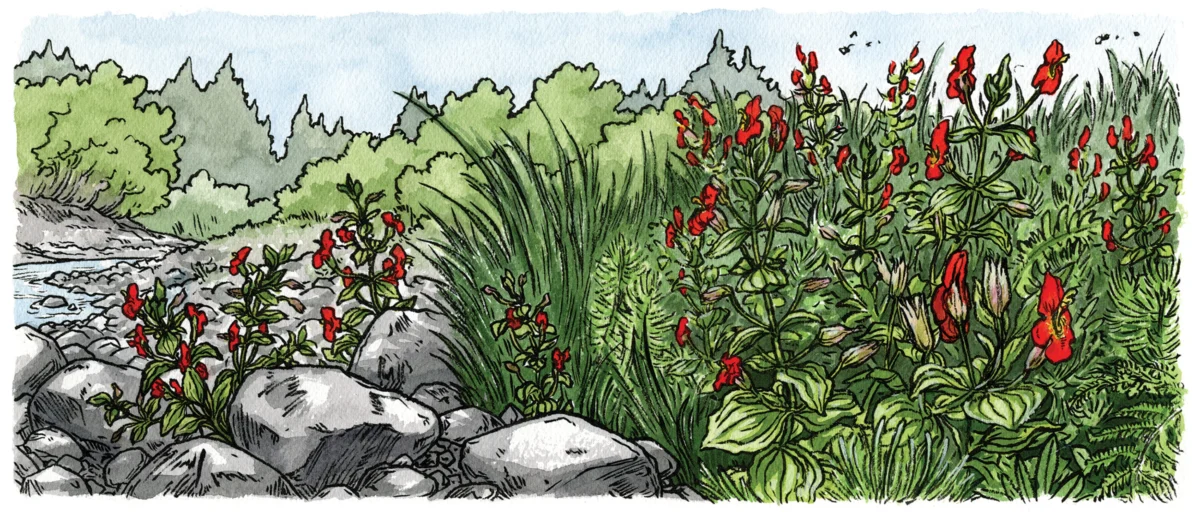
Throughout the summer months, along riparian corridors stretching from the Pacific Northwest down to Northern Mexico, a vibrant display unfolds as hummingbirds flit between the distinctive, face-shaped red blossoms of the scarlet monkeyflower (Mimulus cardinalis). These flowers have, over evolutionary time, become exquisitely adapted to their avian pollinators. As autumn arrives, these same blooms transform into elongated brown capsules, each holding thousands of minuscule seeds. It is these seeds, carrying a wealth of genetic information, that now capture the attention of scientists who, much like the hummingbirds, are keenly observing these plants. This genetic material has become an invaluable resource for understanding evolutionary processes and predicting how changing global climates will reshape Western ecosystems.
A significant breakthrough in this field emerged earlier this year with the publication of a seminal paper by a research team led by Dr. Amy Angert, an ecologist at the University of British Columbia. Their work provides the first definitive evidence that certain plant species can evolve rapidly enough in natural settings to counteract the detrimental impacts of climate change. This discovery builds upon a series of prior findings concerning the scarlet monkeyflower, illuminating how pollinators drive speciation, how a plant’s capacity for evolution can differ across its geographical distribution, and how a unique form of intergenerational plasticity, sometimes termed "floral stress memory," can facilitate adaptation to climatic shifts even in the absence of new genetic mutations.

It is highly probable that this remarkable species will continue to yield significant scientific insights, and Dr. Angert’s laboratory is already leveraging monkeyflower models to develop predictive tools. These models aim to assess the adaptability of other species to escalating environmental pressures such as drought, extreme heat, and wildfires. Dr. Angert’s ultimate goal is to equip conservationists with the knowledge to prioritize their efforts, identifying which species or populations require immediate intervention, and which, like many of the monkeyflowers she studies, possess an intrinsic resilience, capable of "holding themselves up by their own bootstraps."
From Streambank to Laboratory: A Decade of Discovery
Since 2010, Dr. Angert and her research team have undertaken annual expeditions to dozens, and sometimes hundreds, of scarlet monkeyflower habitats. During these visits, they meticulously record observations and collect seeds to transport back to their laboratory for controlled experimentation. Through a series of carefully designed studies, her team has effectively "resurrected" multiple generations of seeds within the same greenhouse environment. These experiments have demonstrated a clear evolutionary response: lineages subjected to drought conditions over successive generations developed traits conferring drought tolerance, including modifications in leaf thickness and altered blooming phenology.

The scarlet monkeyflower is characterized by its fuzzy leaves, which secrete a sticky resin that emits a distinct aroma. Dr. Angert describes this scent as "a little sweet, a little pungent," adding that upon smelling it, she is "immediately transported." These perennial plants typically establish themselves in the rocky crevices adjacent to streambanks and creeks, thriving in locations where water flow is neither so rapid as to dislodge them nor so slow that it allows competitive meadow grasses to dominate. Scarlet monkeyflowers bloom in an array of delicate flowers atop stems that can vary in height from a modest six inches in arid, challenging environments to as much as three feet in more mesic habitats.
A Supermodel for Scientific Inquiry
Within the realm of evolutionary biology, monkeyflowers have emerged as crucial "model species," offering profound insights that extend to a vast array of other organisms. Their utility in scientific research stems from several key factors: they have been subjects of study for an extended period, dating back to the early 19th century; they possess a relatively short life cycle and are amenable to cultivation in laboratory settings; and they produce a prolific number of seeds, often exceeding 2,000 per capsule, which greatly facilitates efficient collection and experimental manipulation. Historically, their relatively small genome size also contributed to their ease of study, though this factor is becoming less critical as advancements in gene sequencing technology and computational bioinformatics continue to reduce costs and enhance analytical capabilities.

A Climate Toolkit for Conservation
Research emanating from Dr. Angert’s laboratory has revealed a significant disparity in adaptive genetic variation between southern and northern populations of the scarlet monkeyflower. Specifically, southern populations exhibit greater genetic diversity, enabling them to evolve more rapidly in response to environmental stressors compared to their northern counterparts. This finding underscores a critical challenge for conservation efforts: generalizations made from studying a limited number of populations cannot be reliably applied across an entire species’ range.
A substantial number of plant species possess what is known as "stress memory." This phenomenon involves the transmission of epigenetic markers—compounds or modifications that alter gene expression without changing the underlying DNA sequence—from grandparents to parents and subsequently to offspring. This ability to adapt to environmental challenges through non-genetic means may also exhibit geographical variation within a species. Dr. Angert’s team posits that even populations lacking the genetic capacity for rapid evolutionary adaptation might still leverage this "stress memory" mechanism to adjust to a changing climate.

The House Special: Pollinator Specialization
The scarlet monkeyflower’s vibrant red coloration, tube-like structure, abundant nectar production, and precisely positioned long stamens are all adaptations designed to attract hummingbirds. These floral features ensure that as a hummingbird forages for nectar, its forehead makes contact with the stamen, effectively collecting pollen. A closely related species, Lewis’s monkeyflower (Mimulus lewisii), has evolved a different set of specializations tailored for bumblebees. Its pink blossoms produce less nectar, and its broader petals provide a convenient landing platform for bumblebees as they collect pollen. While these two species share overlapping geographical ranges and possess the capacity to hybridize, they rarely do so, a phenomenon largely attributed to the distinct preferences of their respective pollinators. Evolutionary biologists have demonstrated that the divergence in floral morphology between these species is linked to changes in just a few key regions of their genomes, suggesting that adaptation to a new pollinator can occur relatively rapidly on an evolutionary timescale, spanning millennia.