Rocky Georgio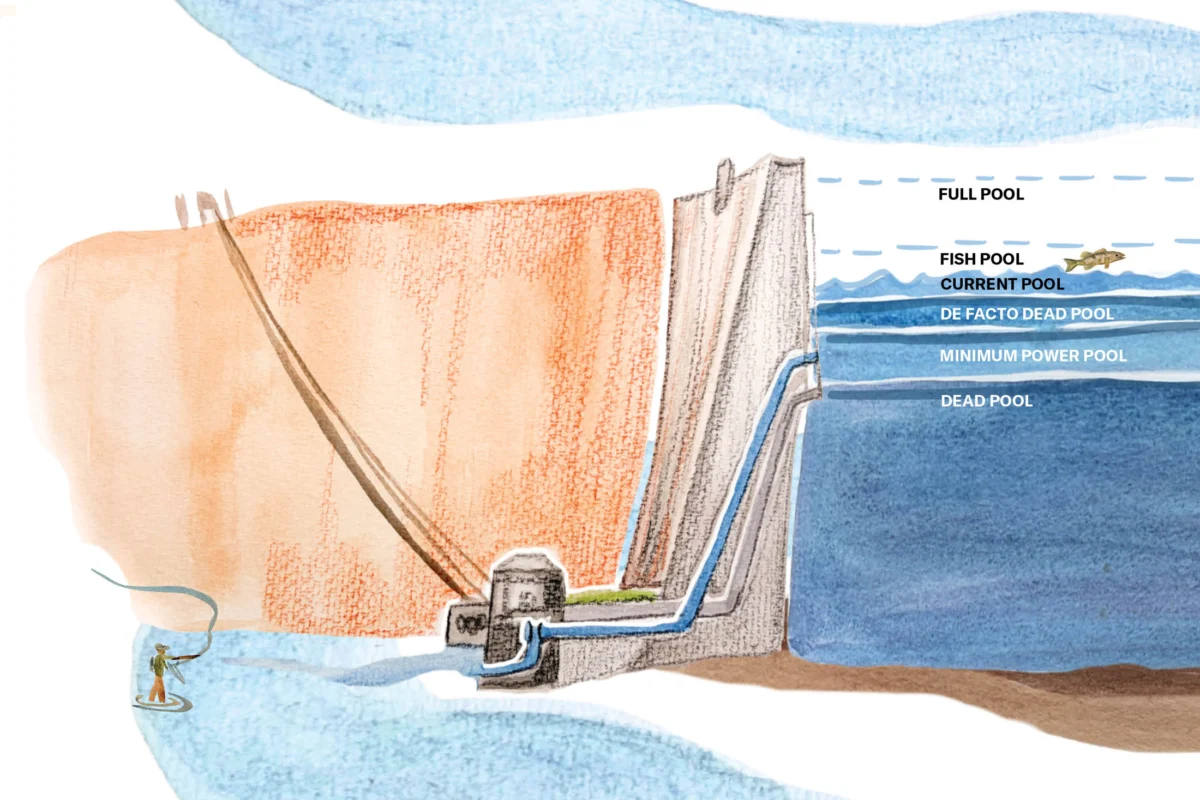
The monumental structure of Glen Canyon Dam, a cornerstone of water management in the American West, is now confronting a crisis that threatens its core functions and the very legal framework it was designed to uphold. Initiated in 1956, the dam’s primary objective was the creation of Lake Powell, a vast reservoir envisioned as a critical water savings account for the Colorado River system. This ambitious project aimed to harness hydropower, foster recreation, and crucially, prevent silt from accumulating in downstream Lake Mead. By storing water from wetter years for use during drier periods, the dam was intended to enable the Upper Basin states—Colorado, Wyoming, Utah, and New Mexico—to meet their obligations under the Colorado River Compact, ensuring that the river’s flow at Lees Ferry, Arizona, would not fall below an aggregate of 75 million acre-feet over any ten consecutive years.
However, the present reality paints a starkly different picture. Decades of persistent drought have significantly depleted Lake Powell’s reserves, pushing its "savings account" to alarmingly low levels. This past winter’s insufficient snowpack has exacerbated the situation, compelling federal dam operators to implement unprecedented measures. These actions are designed to prevent the reservoir from dropping below critical thresholds this summer, thereby safeguarding its capacity to generate hydropower and maintain Glen Canyon Dam’s viability as a vital water storage facility. The irony is profound: while the dam was built to manage water scarcity, it now faces the prospect of contributing to a violation of the very compact it was meant to serve.
The Colorado River Compact of 1922 and the subsequent construction of Glen Canyon Dam were both conceived during an era of relative abundance for the river. The projections for water flow upon which these agreements were based have proven to be overly optimistic in the face of a rapidly changing climate. Increasingly arid conditions across the region are now challenging the long-term sustainability of both the compact and the dam’s operational model, signaling a potential obsolescence for systems designed for a wetter past.
The Colorado River, a lifeline for over 40 million people across seven U.S. states and Mexico, is a marvel of engineering and diplomacy, but it is also a system under immense strain. The river basin, spanning some 246,000 square miles, supports agriculture, urban centers, and critical ecosystems, making its management a complex and politically charged endeavor. The Colorado River Compact, a foundational agreement, divided the river’s waters into an Upper and Lower Basin, each entitled to 7.5 million acre-feet annually. The "Law of the River," a collection of statutes, court decrees, compacts, and regulations, governs its allocation. Glen Canyon Dam and Lake Powell represent a linchpin in this intricate system, designed to provide a buffer against the river’s natural variability.
The concept of Lake Powell as a "water savings account" was central to the Upper Basin’s strategy for meeting its compact obligations. By impounding water, the reservoir was intended to smooth out the river’s flow, ensuring that even in dry years, enough water would be available to meet downstream demands and maintain the minimum flow requirement at Lees Ferry. This buffer was particularly crucial for the Upper Basin states, which, due to their geography, typically have less readily available water compared to the Lower Basin states. The dam’s ability to store vast quantities of water—Lake Powell has a capacity of over 25 million acre-feet when full—was seen as a safeguard against the unpredictable nature of the Colorado River’s flow, which is heavily influenced by snowpack in the Rocky Mountains.

However, the reality of climate change has introduced a new set of challenges that were not fully anticipated when these plans were laid. Rising global temperatures are leading to reduced snowpack, earlier snowmelt, and increased evaporation from reservoirs. These factors combine to decrease the amount of water flowing into the Colorado River system, a phenomenon that has been acutely felt over the past two decades. The prolonged drought, often referred to as a "megadrought," has been one of the most severe in the region’s recorded history, pushing many reservoirs, including Lake Mead and Lake Powell, to historic lows.
The current situation at Lake Powell highlights the precarious balance of the Colorado River system. When the reservoir’s water level drops, several critical functions are compromised. Hydropower generation, a significant source of revenue and electricity for the region, becomes less efficient and eventually ceases altogether once the water level falls below the intake points for the turbines. Furthermore, the dam’s ability to store and release water for downstream users, including agriculture and municipal water supplies in Arizona, Nevada, and California, is directly impacted.
The extraordinary measures being considered and implemented by federal dam operators, such as reduced releases to the Grand Canyon and downstream states, underscore the urgency of the situation. These operational adjustments are aimed at keeping the reservoir above the "minimum power-pool" elevation, a critical point below which hydropower generation is no longer possible. Reaching this point would not only have economic consequences but would also further complicate the management of the entire river system.
The potential violation of the Colorado River Compact’s non-depletion clause is a serious concern. This clause, designed to ensure a minimum flow of water for the Lower Basin and Mexico, is fundamental to the equitable distribution of the river’s resources. If reduced releases from Lake Powell, necessary to conserve water within the reservoir, lead to a sustained depletion of flows below the compact’s stipulated levels, it could trigger legal disputes and necessitate a renegotiation of water rights, a process that would be fraught with conflict and uncertainty. The compact has long been the bedrock of water allocation in the West, and its challenge could have far-reaching implications for water security across the region.
The irony of Glen Canyon Dam potentially causing the Upper Basin to violate the compact is not lost on water managers and observers. The dam was intended to be a tool for compliance, enabling the Upper Basin to store water and meet its obligations. Now, the very scarcity it was meant to mitigate, amplified by climate change, threatens to undermine its purpose and the legal framework it supports. This situation forces a confrontation with the reality that water management strategies developed in the 20th century may no longer be adequate for the challenges of the 21st century.
The implications of this crisis extend far beyond the immediate concerns of water allocation and hydropower generation. They touch upon the future of agriculture in arid regions, the sustainability of burgeoning urban populations, and the health of vital ecosystems that depend on the Colorado River. The need for adaptive management strategies, innovative water conservation techniques, and potentially, a re-evaluation of the Colorado River Compact itself, has never been more apparent. As the West grapples with its increasingly parched reality, the story of Glen Canyon Dam serves as a potent reminder of the delicate balance between human needs, environmental stewardship, and the inexorable forces of nature. The future of the Colorado River, and the millions who rely on it, hinges on finding solutions that acknowledge the new climatic realities and ensure a sustainable future for this indispensable natural resource. The ongoing dialogue among states, federal agencies, and stakeholders is crucial to navigating this complex and evolving landscape, seeking compromises and innovative approaches to water management that can sustain both human populations and the environment.