Rocky Georgio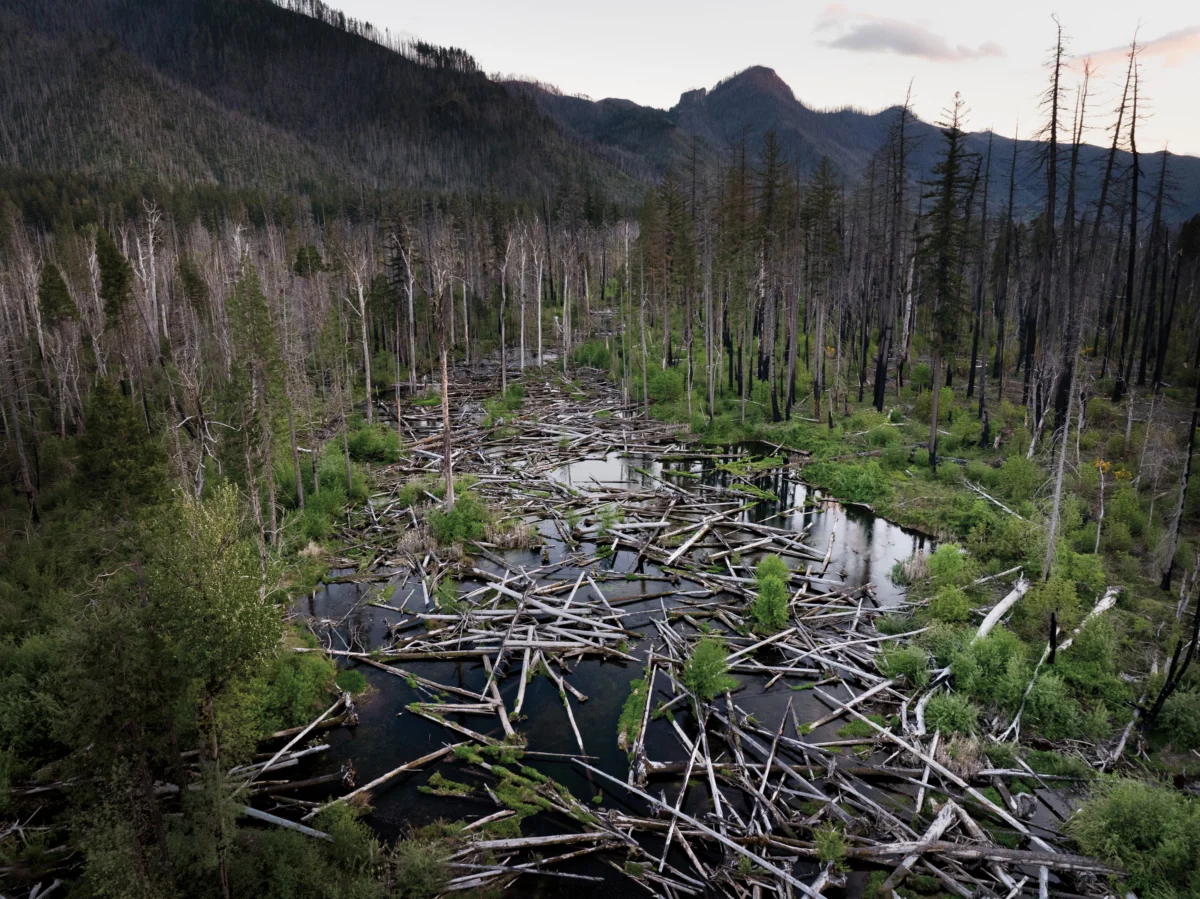
An hour’s drive east of Eugene, Oregon, Quartz Creek cascades down the Western Cascades, flowing into the McKenzie River. This picturesque landscape, shaped over millions of years by volcanic activity, erosion, and natural disturbances like windstorms, wildfires, and landslides, once supported a rich ecosystem. Ancient geological processes created broad valleys where streams meandered, forming wetlands vital for Chinook salmon, bull trout, and Pacific lamprey. These fish, some migrating to the Pacific and returning to spawn, nourished riparian forests and supported the livelihoods of Indigenous tribes like the Kalapuya, Mollala, and Warm Springs, who fished, hunted, and gathered here for millennia.
However, the arrival of Euro-American settlers in the mid-1800s drastically altered this delicate balance. By 1860, native tribes were forcibly relocated to reservations, and settlers began reshaping the landscape to their needs. They drained wetlands, constructed berms, and raised roadbeds along Quartz Creek and similar waterways, concentrating the flow into deeper, faster channels. This engineering effectively transformed the creek into a more manageable ditch, diminishing the floodplain’s moisture and reducing the availability of calm water and sediment crucial for fish habitats. Consequently, native species like lamprey saw significant declines, and Chinook salmon and bull trout disappeared from the area altogether.

Recognizing the profound ecological damage, a new initiative is underway to reverse these historical alterations. Employing modern technologies such as excavators, LiDAR, and GPS mapping, a dedicated team is attempting to restore the valley’s natural hydrological complexity. This ambitious undertaking is part of a broader river restoration effort in the McKenzie River watershed, utilizing an innovative approach known as Stage 0 restoration. This method aims to transform formerly canalized streams back into dynamic wetland-stream complexes by re-grading sections of the valley floor. It represents a significant departure from conventional restoration techniques, involving substantial landscape disruption and representing an unprecedented scale for this type of intervention. Geomorphologist Gordon Grant has described it as a "full-on field experiment," acknowledging the uncertainties and potential risks involved.
The McKenzie River is a cherished natural resource, vital for recreation, angling, and ecological health. Consequently, the implementation of this highly invasive restoration technique has generated debate among stakeholders. While some express reservations about its potential impacts, others view it as a critical opportunity to repair past ecological damage before it is too late. The urgency is underscored by the precarious state of the Upper Willamette River chinook salmon, a species once numbering around 110,000 in the McKenzie River, but now representing less than 2% of its historic abundance. This remaining wild population is considered the best hope for the species’ recovery, with some analyses predicting its extinction by 2050 without intervention. Elizabeth Goward, community engagement manager for the McKenzie River Trust, emphasizes the critical need for immediate action, stating, "We know we don’t know everything. But if we don’t act now, we could lose this species."
The intellectual underpinnings of Stage 0 restoration trace back to fluvial geomorphologist Brian Cluer’s observations from his early days as a pilot. Flying over remote river valleys, he noticed landscapes that defied the prevailing scientific understanding of rivers as single, meandering channels. Instead, he observed broad, undefined wetlands with dispersed water flow. This observation contrasted sharply with the established geomorphological models, influenced by studies of mid-Atlantic streams, which posited a single-thread channel as the natural archetype. Further challenging this notion, a 2008 study published in Science revealed that these mid-Atlantic streams, long considered pristine, had actually been significantly altered by historical mill dams. This research, coupled with similar findings from Western U.S. researchers using new technologies like LiDAR to examine landscape histories, indicated that many precolonial streams were more akin to multi-threaded wetland systems.

This growing body of evidence, combined with practical field experience, led Cluer and fellow geomorphologist Colin Thorne to develop the Stage 0 model. Unlike previous frameworks that began with a single channel, Stage 0 posits that a naturally functioning river system originates from a wet valley floor intricately webbed with streams. This theoretical framework provided a new conceptual basis for restoration efforts.
Meanwhile, Kate Meyer, a fish biologist then with the Forest Service, was grappling with the limitations of conventional restoration methods in the McKenzie watershed. Tasked with improving fish habitat in tributaries like Deer Creek, she and her team found that traditional approaches, such as adding wood to existing channels, yielded consistently underwhelming results. High-energy flows often washed away the added wood, and sediment accumulation took decades to create the desired habitat. This frustration led Meyer to explore alternative strategies, including those being piloted in eastern Oregon, where practitioners were dismantling existing channels rather than attempting to improve them.
A pivotal moment occurred in 2002 when Paul Powers, another Forest Service fisheries biologist, observed a landslide that had inadvertently dispersed a stream across its floodplain, creating ideal habitat conditions. This observation inspired him to replicate this outcome at Whychus Creek in central Oregon. In 2014, Meyer attended a river restoration symposium where Cluer and Thorne presented their Stage 0 research, a presentation she described as an "epiphany." When Powers joined the Deer Creek team in 2016, they proposed implementing the Stage 0 approach, a move that initially caused Meyer considerable apprehension. "I thought, ‘You mean we’re just going to bury the stream?’" she recalled.

Their initial experiments involved dismantling levees and using the material to fill sections of the channel. The immediate effect was the stream spreading across the floodplain, forming multiple slower-moving channels and deeper pools. The researchers were astonished to see their theories validated in practice, with Cluer and Thorne expressing their surprise at witnessing their concepts being implemented by practitioners. This early success emboldened Meyer and her team. In 2017, Chinook salmon were observed spawning in Deer Creek for the first time since 1993, a significant indicator of habitat recovery.
Building on this momentum, Meyer and her colleagues embarked on a larger-scale project in 2018 on the South Fork of the McKenzie, aiming to restore a 200-acre stretch to Stage 0 conditions. By this time, a practical methodology had been refined by practitioners like Meyer and Powers. The process begins with identifying suitable sites—typically low-gradient, historically depositional valleys where streams can naturally spread without impacting infrastructure. This involves using clues like relic wetlands and old-growth trees to infer the valley floor’s pre-settlement shape, augmented by LiDAR data for precise topographic mapping. Fish are carefully relocated, and the river is temporarily diverted. Heavy machinery then reshapes portions of the valley floor, filling channels and removing levees. Large woody debris is strategically placed across the floodplain, some partially buried, to create habitat and slow water flow. Finally, the diversion is removed, allowing the stream to disperse across the valley floor and begin the process of re-establishing a dynamic riverscape.
The implementation of Stage 0 projects, while visually disruptive, is a necessary step in restoring ecological function. When visiting Quartz Creek, the landscape bore the marks of significant earthmoving, with mounds of dirt and scattered logs. However, Lara Colley, floodplain restoration projects manager for the McKenzie Watershed Council, expressed optimism, pointing to the distribution of thousands of logs across the floodplain, sourced from areas where trees had been thinned or removed after wildfires. This collaborative effort has brought together various organizations, including the Eugene Water and Electric Board (EWEB), the McKenzie River Trust, the Confederated Tribes of Warm Springs, and private entities like Franklin-Clarkson Timber Co., alongside construction firms like Haley Construction.

For EWEB, a public utility providing drinking water to the Eugene metropolitan area, stream restoration is integral to safeguarding water quality. Quartz Creek’s historical sediment load during high flows taxed their filtration systems. By allowing sediment to settle on the floodplain, the Stage 0 project is expected to reduce treatment costs and improve water quality. The Confederated Tribes of Warm Springs view Stage 0 as a holistic approach aligning with their goals for sustainable fisheries and the exercise of treaty rights. The $9.5 million Quartz Creek project, largely funded by a grant from the National Oceanic and Atmospheric Administration, highlights the growing recognition of the economic and ecological benefits of such initiatives.
The construction phase, managed by Haley Construction, involved coordinating a large crew, significant volumes of wood and earth, and a flowing river within a tight timeframe. The company’s long history, evolving from timber operations to embracing river restoration, reflects a broader shift in industry practices. "You have to be able to adapt to changing needs, to reinvent yourself," remarked Randy Haley, co-owner of Haley Construction. Their logging expertise now directly contributes to repairing some of the environmental impacts of that industry.
The 2020 Holiday Farm Fire, which burned over 173,000 acres in the region, played an unexpected role in advancing Stage 0 work. The fire provided an abundant source of logs for restoration projects and made the use of heavy equipment more palatable to the public, as heavy machinery was less intrusive in scorched landscapes. More significantly, preliminary observations from the South Fork of the McKenzie restoration site, the largest Stage 0 project at the time, suggest that the restored areas exhibited greater resilience to the fire. The dispersed water channels acted as a firebreak in some sections, and the patched burning pattern allowed wildlife refuge and facilitated quicker forest recovery. This fire resilience emerged as an unforeseen but crucial co-benefit of the restoration.

While the visual impact of Stage 0 construction can be stark, the long-term potential for ecological renewal is compelling. The approach offers a chance to reset damaged river systems, though advocates caution against viewing it as a complete return to a pristine past. Instead, the goal is to empower natural processes to continuously shape and reshape the riverscape, fostering biodiversity and resilience in the face of climate change. Critics, however, argue that the specific historical landscapes envisioned as Stage 0 starting points may have been rarer than assumed, potentially limited to very low-gradient valleys. David Rosgen, a proponent of Natural Channel Design, believes Stage 0 can be effective in specific contexts but warns against its universal application.
Gordon Grant, a retired research hydrologist, expresses admiration for restoration efforts but urges careful study and consideration of potential risks. He notes the historical "bandwagon effect" in restoration, drawing parallels between the enthusiasm for different approaches. Grant highlights the unpredictability of high-energy mountain stream systems, emphasizing that the complex interactions of wood, flow, and sediment exceed the capabilities of current modeling tools. While this unpredictability signifies possibility, it also introduces potential risks. He points to the possibility of mobilized logs causing damage to infrastructure and endangering human safety during severe floods, a concern that warrants thorough investigation.
Researchers Rebecca Flitcroft and Brooke Penaluna are investigating the direct impacts of Stage 0 restoration on fish populations. While studies indicate increased rearing habitat and macroinvertebrate production, concerns remain regarding potential temperature increases and shifts in sediment composition that could affect salmon. The introduction of invasive species is also a consideration. Long-term monitoring is crucial to understand how these sites evolve. Luke Whitman, monitoring Upper Willamette River chinook populations, noted an initial surge in spawning beds after the South Fork project, followed by a decline, possibly influenced by upstream dam operations that limit natural flood pulses. He advocates for creative solutions, including dam management, to complement restoration efforts.

In late January, a visit to Quartz Creek revealed a landscape transformed. The dusty wasteland of the previous August had given way to clear water flowing through braided streams, parting around logjams and depositing sand. The scene, though still bearing evidence of the extensive work, offered a glimpse of renewed dynamism. The unpredictability of such a system, as noted by Grant, represents not only a challenge but also a promise of emergent ecological processes. The success of Stage 0 restoration hinges on ongoing stewardship, recognizing that river systems are nested within larger ecological contexts influenced by human activities like logging and damming. The long-term trajectory of these restored sites depends on continued monitoring and adaptive management, acknowledging that while nature will work to repair and reconfigure, the outcome is not guaranteed. As Thorne suggests, "There aren’t any one-and-dones for rivers," but the hope is that these interventions empower natural processes to create more resilient and diverse ecosystems capable of adapting to a changing world.