Roger Danuarta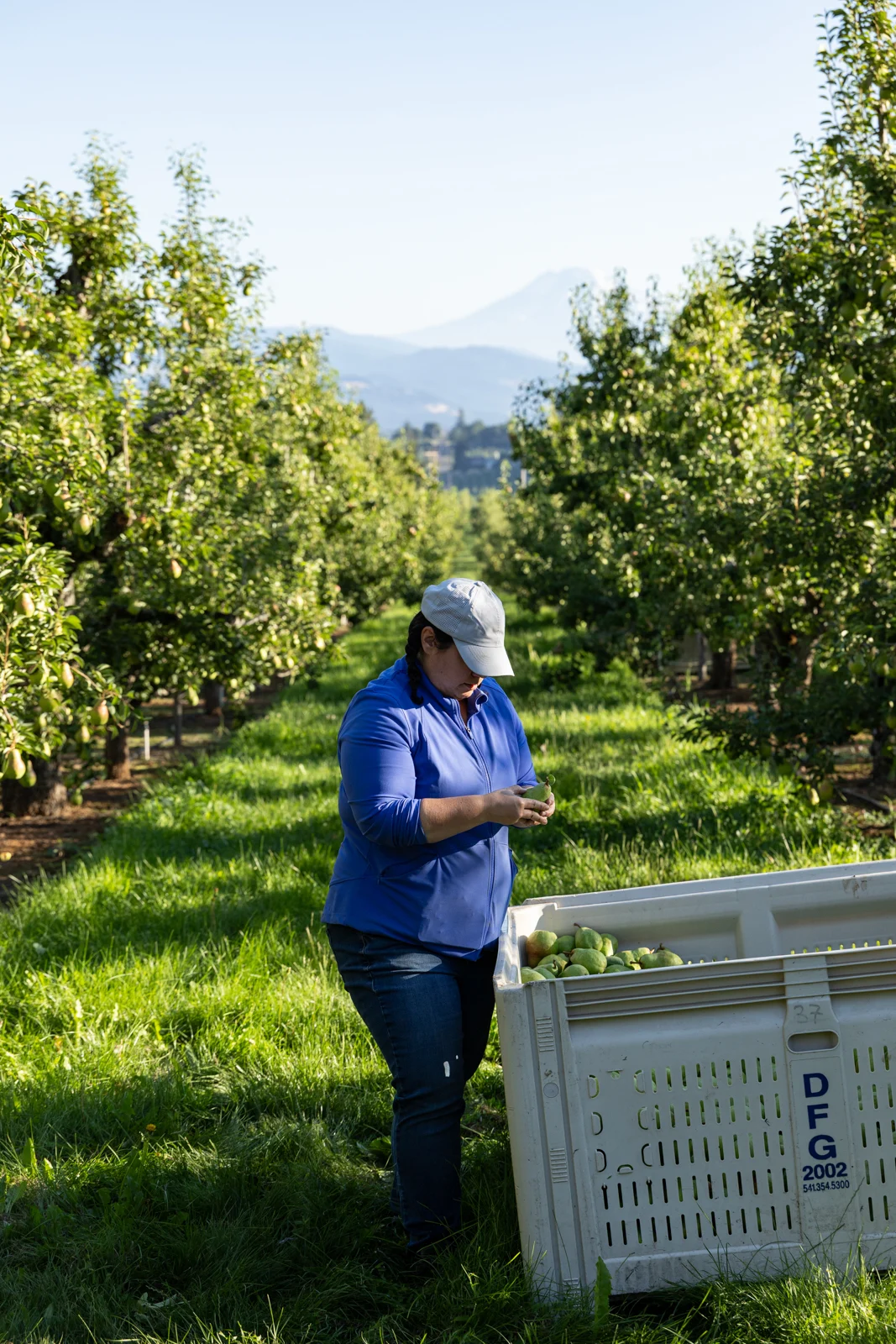
On a clear August morning, as the rising sun cast a pink glow upon the majestic Mount Hood, Lesley Tamura walked through her 42-acre pear orchard in Hood River, Oregon. The rhythmic sounds of a Spanish-language radio station accompanied the industrious hum of workers, deftly plucking green Bartletts from ladders and collecting them in bags strapped to their chests. Tamura, a fourth-generation pear grower, carries the weight of a century-long family legacy on this very land. Her great-grandfather established the farm, and it remarkably remained in the family’s hands even during the harrowing period of forced internment for Japanese Americans during World War II, a time when countless others lost everything. For decades, this resilience fostered a sense of fortune within the Tamura family. Yet, eight decades later, the shadow of unprecedented economic and environmental pressures has cast doubt on their enduring luck, leaving Tamura to question the very survival of their cherished enterprise.
"As much as we do this because we love it, it’s just getting harder and harder each year," Tamura stated with a profound weariness. "I would love to survive doing this and doing it well, but I’m not sure that’s possible." Her sentiment echoes a growing despair across the Hood River Valley, a region renowned for its pear cultivation. Last year alone, the valley’s pear growers faced an estimated $40 million to $45 million in losses, a staggering sum driven by a confluence of low market prices, soaring production costs, and a devastating pest infestation. In response to this escalating crisis, Oregon Governor Tina Kotek formally requested a disaster designation from the U.S. Department of Agriculture, a critical step that could unlock access to low-cost loans and other vital financial relief. However, agricultural economists like Tim Delbridge of Oregon State University Extension Service warn that even such federal intervention might prove insufficient. "I think it’s safe to say that many pear producers will be either reducing pear acreage or, frankly, going bankrupt," Delbridge predicted, painting a grim picture for the region’s agricultural future.

Every spring, the Hood River Valley transforms into a breathtaking expanse of delicate white pear blossoms, a testament to the region’s ideal climate for this particular fruit. Oregon and Washington collectively account for nearly 90% of the nation’s fresh pear production, making the Pacific Northwest a cornerstone of the domestic pear supply. However, the idyllic scenery belied a silent menace that blanketed the trees last year: the pear psylla. This diminutive insect, akin to an aphid, systematically feeds on pear trees, excreting a sticky substance known as honeydew. If left untreated, the honeydew fosters a type of sooty mold that, while edible, renders the fruit unsightly and, crucially, unsellable in the competitive fresh produce market. The 2025 season witnessed an unusually large pear psylla population, a phenomenon that has puzzled scientists. While climate change is suspected as a contributing factor, the infrequent nature of such severe psylla spikes—occurring roughly once a decade—makes comprehensive study challenging. "It’s really hard for us to tease apart all of these big ecological interactions and try and figure out exactly what’s happening," explained Ashley Thompson, a horticulturalist specializing in the region’s pear crops. "We don’t have good answers, and that’s frustrating for us and for the farmers."
In a desperate bid to salvage their harvest, Hood River’s pear farmers embarked on an arduous and costly battle against the psylla. They meticulously hosed down their trees, with Tamura alone reporting a near-triple increase in water usage compared to typical seasons. This intensive effort successfully removed much of the honeydew, allowing growers to save a significant portion of their fruit. The result was a paradox: a massive harvest, which, unfortunately, flooded the market and drove prices to historic lows. Compounding this issue was the closure of a cannery in Yakima, Washington, a long-standing outlet for surplus and cosmetically imperfect fruit. This closure eliminated a crucial market diversification strategy for growers, leaving them even more vulnerable to the volatile fresh market.
Despite the initial setbacks of a huge harvest and depressed prices, farmers believed they had averted outright disaster. Throughout August and September, they meticulously packed and shipped their year’s labor to nearby packing companies, entrusting the fruit to be stored and released incrementally to the market. However, a horrifying discovery awaited them in January. As packers began opening boxes of stored pears, they found that not all the honeydew had been successfully removed, and many bins of fruit had developed extensive mold, rendering them unsalvageable and necessitating their immediate discard. This revelation sent alarm bells ringing throughout the agricultural community, particularly for Lesley Tamura, who also chairs the Columbia Gorge Fruit Growers. For each bin of pears she had diligently cultivated at a cost of approximately $300, the packinghouse offered her an average payout ranging from nothing to a mere $150. In some extreme cases, farmers even faced bills to cover the packers’ disposal costs. "We paid to grow the pears, we paid to pick the pears, we paid to pack and store the pears," Tamura lamented. "We’re going to pay for the cost to discard them as well." The emotional toll of watching truck after truck of moldy fruit being carted away, leaving sticky pear juice on the roads near the packing facility, was immense.

The federal government’s crop insurance program, designed to protect farmers in such unforeseen circumstances, typically requires notification of damage soon after harvest. However, the full extent of this disaster only became apparent months later, during the storage phase, leaving Tamura and her colleagues with limited recourse. This critical loophole prompted their urgent appeal to Governor Kotek, whose July letter to the USDA outlined a range of proposed measures, including low-interest loans and direct relief payments. A USDA spokesperson confirmed receipt of Gov. Kotek’s letter, stating, "USDA has received Gov. Kotek’s letter and is actively working to gather the necessary data and information," signaling that a decision is pending.
Pear producers find themselves operating in a precarious economic environment with little room for maneuver. As they frequently lament, "We’re price takers, not price makers." This adage succinctly captures their lack of control over market prices, dictated primarily by large retailers. The financial uncertainty is further exacerbated by the prolonged payment cycle; farmers often do not know the exact remuneration for their harvest until almost a year after picking the fruit. While partial distribution checks typically arrive starting in January, the full payment is only disbursed after packers and retailers have subtracted their substantial shares. "We just get whatever’s left over," Tamura explained, highlighting a systemic imbalance. "And for a very long time now, that amount is not even enough to cover our costs." The stark reality is illustrated by USDA data: in 2008, Oregon farmers received an average of $473 per ton for their pears. Seventeen years later, in 2025, that figure remained precisely the same, $473 per ton, a shocking stagnation that starkly contrasts with the relentless march of inflation.
Many agricultural advocates and policymakers point to the increasing consolidation within the retail grocery sector as a primary driver of this price stagnation. Just four major companies now command an estimated two-thirds of America’s grocery spending, granting them immense leverage over suppliers and, consequently, how much farmers are paid. While economist Tim Delbridge notes that research on the direct impact of retail consolidation on farmer prices remains inconclusive, stating, "It is intuitive that that level of market power at the retail level would have an impact, but it is tough to say that’s what’s driving lower prices," the pervasive trend of corporate concentration across global food supply chains undoubtedly limits competitive opportunities for growers. What is unequivocally clear, Delbridge asserts, is that pears are simply not the fruit of the moment. Since the 1980s, per capita consumption of canned pears in the U.S. has plummeted by approximately 70%. Demand for fresh pears has also remained stubbornly sluggish, failing to keep pace with the surging popularity of other fruits like fresh berries, whose consumption has more than tripled. A significant challenge, Delbridge suggests, lies in consumer education. Many consumers expect pears to be ready to eat immediately upon purchase, unaware that many varieties require several days of ripening on the kitchen counter to achieve optimal flavor and texture. Tamura concurs that consumer patience, a casualty of the instant gratification culture, is a major hurdle. "People are so used to the immediate results of ordering things and getting same-day delivery," she reflected. "We’ve lost a bit of our patience, and that works against us as pear growers."

While revenue has stagnated, pear producers’ operational expenses have surged dramatically. Since 2008, not only has the cost of labor significantly increased, but inflation has risen by a staggering 54%, making every input, from fertilizer and pesticides to fuel and machinery, considerably more expensive. Mike McCarthy, a pear grower in Parkdale, just up the road from Tamura, has cultivated pears for 47 years. He estimates that labor now constitutes a formidable 60% of his total expenses. McCarthy contends that while well-intentioned, recent state regulations concerning farmworker overtime and housing have stretched him and many other farmers beyond their financial limits.
The past season stands as the worst in McCarthy’s long and arduous career. To simply survive for another year, he reveals that many of his fellow farmers have "borrowed to the hilt," taking out new mortgages on land that had long been paid off, leveraging generational assets against uncertain futures. Others have been forced to sell their operations to larger entities, consolidating land and power, or have simply abandoned their orchards altogether. "There’s a number of abandoned orchards around the county now, which is very unusual," McCarthy observed, noting the distressing trend. "It seems like the number is growing all the time." While McCarthy approaches the twilight of his own farming career, his profound concern lies with the next generation. "That’s really where the rubber meets the road is with these younger people," he stated, his voice laced with empathy. "Many of them are just super depressed."
Amidst these profound challenges, Lesley Tamura clings to a fragile hope. The current harvest appears smaller, a factor that often translates to better market prices. Crucially, the psylla infestation this year seems significantly less severe than in the disastrous previous season. These two factors offer a glimmer of optimism for improved returns. She is keeping her fingers crossed for a season where, at the very least, she can break even, a modest aspiration that underscores the immense pressures facing America’s foundational agricultural industries. The fate of Hood River’s pear growers serves as a potent microcosm of the broader struggles confronting family farms worldwide, caught between the inexorable forces of climate change, evolving consumer habits, and an increasingly consolidated global food supply chain. Preserving these multi-generational agricultural enterprises requires not just individual resilience, but systemic solutions that address the inherent vulnerabilities of those who feed the world.