Rocky Georgio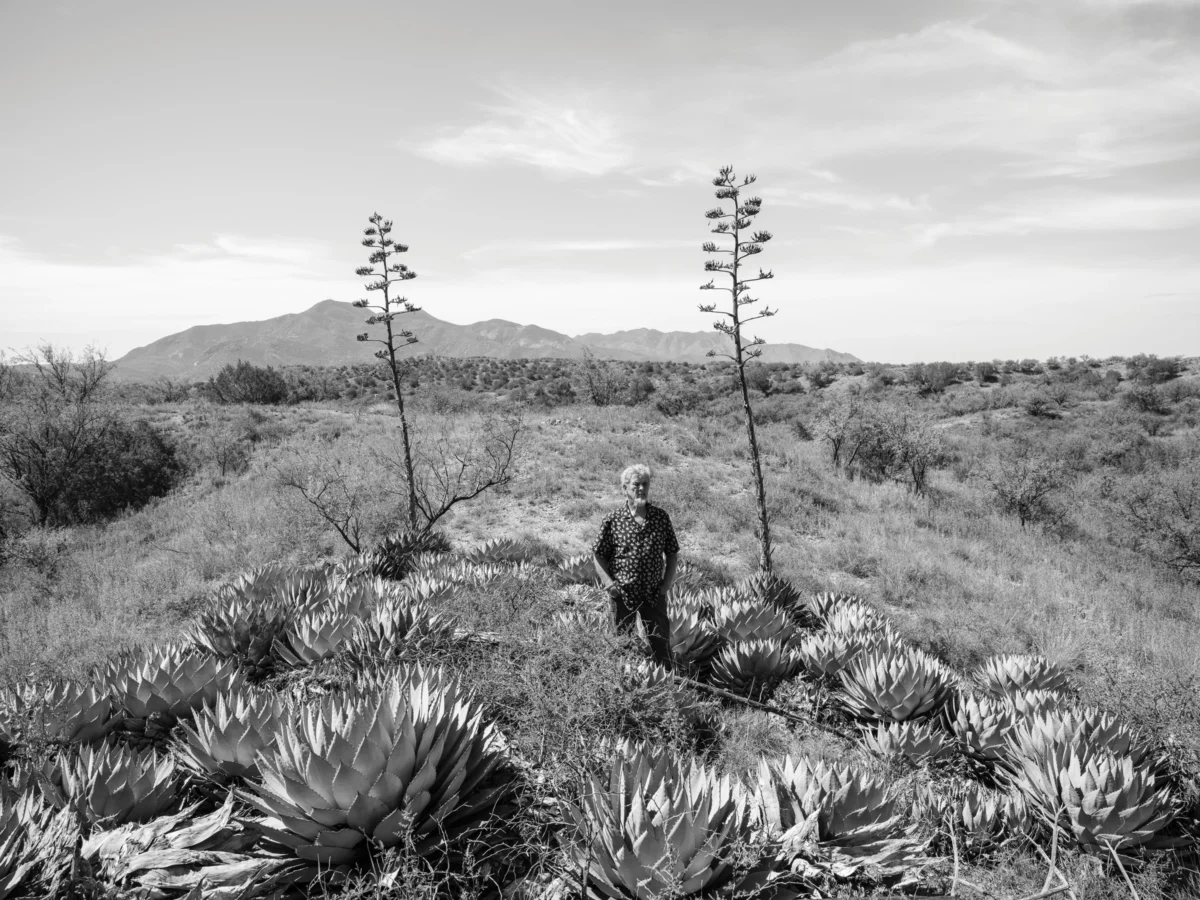
In October 2021, the arid expanse of southern Arizona provided the backdrop for a journey alongside Gary Paul Nabhan, a renowned botanist, activist, and author whose life has been inextricably linked to the U.S.-Mexico borderlands. For half a century, this region has served as his laboratory, his sanctuary, and his home, a mere 22 miles from the Nogales port of entry. It is a landscape that has also captivated me for much of my life, and it is Gary who has illuminated the profound truth that the border is far more than an arbitrary line etched in desert sand.
Nabhan has been a consistent presence in this region since the early 1970s, visiting, living, and traversing its complex geography. I, too, have followed in his footsteps, bearing witness to the intricate human and ecological dramas unfolding along this frontier since 1984. On this particular day, Gary is in his element, clad in his characteristic field attire: a well-worn khaki baseball cap, a faded t-shirt bearing a Spanish slogan urging workers to "rise up," and a simple wooden cross adorning his neck. His face is framed by a distinguished gray beard, and a gentle, familiar belly hints at a life lived fully. He possesses the air of a seasoned farmer, his deep, gray-blue eyes sparkling with an inner light as he speaks in a soft, raspy voice.

"It’s okay to have boundaries in our lives," Gary once shared, reflecting on the very line that fascinates us both. "But if we were to seal every pore on our skin, or every stoma on a plant leaf, we would perish. Thus, we truly need porous borders, for it is a time-tested method to enrich life rather than suffocate it."
Our journey takes us along the Roosevelt Reservation, a 60-foot-wide corridor established by Theodore Roosevelt in 1907 for security purposes, stretching across 632 miles of the border. We are on the U.S. side, traversing the San Bernardino National Wildlife Refuge, a dynamic ecotone where desert scrub meets grasslands within the Chihuahuan Desert. It is a landscape transformed from Roosevelt’s vision into what appears today as a militarized desert, teeming with Customs and Border Protection agents on vehicles, ATVs, and horseback, their operations amplified by an extensive network of surveillance towers, drones, and powerful, carceral lighting that pierces the night.
The physical manifestation of the border is stark: a 30-foot-high barrier of rust-colored bollards set against the impossibly cerulean blue of an early autumn desert sky. We navigate through pools of muddy water left by late-season monsoon thunderstorms. My gaze is drawn to the north, to the north, to the refuge’s breathtaking ecological paradox – the riparian desert. Stands of sacaton grass sway in the breeze, stoic creosote bushes offer up their yellow blossoms, and nearby, thick-trunked cottonwoods shimmer, their leaves catching the light. Historically, springs, creeks, and ephemeral draws nourished wetlands here, creating a vibrant ecosystem that supported a rich diversity of flora and fauna, including hundreds of bird species, dozens of mammals, reptiles, amphibians, and fish, such as the endangered Yaqui chub and Yaqui topminnow, and the threatened Yaqui catfish. While human development had depleted these water sources throughout the 20th century, the designation of the refuge in 1982 initiated a significant restoration effort.

However, this refuge was also targeted for the construction of President Donald Trump’s much-vaunted "big, beautiful wall." Dozens of environmental and cultural protection statutes were bypassed. During the first Trump administration, $408 million was allocated to the region, and a well was drilled adjacent to the refuge to supply water for concrete mixing, a move that inflicted damage upon the fragile desert wetland biome. Upon completion, the wall severely restricted cross-border mammal migration, though its impact on drug smuggling is debatable, as an estimated majority of illicit substances enter the country through official ports of entry.
As we drive eastward along the border, the passage of time allows for reflection on the profound changes that have occurred in just a few decades. I recall witnessing border fence construction west of our current location, near the Santa Cruz River. This fence was ingeniously designed with holes large enough to prevent desert windstorms from toppling it, yet small enough to thwart human climbers. During a visit, a swarm of grasshoppers effortlessly navigated these openings, an act of nature subverting a human-made barrier.
Gary then brings up the San Miguel Gate on the Tohono O’odham Nation, a vast territory that spans numerous border miles. This site, once an informal crossing where the fence simply ended and was symbolically understood as a "gate," had historically been respected by Border Patrol due to O’odham ceremonial routes and binational Indigenous families. While vehicular traffic ceased years ago, it was not due to Border Patrol actions. In a poignant irony, a physical gate was erected and welded shut by a Mexican landowner on the opposite side.

We both fondly recall another informal crossing, at Boquillas in Big Bend National Park, on the Río Grande. There, an elderly man would ferry visitors across the river when it was low, allowing them to enjoy a cold drink on the Mexican side, with no Border Patrol in sight. This idyllic scene, immortalized in a song by singer-songwriter Robert Earl Keen, now stands in stark contrast to the present reality.
The nostalgia intensifies the pain of witnessing the current border wall, a 30-foot-high structure that stretches for miles across the desert plain, appearing as alien and out of place as the black monolith that profoundly impacted early hominids in Stanley Kubrick’s "2001: A Space Odyssey." Its shape and color are wholly foreign to the desert landscape, a stark, artificial intrusion that irrevocably alters the natural environment.
And then, remarkably, it is gone. We stop the truck and disembark. The most recent monsoon storm had flooded the wash where the fence is situated, tearing a series of bollard gates from their hinges, effectively rendering the wall impassable. While the Army Corps of Engineers had designed these gates to withstand such flooding, they were intended for manual opening before the monsoon season. During the storm, an immense volume of water—approximately 290 cubic feet per second, or about 112,200 gallons per minute—surged from north to south, striking the wall with a force that may have reached heights of 25 feet.

To illustrate the scale, I ask Gary to stand near the remnants of the wall, his body mere inches from the Mexican side. The debris line towers several feet above his head. A Border Patrol surveillance tower stands a short distance away. "The Border Patrol’s gotta show up any minute," I remark to Gary. They never appear. For those fleeting moments, Gary and I share a glimpse of a time before the wall, and perhaps a premonition of a future when all human-made barriers are ultimately swept away by the relentless march of time.
There are, in essence, many Garys. He is the MacArthur "genius grant"-winning ethnobotanist who revolutionized his field by seamlessly integrating rigorous scientific observation with social witness and accompaniment—a practice, inspired by Catholic social teaching, of simply being present and offering support when and where needed within Indigenous communities. He is the devoted scholar and activist of the Arizona and Sonora Borderlands, a region he has dedicated half a century to studying and inhabiting. Gary is also the co-founder of Native Seeds/SEARCH, a pioneering arid lands seed bank that safeguards vital genetic diversity. He embodies a spiritual dimension as a member of the Order of Ecumenical Franciscans, deeply influenced by St. Francis of Assisi’s profound reverence for the holiness and vulnerability of all life, human and non-human. Furthermore, Gary is a prolific writer whose work transcends genre boundaries, encompassing scientific articles, narrative nonfiction, and poetry. With 36 books to his name, nearly all of them monographs, he fearlessly explores not only diverse forms but also a vast array of places, peoples, and the intricate web of life. His writings delve into the biological, cultural, and spiritual significance of mesquite trees, the art and science of distilling agave spirits, and offer poignant vignettes of American and "more-than-American" activists, artists, and visionaries. He has even penned a Gospel-oriented guide for farmers and fishers. This past summer, he published "Water in the Desert," his first true autobiography, a compelling attempt to weave together the disparate threads of his life into a unified field theory that braids matter, history, and spirit.
From his earliest days as a college student studying and observing the Borderlands, Gary has consistently registered profound losses: the erosion of habitats and species, the infringement upon civil rights, and the disfigurement of desert vistas by the imposition of walls. His very first book, "The Desert Smells Like Rain," poignantly chronicled the precarious future of the Tohono O’odham people’s ancient dryland-farming traditions. More than four decades later, "Water in the Desert" documents the severe degradation of the border biome near his home in Patagonia, Arizona. Throughout his career, Nabhan has maintained a consistent voice, one of Old Testament-like lament, tempered by a disarming wry humor and an effortless command of wordplay. He writes about the interconnectedness of mesquite trees in the desert Southwest, transforming a phrase like "ménage à trois" into "ménage à tree." Ultimately, his work cycles through grief, only to consistently arrive at hard-won seeds of renewal and recovery.

I had intended to write this story in 2021, but at that time, writing felt impossible. Five years elapsed, and it was only recently that I began to write again, having navigated my own landscape of losses. Gary, who is a little over a decade my senior, was a significant catalyst for my return to writing. I have now reached an age where receiving AARP mailers feels commonplace, and one of the revelations that accompanies this season of life is the understanding that being an elder does not negate the need for guidance from those who are older, even as one increasingly assumes the role of elder for those younger.
Therefore, I write now of my elder. But Gary is also, particularly in the desert West, our elder—a guiding presence for all who care deeply for the land and the myriad beings that inhabit it. My pursuit of this narrative led me to his home and onto the road, transforming what began as a journalistic endeavor into a profound mentorship and friendship. Even when I believed I would never write this story, our conversations continued. More accurately, he remained in contact with me. I would find myself hiking in San Francisco’s Golden Gate Park, the foggy breeze rustling through Monterey cypress boughs, mirroring the dampness in my own spirit, and Gary would call, simply to discuss a new book he had read about the Sanctuary movement, or about folk music, or a magnificent thunderstorm that had just swept across the desert. I believe he was, quite intentionally, accompanying me through my period of darkness.
His voice and his texts have been my constant companions for years. The stacks of books on my desk, the lectures on YouTube, the shared conversations in his Prius (adorned with a peeling "No Border Wall" sticker in cholo-style Old English script along the driver’s side door) as we traversed the roads of southern Arizona. Dozens of photos and videos on my phone, Gary’s presence etched in my laptop journals and in the cryptic scrawls of reporter’s notebooks. To journey alongside Gary is to engage in a profound dialogue with the world, to perceive it intimately through its landscapes and species, its policies and poetry.

In October 2021, I listened to a recording from a visit to Quitobaquito, a natural spring situated mere yards from the border and one of the most sacred sites for the Hia-C’ed O’odham and Tohono O’odham peoples. Like the San Bernardino National Wildlife Refuge, it is a vital crossroads, maintained for Indigenous migratory and ceremonial routes, as well as for the sustenance of desert flora and fauna. Bulrushes encircled the pond like a reedy picket fence, and a pair of ancient cottonwoods stood sentinel, taller than anything else in the vicinity, save for the Border Patrol surveillance towers. While I had heard about the wall’s presence here, nothing could have prepared me for the jarring juxtaposition of this miraculous spring—the largest water source for dozens of miles—and the imposing 30-foot-high bollard wall, a structure situated over 200 miles east as the crow flies from the San Bernardino refuge. The immediate surroundings were quiet, with only the distant hum of traffic on Mexican Highway 2 across the line. Joe Biden was in the White House, and wall construction had paused. Gary, along with his longtime friend and Tohono O’odham leader Austin Nuñez, had recently published a manifesto in The New York Times calling for the healing of the wounds inflicted upon the Borderlands during Trump’s first term. "We must reimagine the landscapes we share with Mexico," they urged. "The border should not be a line that divides cultures and fragments their desert environment. It is a juncture where two nations connect, where history is shared, where cultures are alive and where a common future must unfold." Little did we know, at that hopeful moment, that this respite would be temporary. The modest reclamation efforts under Biden would not only be undone in a potential second Trump term but would be accompanied by a new wave of violence, with preparations for a second wall parallel to the first, an even graver assault than under Trump I. At the time, we naively envisioned an era of open-ended recovery. A lone coot, its pale beak a stark contrast to its glossy black feathers, glided across the main pond, seemingly indifferent to its human observers. Rivulets of water feeding the pond created smaller pools where the endemic and endangered Quitobaquito pupfish, one of the desert’s most resilient inhabitants, had adapted to high salinity and water temperatures exceeding 100 degrees Fahrenheit. This tenacious species had, remarkably, survived the construction of the border wall and the rumbling passage of Border Patrol vehicles along the Roosevelt Reservation.
I noticed a distinct, uniform color change on the bulrushes—a shift from vibrant lime-green to a muted oatmeal hue approximately three feet above the water line. "They pumped 800,000 gallons per mile of border wall to do the concrete footing," Gary explained, "and this is a fragile aquifer." The flow from the spring into the pond had been in decline even before the wall’s construction, primarily due to agricultural practices on the Sonoran side. With record-breaking heat, the water levels had reached their second-lowest point in recorded history. On the recording, my exclamations of "God!" punctuated the somber atmosphere. The decline in the pond’s water levels correlated with a steady decrease in bird populations. Research conducted by Gary for a study published in the Journal of Arid Environments indicated that 45 bird species promptly disappeared, although there was a temporary increase of 15 others—mostly accidental visitors like sandpipers and dowitchers migrating from the Gulf of California, species adapted to lower water levels and mudflats. Gary has been visiting this site since the 1970s, and the pause in wall construction had not reversed the decades of damage already inflicted. "See those two cottonwoods there?" Gary pointed them out, their green leaves shimmering in the breeze. "There used to be 15, 20 of them. I lowered my son down to the water to have him baptized with a Catholic priest and an Indian medicine man right off that cottonwood there." He then gestured to the skeletal remains of a collapsed tree. "It died three or four years ago. So, there’s been a complete habitat decline since I did my dissertation here in 1982."
We returned to the pupfish one last time. My eyesight is not what it once was, and I hadn’t clearly seen them when we first passed the shallow pools in the dappled light of a mesquite thicket. This time, I knelt, catching glimpses of iridescent flashes—blues and silvers, indicating males and females. These guppy-like fish were already critically endangered before the wall construction began, facing such a high probability of extinction that Biosphere 2 had collected a few dozen and introduced them to a stream environment within their "desert biome" research center, a sanctuary established to perpetuate the species should it disappear from Quitobaquito. Gary, holding a cherished volume of desert verse by his friend, the Tohono O’odham poet Ofelia Zepeda, titled "Ocean Power," sat at a weathered, splintered picnic table. He began writing a letter to her on the blank pages at the end of the book, expressing his desire to "speak" to Zepeda from this, her sacred place, where cell reception was non-existent. He recalled her sharing stories of her childhood visits to Quitobaquito and expressed his gratitude for her mentorship in O’odham dialects. Zepeda’s poems are meticulously crafted, clear, and spare desert verse. Consider her poem "Morning Air": "The early morning air, / enveloped in heavy moisture. / I go outside and it lays on my shoulders. / I go about my business, / carrying the morning air / for the rest of the day." This, in essence, is how desert dwellers, both human and non-human, survive: the moisture is both material and spiritual. It emerged into the world with the wet breath of the creator-god I’itoi from a cave high atop Baboquivari Peak, the magnificent, ruddy, heart-shaped sky island that dominates the Tohono O’odham landscape and cosmology. It is a place where arroyos and tinajas fill during the sudden deluges of summer and the prolonged soaking rains of winter. I once visited the mountain alone and became lost; clearly, I was neither prepared nor welcome. Decades ago, Gary, already deep into his work alongside the "people of the desert" (the literal translation of "Tohono O’odham"), had hiked to I’itoi’s cave with young O’odham pilgrims. In "The Desert Smells Like Rain," he described the offerings within this sacred emergence place: rosaries, gum, cigarettes, and a multitude of other items hanging in the dimness. This experience prompted a profound reflection: "There is always something hidden in this world, that you can’t just realize from the outside. You need to make contact with it now and then, to nod your head in knowing, to receive its blessing." In a landscape marked by loss and grief, this contact signifies holding onto the spirit of what has passed, what remains of what is even now being lost, and what will be—perhaps even what will be again, reborn from drought, fire, or flood, from the relentless steel slashing through the desert. The path to healing must encompass both science and art, policy and prayer, a poem. This is the essence of sacred activism.

Known for his role as one of the founders of the regional seed bank Native Seeds/SEARCH, Nabhan has long been an advocate of conserving and sharing seeds. A children’s book about the Seri Indians (below) is just one of the 36 books that he has written or edited. Credit: Roberto (Bear) Guerra/High Country News.
My initial encounter with Gary’s profound insights occurred long before our physical meeting, sometime in the 1990s, when I first read "The Desert Smells Like Rain." This book is now considered a classic in arid and Borderlands ethnography and botany. The narrative opens with the blessing of a summer monsoon shower on the Tohono O’odham Nation; a young Native boy’s poetic observation provides the book’s title, a reference to the distinct fragrance released when raindrops activate the resins on creosote leaves. The traditional lands of the Tohono O’odham Nation stretch across a border established in 1853. This frontier, now 173 years old, represents less than 2% of the 10,000 years that the O’odham and their ancestors have called the Sonoran Desert their home. Like many writers who focus on border regions, Gary is not indigenous to this area. Much like numerous other artists and thinkers, he was drawn to the American West in search of himself within a world of intersecting cultures, with all its inherent tensions and syntheses. The Borderlands, a region geopolitically defined, are themselves a waystation, migratory in their very essence for both human and non-human life, a place of transitions stretching back into deep time.
Gary grew up amidst the unique environment of the Indiana Dunes, an arid oasis bordering Lake Michigan. His upbringing was shaped by his Irish Catholic mother, his Lebanese American father, and his extensive paternal family. His deep affinity for the deserts of the American Southwest can be traced to the dunes of his youth and to his relatives’ ancestral lands in the arid regions between Lebanon, Syria, and Israel. I, on the other hand, was born in Southern California to an immigrant mother from El Salvador and a Mexican American father whose parents hailed from the arid north of Mexico; together, my parents represented a riparian desert. This shared experience of borders, and a ceaseless desire to traverse them, alongside the frustration of being pushed back by them, the laughter at their inherent absurdity, the hoarse shouts against their imposition, the despair they evoke, the contemplation they inspire, the kneeling in prayer before them, and the mourning of their terrible cost—the border dead, both human and non-human—unites Gary and me. The United Nations’ International Organization for Migration identifies the U.S.-Mexico border as the "deadliest land crossing in the world," with at least 10,000 lives lost since 1994.

In 2023, I embarked on another road trip with Gary, this time to the Sonoran coast on the Gulf of California. This region holds profound significance for him; he first encountered these traditional lands as an undergraduate student at Prescott College, which has maintained a presence there since 1969. The journey was not without its challenges. En route, we visited with his friend Wenceslao Monroy, a respected community leader known for hosting delegations of Zapatistas from Chiapas. Monroy shared a harrowing account of a close encounter with cartel violence that forced him to flee his family’s ancestral ranch for weeks. Later, Gary spent an extended period engaging with students at the Universidad de Sonora herbarium in Hermosillo, a testament to his characteristic enthusiasm for knowledge and dialogue. As night fell, we navigated a dark, unlit two-lane desert road, seemingly the only foolish enough souls driving it. Miles passed without another vehicle in sight. Nevertheless, we reached the coast safely. The following day, as documentary film crew cameras rolled, Gary collected a bunch of glistening eelgrass, showcasing his expertise on what celebrity chefs have lauded as the new superfood—"sea rice," a grain derived from this versatile grass. This attention was beneficial for the Comcáac people, an Indigenous group so geographically remote from centralized Mexican government authority that they have tenaciously preserved their traditional identity. However, they remain vulnerable to Mexico’s concurrent romanticization of Indigenous history and its disregard for the welfare of contemporary Indigenous communities.
Here, in one of the communities Gary has visited for decades, the inevitable question regarding his positioning arose. It’s a question I’ve grappled with myself since I first ventured into the periphery of Indigenous territories as a young writer. Fifty years ago, anthropology was still a field tainted by a largely unconscious colonial gaze, the legacy of centuries of scribes meticulously recording Native geographies and identities to serve military conquest, economic exploitation, and, according to the Church, spiritual salvation. Then, while Gary was pursuing his graduate studies, Palestinian scholar and Columbia professor Edward Said published his seminal work, "Orientalism," exposing this very gaze. The immediate consequence was a critical examination of the ethics of representation and increased scrutiny of "objective" research for its implicit power imbalances between the observer and the observed. This critique, however, did not originate with Said; it is as old as the resistance to colonialism itself and remains an ongoing dialogue.
To journey alongside Gary is to be in dialogue with the world, to see it up close in landscape and species, in policy and poetry.

If Gary were a novice graduate student today seeking to research the Indigenous cultures of the Sonoran Desert, he would likely face questioning—from academic advisors and Indigenous leaders alike—about the nature of his relationships with his research participants (formerly referred to as "research subjects"). Would his mixed heritage (he identifies as Arab American) be perceived as fostering a more "horizontal" relationship, partially mitigating his colonial baggage? Gary himself acknowledges that today, he would not feel comfortable in such positions—that is, as an outsider with the privilege to come and go as they please, and possessing the power to represent Indigenous "others" in writing. Gary and I stand at a generational crossroads, witnessing a significant shift. Slightly older than me, he was educated under the academic ancien régime of predominantly white male researchers working within Indigenous communities. Yet, we were both participants in the post-Orientalism discourse that celebrated the border not merely as a physical line but as the Borderlands—a cultural space, a site of profound violence and suffering, but also a realm of intentional intermingling and fusion of languages and aesthetics—the theory and practice of forging a "third country," a distinct and transcendent region, as an act of creative and spiritual survival. However, that era too has passed, and in recent decades, there has been a more stringent demarcation of cultural boundaries, particularly between Indigenous and non-Indigenous peoples, in alignment with the ideal and practice of Native sovereignty.
None of these shifts diminish the reality of Gary’s relationships with the Tohono O’odham or the Comcáac, neither in the social sphere, which I have observed on numerous occasions, nor in his extensive body of research, nor in his unwavering allyship on critical issues such as the border wall and the preservation of arid lands and seeds. What has evolved is that the Indigenous communities of the Americas, both North and South, have increasingly taken control of their own narratives and means of representation. This was powerfully evident with the Comcáac. We spent time with Alberto Mellado Moreno, a brilliant young scholar who has authored a quartet of history books and cultivated a strong social media presence, sharing striking drone footage of the Comcáac landscape. He is now an elected official within his community. The Comcáac, whose population had dwindled to about 130 at the turn of the 20th century, has now rebounded to over 1,000 individuals.
One afternoon, standing on a sandy bluff overlooking the emerald, eelgrass-laden sea, with the serrated mass of Tiburón Island rising from the water just a few miles to the west, Mellado regaled us with the Comcáac origin story. In his essay "Heeno," which Gary published in the anthology "The Nature of Desert Nature," Mellado personifies the desert, which becomes the "skin" of creation: "…for I have grown a skin of sand and stone, of plants with spines and thorns, of leaflets small but fragrant, of miniscule pools of water that sparkle like gems in the sun." The story of the Comcáac is so intrinsically intertwined with the story of the land that Mellado’s desert "skin" cannot envision its own survival without the presence of Indigenous peoples: "I knew that as long as they continued to live, I too would exist." This positions the Comcáac as guardians of that skin and calls upon the rest of us to follow their example—a call that reached me from Mellado through Gary. This represents one of Gary’s essential roles: an interlocutor who facilitates the passing on of knowledge, continuing the vital conversation between those who were here before and remain, and those of us who, relative to the human history of the region, arrived only yesterday.

Nabhan holds a horned lizard mask made by his friend, the artist Beckie Kravetz, for him to wear to a late July gathering of Borderlands activists and Indigenous community members to protect the sacred Quitobaquito Springs from encroaching border wall construction. Credit: Roberto (Bear) Guerra/High Country News.
In March 2026, I found myself hiking with Gary in the Mojave Desert. My elder maintains a steady, sure-footed pace. This morning, he was up at 6 a.m. for a 20-minute run. We are staying at the 29 Palms Inn, one of the last vestiges of old-school, pre-Airbnb accommodations in California’s high desert, featuring adobe cabins dating back to the 1920s. Joshua Tree National Park is expected to be inundated with spring break crowds today, so I suggest the less-visited Covington Flats area, which offers fewer granite boulders, a wider vista, and a nearly 30-year-old burn scar that provides a valuable research window into a critical climate impact in arid lands: the desert on fire. It has been an unusual water year in the Mojave. Soaking rains arrived in November and December, followed by an unseasonably warm and dry January; modest rains finally returned in February, causing the flora to exhibit an unusual and out-of-rhythm response. During my visit in early January, there had already been sufficient rain and sun for the Joshua trees to prematurely sprout their large, creamy blossoms. In the dense stand of trees lining the road to Covington, it appeared as though popcorn kernels had burst within the spiky green bowl of a gentle draw. We park several miles in, with no other vehicles in sight. A sweeping panorama unfolds—the land descends steeply southward before rising again; a rock-walled canyon opens to the east, while modest, gently formed peaks emerge to the west.
Back in 1999, the Juniper Complex Fire consumed nearly 14,000 acres, with a finger of the blaze coming within a few hundred yards of the community where I lived at the time. I visited Covington Flats in the immediate aftermath of the fire and, with absolutely no scientific authority, harbored the conviction that the desert I knew and loved was irrevocably lost. Humans process loss through developed rituals of grief, an experience that is both intimate and communal. The non-human world also suffers losses, and its corollary to grief is adaptation, a process that is both species-specific and "communal"—no species exists in isolation. During our walks, Gary consistently points to the cooperation rather than competition among organic life, noting a mature piñon pine "nursing" a Joshua tree seedling with its shade. The fire did not, however, kill the desert. Our footsteps crunching on the pebbly earth can be heard on my iPhone recordings, interspersed with the wonder in our voices. The Joshua blossoms, the carpet of brittlebush shoots with their cheerful yellow daisy-like flowers spread across the loamy plain, desert bluebells nodding their otherworldly cobalt hue, and evening primrose thriving on the road berms, their flowers beginning to curl inward mid-morning for protection as the early spring sun silvers the land.

He has the look of a farmer, which he is, and oh, his eyes: deep gray-blue pools that shimmer as he talks to you in a gentle rasp.
The devastation from decades past is most evident in the charred skeletons of ancient junipers. The Joshua trees that burned are long gone; fire consumes their fibrous internal structure more rapidly and completely. However, what was lost to the fire has mulched the soil with potash, which is now aiding the emergence of young yuccas, junipers, and piñon pines. In any event, the damage was not uniform. Here, a nearly barren hillside; there, a stand of centuries-old piñon pines nestled in a gully that the fire somehow bypassed. I notice a silky-silvery cloud within a wolfberry bush, which my untrained eyes initially mistake for catclaw. A spider web, I wonder? No, Gary corrects me, it is a caterpillar tent. It hangs like cotton candy, intricately woven around the bush’s branching structure. I now realize there are at least a dozen such tents glowing within the wolfberry patch. Upon closer inspection, I see hundreds of wriggling caterpillars inside each cloud. Within days, Gary explains, they will transform into buff-colored moths, drifting amidst the verdant landscape of spring. Once they emerge from their chrysalises, they will feed, mate, and die within a week, their life cycle ensuring the continuation of the next generation by laying eggs on the very twigs where they were born. The caterpillars trigger a memory. I tell Gary about an essay titled "The Desert" by Aldous Huxley, which I read years ago. Gary immediately recalls it; I suspect he has read every essay ever written about the desert. The most striking scene in the piece describes Huxley walking into the Mojave, where he resided during the 1940s, and encountering a carpet of caterpillars, the very same species we are observing now. Huxley juxtaposes their wild persistence with a visit to a nearby military research site, prompting him to ruminate on the atomic bomb and how it heralded annihilation at the dawn of the Cold War. "Forget humans and their ‘common sense’," Huxley advises. We have spent tens of thousands of years developing language and its symbols, and observe where it has led us. "Look to the caterpillars," Huxley urges, "To intelligence that operates on the organic level." There is something more: "And beyond survival," he writes, "is transfiguration; beyond and including animal grace is the grace of that other not-self, of which the desert silence and the desert emptiness are the most expressive symbols."
Perhaps when we achieve our "not-selves," much like the caterpillars, we will discover a path out of the current climate crisis, a threat as perilous as the nuclear shadow that loomed over Huxley’s era. As Gary and I stand amidst the wriggling mini-accordions within the luminous silk of their tents, I recall the grasshoppers that popped through the fence years ago and think of the jaguar recently captured on wildlife cameras crossing the border not far from Gary’s home. I also reflect on the human migrants who form both his and my family lineages, and of the migrants who, even today, arrive at the wall, dreaming of ways to cross it. Merging the ideas of both Gary and the Comcáac chronicler Alberto Mellado Moreno, we arrive at the concept of the skin of our bodies and the "skin" of the land, and the necessarily porous border that lies between them. The same can be said for the porousness between distinct cultures, and indeed, in the blending of academic disciplines and literary genres: growth occurs when difference is allowed to roam freely. At a time when borders inflict such profound harm upon both the human and non-human realms, Gary Paul Nabhan stands steadfast at the line, beckoning us to cross it.

Originally from Indiana, Gary has spent the majority of his adult life living and working throughout the Sonoran Desert. Credit: Roberto (Bear) Guerra/High Country News.
"Morning Air" from Ocean Power: Poems from the Desert © 1995 Ofelia Zepeda. Reprinted by permission of the University of Arizona Press.