Johny Prima
Immediately following California’s admission to the Union in September 1850, Senator John C. Frémont, a prominent figure who had relocated to California from Savannah, Georgia, initiated a legislative campaign that would profoundly reshape the state’s demographic and territorial landscape, submitting ten bills to the U.S. Senate aimed at transferring millions of acres of Indigenous lands to the newly formed state. Among these, a particularly impactful bill sought to dispossess California’s Indigenous populations by "providing for the extinction of their territorial claims in the gold mining districts," a legislative maneuver that historians argue paved the way for a brutal, systematic assault on Native communities.
Distinguished historian Benjamin Madley, author of the critically acclaimed An American Genocide: The United States and the California Indian Catastrophe, highlights how this legislation opened the floodgates to widespread violence and dispossession. Crucially, Indigenous peoples in California held established land titles under Spanish law, the initial colonial power in the region, which explicitly recognized their property rights. Senator Frémont himself, in an astonishing moment of candid admission to his fellow senators, acknowledged this legal precedent, stating, "The Spanish law clearly and absolutely secured to Indians fixed rights of property in the lands they occupy, beyond what is admitted by this Government in its relations with its own domestic tribes." Despite this explicit recognition of pre-existing Indigenous sovereignty and land rights, the U.S. Senate proceeded to pass the bill, effectively nullifying these claims and setting a dangerous precedent for future land grabs.
Madley further elaborated on this critical juncture, noting that Frémont’s statement served as an implicit acknowledgment that "Native title had not been sundered under Spain or under Russia or under Mexico in their colonial regimes in California." He emphasized that "legislators under U.S. rule were aware of this, and they are profoundly concerned about its legal ramifications," indicating a conscious decision to circumvent established international and colonial law in favor of rapid American expansion and resource exploitation, particularly fueled by the California Gold Rush. This deliberate disregard for existing legal frameworks laid the groundwork for decades of conflict and injustice, as the burgeoning state sought to consolidate its control over invaluable resources and territories.

In an effort to legitimize its territorial claims and assuage growing legal concerns, the U.S. government turned to treaty-making. Between 1851 and 1852, a series of negotiations unfolded, culminating in 18 treaties signed by 119 representatives from various Indigenous tribes across California. These agreements promised the establishment of 19 reservations, encompassing an expansive 7,488,000 acres—approximately 7.5% of California’s total landmass—intended to secure a future for the state’s Native inhabitants. However, this glimmer of hope proved fleeting. The U.S. Senate, yielding to intense pressure from an influx of white settlers and mining interests who coveted these very lands, ultimately failed to ratify any of these treaties. Consequently, Congress provided a paltry substitute: seven temporary military reservations totaling no more than 125,000 acres, with none exceeding 25,000 acres. By the late 1860s, a mere decade and a half later, all but two of these already inadequate reservations were abandoned, leaving California’s Indigenous populations largely landless and vulnerable.
The repercussions of these unfulfilled promises and systematic dispossession reverberated for generations. Nearly eight decades later, in 1928, a significant legislative development emerged with the passage of the California Indians Jurisdictional Act. This act authorized California’s attorney general to sue the federal government in the U.S. Court of Claims on behalf of California Indian people, seeking compensation for the lands that had been unjustly taken. Critically, however, the act did not grant the Indigenous communities themselves the agency to control their own litigation or even select their legal representation, perpetuating a paternalistic approach that undermined tribal self-determination.
The legal battle that ensued drew prominent figures, including Earl Warren, who would later achieve national renown as Chief Justice of the Supreme Court and author the landmark majority opinion in Brown v. Board of Education. In 1941 and 1942, Warren argued on behalf of California Indian people, striving to rectify historical wrongs. The initial settlement, reached in 1953, provided a meager sum of $150 to each of approximately 33,000 individuals. This compensation was based on a radical undervaluation of the land, further diminished by the deduction of substantial legal fees and "offsets"—expenses the state of California claimed it had incurred to "care for the Indians," a euphemism that masked a history of exploitation and neglect. The broader Indian Claims Commission Act of 1946, enacted to address similar land grievances nationwide, also limited redress to monetary awards based on the land’s market value at the time of its taking, precluding the return of ancestral lands and ignoring their immense cultural and spiritual significance.
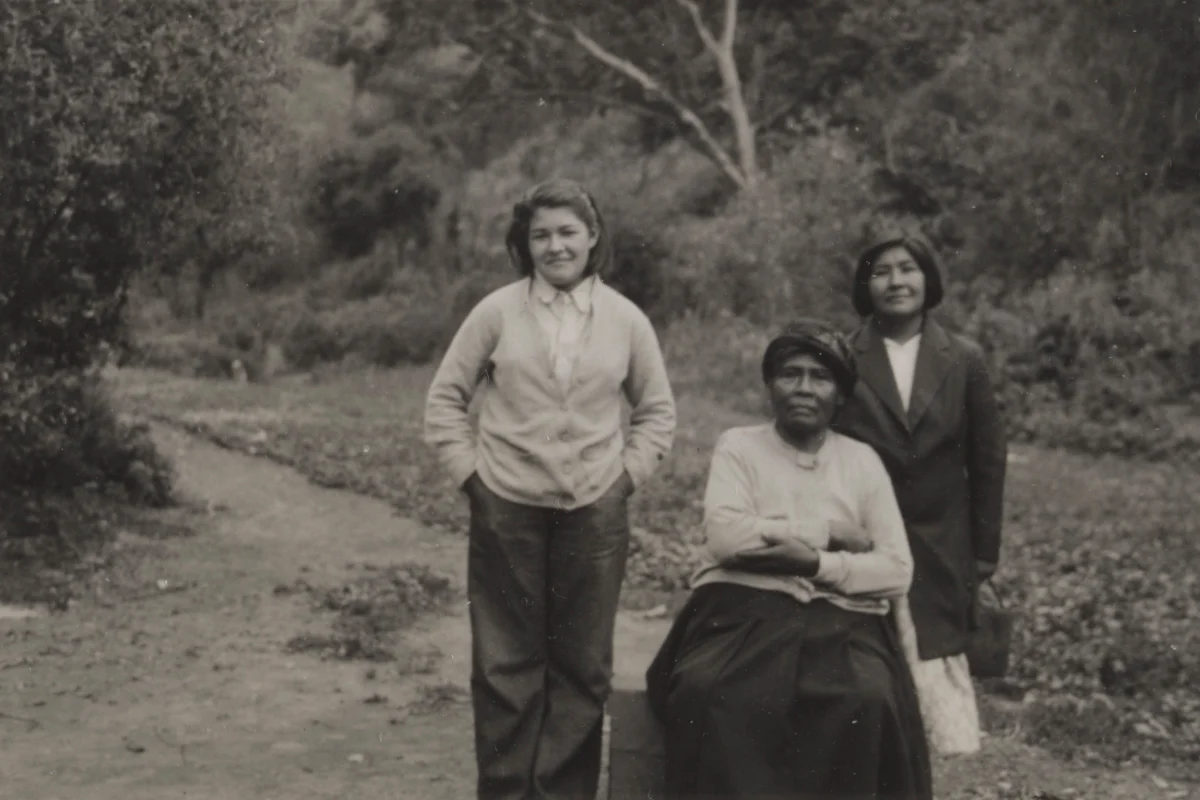
The court case, known by its docket number K-344, dragged on for nearly 30 years, an agonizing wait for justice. When final payments were eventually distributed, California Indian families received between $600 and $700. My own grandmother, Anna Herrera (née Forsting), a Salinan Indian born in 1921, three years before the United States formally recognized Indigenous people as citizens on their own land, was among them. She carried vivid memories of her mother, grandmother, great-grandmother, aunts, and uncles living in Toro Creek, a cherished village nestled in the oak country between what is now Atascadero and Morro Bay on the central California coast, offering breathtaking views of the mountains. Tragically, her family, like countless others, faced forced eviction when she was still a teenager, a years-long campaign waged by the Marre Land and Cattle Company.

After my grandmother’s passing, I discovered a poignant letter among her belongings, dated September 1972 and addressed "TO ALL CALIFORNIA INDIANS." It was an invitation from a group called California Indians for a Fair Settlement, urging her to attend a meeting to discuss the federal government’s impending check. The U.S. had agreed to pay California Indians $29.1 million for the land taken in 1853, an amount that shockingly equated to just 47 cents per acre. The letter starkly reminded recipients that some of this land, rich in gold, had been valued at $20 an acre at the time, with timber and mineral resources worth even more. "What do you think California Indian land is worth?" it provocatively asked. My grandmother never spoke of the letter, the settlement, or the ancestral village from which her family was forcibly removed. Her silence, like that of many survivors, spoke volumes about the pain and injustice endured.
To truly grasp why California Indian land was ultimately valued at less than the price of a postage stamp, one must delve into the obscured history of those unratified treaties, a history largely absent from mainstream Californian education. This historical struggle for land, dignity, and recognition is the very foundation upon which the modern Indigenous LandBack movement, now gaining significant global attention as #LandBack, was born in California nearly a century ago. By enabling California Indian families the right to sue for lands lost after the 18 unratified treaties, state leaders, however imperfectly, acknowledged the profound harm inflicted. This represented a crucial, albeit flawed, opportunity to begin rectifying these historical injustices.
Fast forward to March 2026, a seemingly new era dawned with a glowing press release from the California Natural Resources Agency, celebrating a groundbreaking policy designed to return 7.5 million acres to the stewardship of tribal nations. The announcement heralded the "state’s first-ever Tribal Stewardship Policy," establishing a comprehensive statewide framework for tribal access, collaboration, and the return of ancestral lands. The agency affirmed that this acreage symbolically represents the land promised for reservations to California Indians under those 18 unratified treaties. Over the preceding two years, more than 7.5 million acres had indeed become part of California’s evolving LandBack pledge. Notable examples include the Yurok Tribe in Northern California, the Washoe Tribe, and the Southern Sierra Miwuk, who successfully reclaimed land bordering Yosemite National Park, a globally renowned natural attraction. These lands, previously held by the Pacific Forest Trust nonprofit, represent tangible victories in the ongoing struggle for restorative justice. The Yurok, Washoe, and Klamath tribes, among others, continue to share powerful stories of land return, contributing to the growing momentum of the #LandBack movement across Indian Country and internationally. However, it is a stark reminder that nearly a century ago in California, Native people were compelled to file lawsuits with the hope of either having their land returned or receiving fair compensation—neither of which fully materialized.
The California Indians Jurisdictional Act of 1928 specifically permitted lawsuits on behalf of "the Indians of California," defined as anyone who could trace descent from an individual living in the state on June 1, 1852, seeking restitution for land they would have received under the unratified treaties. This complex legal battle became widely known by its docket number, K-344, a lawsuit that proceeded in the wake of the congressional act. In 1937, a Government Accounting Office (GAO) report meticulously documented every dollar the state claimed to have spent "for the benefit of" California Indians between 1852 and 1932. This included funds allocated for schools, hospitals, and even the surveying of reservations that were never actually established. California then controversially demanded that this sum be subtracted from any monetary compensation the federal government might award for land claims.

These so-called "offsets" encompassed an astonishing array of expenditures, from the prosecution of kidnappers—a grim acknowledgment of California’s documented Indian child-kidnapping and indenture trade of the 1850s and ’60s—to the salaries of Indian Commissioners and the administrative costs of enrolling every California Indian on a 1928 compensation list. The proposed settlement amount stood at $17,816,624.48, but the offsets to be deducted totaled a staggering $12,650,761.02, leaving a net award of a mere $5,165,863.46. Almost as a chilling aside, the GAO report noted that it did not include the money the U.S. had reimbursed California for "suppressing and repelling Indian hostilities"—reimbursements, in essence, for state militias paid to hunt and kill Native people. This separate ledger entry vividly underscores the dual nature of state policy: ostensibly "caring" for Indigenous populations while actively funding their subjugation and elimination.
By the time the case reached its final hearings in San Francisco in 1955, it had devolved into a contentious debate over how to quantify a people’s relationship to their ancestral land. The government’s expert witnesses employed the controversial "ecological theory," an argument positing that a tribe’s true territory could be mathematically calculated by mapping the areas that supplied the majority of its food. Any remaining land was deemed secondary, less deserving of compensation. Some government witnesses boldly asserted that 90% of subsistence was derived from a mere 5% to 20% of a tribe’s claimed land, an argument designed to drastically reduce the amount of land recognized as Indigenous, thereby shrinking the potential payout. However, anthropologists Alfred Kroeber and Robert Heizer systematically dismantled this flawed argument. When directly asked how much land Indigenous people in California owned, Kroeber famously and unequivocally replied, "All of it." The three commissioners, in a unanimous decision in 1959, rejected the ecological theory, affirming the inherent rights of Indigenous peoples to their entire ancestral domains. Yet, it would be another 13 years, until 1972, before letters like the one my grandmother received were sent to households across the state, presenting a take-it-or-leave-it offer and forcing people to decide whether 47 cents an acre was an acceptable sum for generations of stolen heritage.
In the 1960s, the Washington D.C.-based Wilkinson, Cragun and Barker Law Firm conducted meetings across California, actively campaigning to persuade tribal leaders and citizens to accept the proposed settlement money, warning of the risks of further litigation and a potentially even smaller payout. While most California Indians reluctantly accepted the offer, it was not without widespread complaints regarding the grossly undervalued compensation. At a particularly contentious meeting in Eureka in 1964, Michael Rogers, an authorized representative of the Klamath River from the Witchback Hoopa Valley Reservation, powerfully contested the amount. "The real issue today is that these attorneys are here to ask you to sell the rest of the state of California for 47 cents," he declared. "Now they state that 47 cents comes from the price of 1853. Well, in 1853, if land was selling for 47 cents an acre, at that time gold was only worth $16 an ounce. Today, the price of gold is $35, and that 47 cents would be equal to $1 and a quarter, which Congress said that the Indians could sue for would be the limit."
Ultimately, the settlement stood, and the California Indians’ lawyers convinced them to accept the offer. My grandmother, like tens of thousands of others, received her share—approximately $688. Tragically, her mother, Felista Forsting, her grandmother Maria Severiana Bailon, and her uncles Jose Bailon and Ramon Roses, all listed on the judgment rolls of the 1928 lawsuit, passed away without ever receiving a single penny for their stolen ancestral lands. Half a century later, the state of California has shifted its rhetoric from "settlement" to "stewardship." While this linguistic change marks a conceptual evolution, the underlying dynamic remains unsettlingly familiar: California continues to dictate what to "give back," when, and to whom—the very same government that, in 1852, decided what to take. Some estimates suggest Indigenous people lost more than 75 million acres across California, a scale of dispossession that dwarfs any current efforts at restitution. Despite new initiatives, official apologies, or policies of stewardship, no measure can fully compensate my family, or the countless others, for the profound and enduring losses of land, culture, and sovereignty.