Johny Prima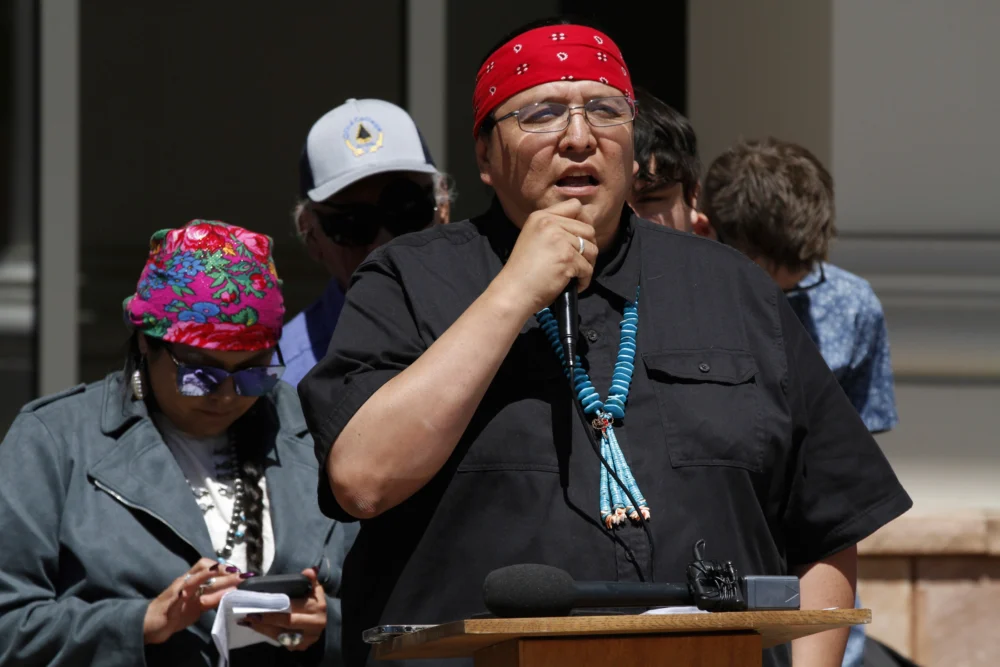
Mario Atencio (Diné) carries vivid memories of his grandmother’s serene life in Counselor, New Mexico, a remote haven within the sprawling Greater Chaco Landscape. Her property, a lush tapestry supporting dozens of animals, represented a tranquil, traditional Navajo existence, a stark contrast to the environmental degradation that would later engulf it. This idyllic peace began to erode in 2015, when oil and gas drillers initiated extensive hydraulic fracturing operations across New Mexico’s vital northwest corner. What followed was a profound transformation, as Atencio’s ancestral lands became increasingly besieged by the relentless hum of machinery, the omnipresent haze of air pollution, and the stark reality of industrial expansion. The situation escalated dramatically in 2019, when the land and its precious groundwater resources suffered massive contamination from spills that released thousands of gallons of oil, irrevocably altering the ecosystem. Once-thriving native plants, including those crucial for traditional medicinal practices, vanished, and the area’s rare birds and diverse wildlife began to disappear, signaling a deep ecological wound.
Two years ago, Atencio stepped forward as the lead plaintiff in Atencio v. State of New Mexico, a pivotal climate litigation case that now stands poised to set a national precedent. This lawsuit directly accuses the New Mexico Legislature and various state agencies of actively contributing to the harm inflicted upon Indigenous communities and of failing in their fundamental constitutional duty to prevent harmful pollution. Atencio articulates the core grievance with poignant clarity: "The rights that we have as Indigenous people to free, informed, prior consent are being violated. We’ve never had people from the government come and say, ‘This is what’s going to happen to your land and water.’" This statement underscores a historical pattern of disenfranchisement and disregard for tribal sovereignty that has plagued Indigenous communities globally in the face of resource extraction.
After navigating the complexities of the lower courts, the New Mexico Supreme Court recently agreed to hear the case, marking a significant advancement for environmental justice advocates. Should the court rule in Atencio’s favor, this decision would join a growing body of high-profile climate litigation successes. Among these is Held v. Montana, a groundbreaking case where young plaintiffs successfully argued that Montana violated their constitutional right to a healthy environment by failing to adequately regulate greenhouse gas emissions. Similarly, last year saw a victory for young, Indigenous climate advocates in Hawaiʻi, who secured a settlement against the state’s Department of Transportation. That case challenged the department’s continued support for highway expansion projects, which contradicted the state’s stated goal of decarbonizing its transportation sector by 2045, highlighting the increasing legal pressure to align policy with climate commitments.
The burgeoning landscape of climate litigation extends beyond these prominent cases, with similar lawsuits filed in virtually every state across the nation. Margaret Barry, who meticulously tracks climate litigation at Columbia University’s Sabin Center for Climate Change Law, notes a handful of significant successes over the past decade. These cases often leverage state constitutional provisions that explicitly outline a government’s duty to proactively safeguard residents’ rights, including the right to a healthy environment. However, the strength and interpretation of these protections vary widely. For instance, in Sagoonick v. State of Alaska, a group of young people sought to halt a liquified natural gas project, asserting that the state constitution’s protection of natural resources for the general public implicitly required a livable climate. The Alaska Supreme Court, however, ultimately disagreed with this broad interpretation in March, illustrating the ongoing legal challenges in establishing explicit constitutional climate rights.

New Mexico’s legal framework, however, presents a more robust foundation for the Atencio case. In 1971, voters adopted a constitutional amendment that unequivocally directs the state government to "provide for control of pollution and control of despoilment of the air, water and other natural resources." Gail Evans, the Center for Biological Diversity attorney leading Atencio’s legal team, emphasizes that the Atencio case rests squarely on this provision, arguing that the state has demonstrably failed to uphold these constitutional responsibilities. This "Green Amendment" empowers New Mexico citizens with a powerful tool to demand environmental accountability from their government, reflecting a progressive legislative foresight that many other states lack.
Evans draws a compelling parallel between the state’s duty to control pollution and its obligation to adequately fund public education. Just as the state must provide resources for teachers and establish guidelines for schools, it is constitutionally bound to provide the necessary tools and oversight to protect public and environmental health from oil and gas pollution. Evans asserts that New Mexico has "just utterly failed" in this regard, citing lax enforcement, a labyrinth of loopholes, and a regulatory environment that allows the industry to pollute with minimal consequences. The lawsuit contends that this systemic failure has directly led to the environmental degradation experienced by communities like Mario Atencio’s.
Further substantiating these claims, data from the environmental watchdog group Earthworks reveals a stark reality: in 2023, the New Mexico Environment Department employed a mere two full-time inspectors to investigate complaints across all 56,000 oil and gas facilities within the state. This severe understaffing effectively leaves the industry to largely self-report its emissions of harmful air pollutants and potent greenhouse gases like methane, a system rife with potential for underreporting and unchecked pollution. The lawsuit also highlights the personal experience of Kendra Pinto, another Diné plaintiff, who documented a significant methane leak near her home, even after the Environment Department had assured her that no leaks were detected. This anecdote vividly illustrates the disconnect between regulatory assurances and ground-level reality, underscoring the profound lack of effective oversight.
"You can get a permit to frack simply for asking," Evans contends, emphasizing the state’s permissive approach to fossil fuel extraction. She adds, "The state doesn’t do any type of environmental or public health overview or consideration before granting that permit." This policy has led to critical environmental and health crises, particularly in the Permian Basin, a geological formation that spans parts of New Mexico and Texas and is one of the world’s most prolific oil-producing regions. Here, ambient air quality readings consistently exceed federal standards, yet new wells continue to be permitted, exacerbating pollution and intensifying public health concerns for the predominantly low-income and Indigenous communities living near these industrial operations.
The potential ramifications of Atencio v. State of New Mexico are immense, as a favorable ruling could compel the country’s second-largest fossil fuel producer to fundamentally reform its environmental practices. However, leveraging similar legal victories at the federal level has proven significantly more challenging, as Margaret Barry points out. The U.S. Constitution, in its current interpretation, primarily functions to limit governmental infringement on civil liberties, such as free speech, rather than proactively granting rights like the right to a healthy environment, a distinction that sets many state constitutions apart. This difference explains why federal climate lawsuits face steeper uphill battles.

A recent example of this federal limitation is the October dismissal of Lighthiser v. Trump by a federal judge in Montana. This case sought to expand protections won at the state level in Held v. Montana, with twenty-two plaintiffs, including several from the Held case, arguing that the Trump administration’s executive orders rolling back climate protections and boosting fossil fuel production were unconstitutional and threatened their right to a stable and healthy climate. While the judge acknowledged the plaintiffs were indeed being harmed by climate change, he ultimately ruled that federal courts lacked the authority to force the government to alter its course, underscoring the judiciary’s perceived constraints in mandating climate policy at the national level.
Should the New Mexico Supreme Court rule in his favor, Mario Atencio envisions a future where the state is not only forced to meticulously document the adverse effects of oil and gas pollution on Indigenous communities’ health and sacred lands but also compelled to take decisive action to protect them. Such actions could encompass a range of transformative measures. These include implementing a moratorium on new oil and gas development until verifiable emissions reductions are achieved, systematically closing the legal loopholes that currently allow operators to pollute with impunity, significantly increasing funding for environmental enforcement and regulatory oversight, and establishing larger, more protective buffer zones between drilling sites and sensitive areas like homes, schools, and traditional cultural sites.
The industry’s counter-argument, often heard in these legal battles, is that such stringent regulations would jeopardize their business model. Evans directly challenges this notion: "What’s so shocking to me is that the industry will come forward and say, ‘If you do what the plaintiffs are asking for, you’ll put us out of business.’ So you can’t operate in a way that doesn’t harm people’s health and environment? Because that’s what we’re asking for." This statement encapsulates the core conflict between economic interests and the fundamental right to a clean, healthy environment, a conflict that the Atencio case in New Mexico seeks to resolve in favor of its citizens and their ancestral lands. The outcome of this landmark litigation could redefine the balance between energy production and environmental protection in one of the nation’s most significant fossil fuel-producing states, offering a beacon of hope for environmental justice movements across the globe.