Roger Danuarta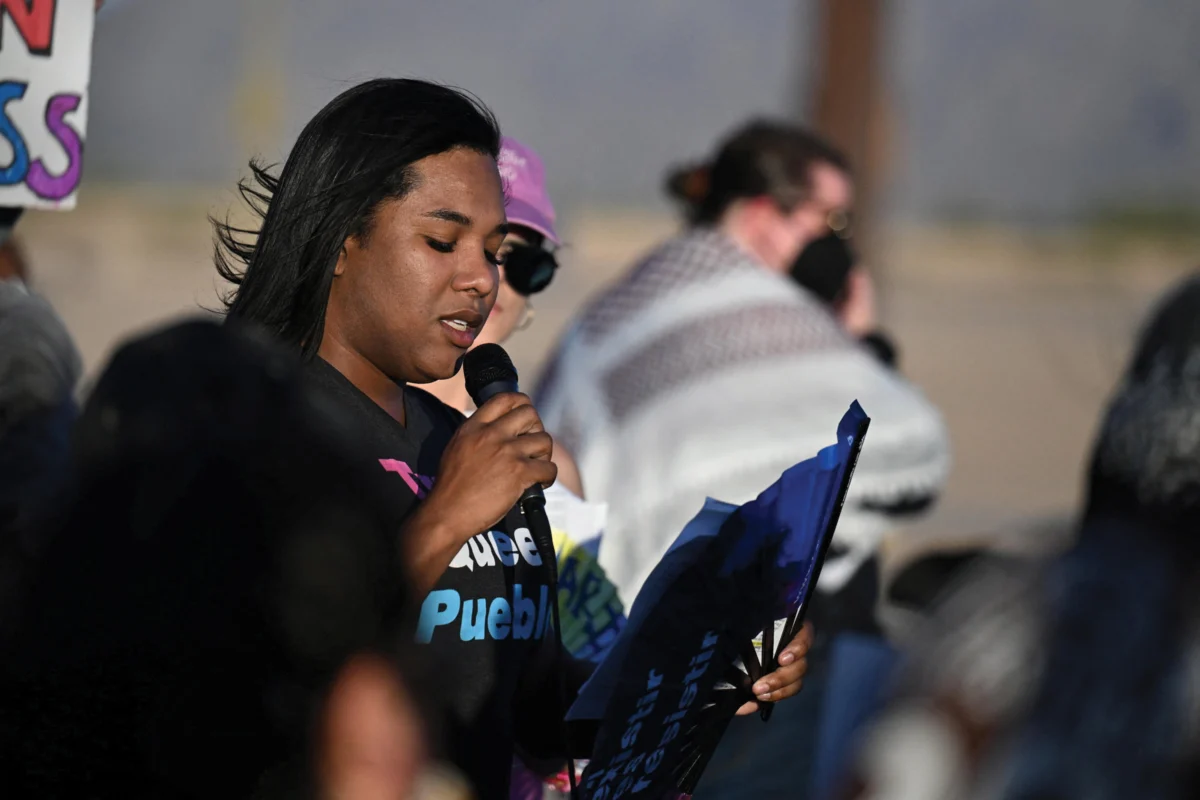
Minutes after her release from the notorious Eloy, Arizona, immigration detention center, Karla Saenz, 26, sat in a truck-stop Wendy’s, her pink tennis shoes lacking laces confiscated by United States Immigration and Customs Enforcement (ICE). Though physically exhausted and hungry, her voice, though tired, carried an unyielding resolve to continue her fight. Saenz, a trans woman, had dedicated the preceding year to campaigning for Arbella "Yari" Marquez, a lesbian Phoenix resident held captive in the same Eloy facility, suffering from leukemia and significant weight loss. For Saenz, Marquez’s plight was deeply personal, fueling her efforts to organize advocacy campaigns, facilitate visitations, liaise with politicians and the media, and relentlessly expose the dire conditions within the camp, particularly for LGBTQ+ individuals.
Working alongside Trans Queer Pueblo, a Phoenix-based racial and gender justice organization championing trans and queer migrants, Saenz propelled Marquez’s story onto the national stage. Their collective activism garnered critical attention from members of Congress and a diverse array of community faith leaders, highlighting the urgent need for humanitarian intervention in immigration detention. Saenz’s own journey to advocacy was forged in the crucible of severe persecution in her native Venezuela, where, as a trans woman, she endured multiple instances of rape, two kidnappings, and forced labor while fleeing across several South American borders. These traumatic experiences, which she finally escaped in 2024, underscored the profound risks faced by LGBTQ+ individuals seeking safety and asylum, ultimately leading her to the U.S. border to initiate the asylum process.

Her own detention began in March when, accompanied by a Trans Queer Pueblo volunteer, Saenz attended what she believed to be a routine immigration check-in. Without explanation, an agent informed her she was being detained, an announcement that reduced her to tears. A week later, after a bewildering series of deprivations and transfers, she tested positive for COVID-19 and found herself in isolation, eerily close to Marquez within the same detention center, yet unable to communicate with the woman she had fought so fiercely to free. Following her isolation, Saenz spent six agonizing weeks confined to the men’s unit, a placement that subjected her to profound distress and misgendering. During this time, Marquez managed to send her a letter, a powerful message of solidarity and encouragement, urging Saenz to remain strong and expressing hope for their eventual freedom. Unable to directly assist Marquez from within, Saenz redirected her energy toward supporting other trans women held in the men’s unit, recognizing their shared vulnerability and urgent need for advocacy.
The Eloy Detention Center, a sprawling facility opened in 1994 and operated by the private, for-profit company CoreCivic, has long been a focal point of controversy. Situated amidst farmlands about ten minutes from Eloy, a sun-baked town of just over 15,000 people, the camp’s grim facade of concertina-wire double-fencing and flat gray walls belies the harrowing experiences reported by those confined within. Advocacy groups and human rights organizations have consistently decried Eloy as one of the deadliest detention centers in the country, citing a consistent pattern of inadequate medical care, unsanitary conditions, physical abuse, and frequent lockdowns. Saenz’s personal account corroborates these systemic failings; she recounted weeks of being denied her essential hormone treatment and medication for a chronic illness, enduring pervasive transphobia, subsisting on substandard food, and having her complaints repeatedly ignored by guards.
In response to Saenz’s allegations, an ICE spokesperson issued a detailed email, controversially referring to her by her deadname and using male pronouns, asserting that her claims of "mistreatment and denied medical care are entirely false." While declining to comment on her COVID-19 diagnosis due to patient privacy, the spokesperson maintained that Saenz had filed no official grievances during her detention and that her arrest stemmed from missed scheduled check-ins, a claim Saenz vehemently denies. The ICE representative emphasized that "Facility staff treat all detainees equally, with respect and dignity," and provocatively added that "Being in detention is a choice," suggesting that unauthorized migrants should voluntarily depart the country. This official response starkly contrasts with international human rights standards, which emphasize the right to dignity, appropriate medical care, and gender-affirming treatment for all detainees, particularly vulnerable populations like transgender individuals. The act of misgendering, especially by an official agency, is a deeply harmful practice that denies an individual’s identity and can exacerbate trauma.

Saenz’s detention unfolded against a backdrop of dramatically escalating immigration enforcement in the United States. Since the commencement of Trump’s second term, detention book-ins have surged, running over 60% higher in early 2026 compared to the same period the previous year. For transgender detainees, this expanding enforcement presents an even more perilous and opaque reality. In a concerning move that severely impedes oversight and protection efforts, ICE ceased publishing data on transgender people in custody in February 2025, making it nearly impossible for advocates to accurately track or safeguard these highly vulnerable individuals. This lack of transparency has drawn sharp criticism from human rights organizations, who argue it masks potential abuses and hinders accountability.
The powerful campaign initiated by Trans Queer Pueblo for Marquez, which then extended to Saenz herself, coupled with critical media coverage, ultimately prompted legal intervention on Saenz’s behalf. After more than six weeks in detention, a judge ordered her release on April 21, and she walked free the following day. Within half an hour of her release, she met with reporters at the Wendy’s off I-10, approximately 45 minutes south of Phoenix, where she began to share her story. The following insights, translated from Spanish and edited for clarity, are drawn from three conversations: one conducted by phone while Saenz was still detained, another immediately following her release, and a third several weeks later, together tracing the arc of her 44-day ordeal and her steadfast refusal to be silenced.
While still detained, when asked how she was, Saenz replied, "Bad." She elaborated on the "inhumane treatment, living with so many men, the discrimination and transphobia." She described being isolated for five days, supposedly for COVID, despite having no symptoms, allowed out only to bathe, eating in her cell, unable to communicate, crying all day, losing track of time, and experiencing inconsistent or withheld meals. "Yes," she confirmed, when asked if she went hungry. On how she coped, Saenz explained, "I’ve tried to stay strong, maintain my ideals, but it’s really complicated to fight alone against everything when there are no human rights, no respect, no nothing."

Recounting her arrest at the U.S. Citizenship and Immigration Services office in Phoenix, Saenz detailed how an agent separated her from her accompanying volunteer for a "verification." She was led to a room, asked for basic information, then saw an official with gloves who declared she was being detained. "They put shackles on my hands, ankles, waist, and then took me out the back like a criminal. And I started crying and shaking with nerves." Members of Trans Queer Pueblo assert her detention was retaliation for her advocacy for Arbella "Yari" Marquez, a view Saenz unequivocally shares. "Yes, it’s retaliation. It’s their way of trying to silence us, but they won’t be able to. They have me locked up without any reason except I’m trans, Black and an immigrant, because I raised my voice and have no fear."
Reflecting on her time inside shortly after her release, Saenz described her feelings as "all mixed up," but unequivocally stated, "it’s disgusting, and nobody deserves to be held inside — nobody." Challenging ICE’s denial of her solitary confinement, she asserted, "It’s not in their interest for people on the outside to know what’s happening inside. There are no human rights. There’s no respect for anybody. They do whatever they want with us. A lot of people are isolated, a lot of people are medicated (against their will), a lot of people are dying inside, and they don’t care." She further exposed the coercive tactics used by detention staff: "They try to make you sign a voluntary departure form, and if you don’t, they throw you in a room." This practice, where detainees are pressured to waive their right to a hearing and agree to leave the country, often without legal counsel, is a significant concern for human rights advocates. Saenz revealed she was pressured to sign voluntary departure papers "more than 10 times," each time refusing, often ripping up the documents and fighting back.
Saenz confirmed there were three other trans women detained with her in Eloy, all also held in the men’s unit. "We asked to please be treated as women. We had come from fighting transphobia on the outside. They kept calling me ‘Mr. Carlos Saenz.’ I’ve been struggling with this for years, trying to escape it, and all I ask is, please, respect my identity as a woman. I spoke with the manager, with the boss; I spoke with everyone, and they didn’t care." Despite the restrictions, Saenz recounted how the trans women would gather in the yard. "They wouldn’t let us be together inside. But we’d go out to the yard together, the three of us, and we’d cry and laugh together. They had been in longer than I had. I defended them so many times. It’s so hard to fight against a system and against the rooted machismo. I defended them because the men cat-called them, humiliated them. They’re my sisters." Her unwavering commitment underscores the critical role of peer support and advocacy within detention settings, where vulnerable populations face heightened risks of abuse and discrimination.

Looking ahead, Saenz declared, "I’m going to keep fighting. Right now, I feel in my heart this desire, this need, because I was able to get free, but my sisters are still inside. They’re still living that discrimination, the transphobia." Weeks later, reflecting on her confinement, the memories remained vivid. "I remember everything: the pain, the sadness, the despair, the inhumane treatment we received, and the discrimination and racism we faced from the CoreCivic guards. The transphobia is really intense inside." She described being forced to wear ill-fitting, baggy clothes, forbidden from knotting or tucking her shirt, with threats of punishment if she did. She also recalled waiting 15 days to receive a bra after requesting one, highlighting the pervasive delays in providing basic necessities and gender-affirming items.
During the long, isolated nights, Saenz’s thoughts turned to her fellow trans detainees. "That I couldn’t give up — that I had to share my understanding with the other girls so they could defend themselves. I thought about them a lot. I’ve always been able to stay strong because I felt that Trans Queer Pueblo had my back." She saw their vulnerability, the mistreatment from both inmates and guards, and felt a profound need to empower them. "I just kept thinking about what talks I could give them, or how to educate them so they had the tools to defend themselves against all of it. And I’d get sad, too, and cry, though I never lost hope I’d get out of that place."
There was no peace or tranquility inside the detention center. "Inside, we were the only feminine presence, and the men saw us as sexual objects." Saenz transformed this threat into an opportunity for education, engaging with other inmates to explain and demand respect for trans women. "I stayed strong and leaned into my knowledge, and I demanded respect. I taught them how to live with a trans woman." She never considered hiding her identity. "Never. I always stood firm: that I am a trans woman, that I’m Karla Saenz, and that I won’t let anything or anyone rob me of my identity."

The psychological toll of detention remains evident in her healing process. "When I got out, I was scared to be out again, to return to daily life, and it felt really odd. I couldn’t sleep. I would wake up crying. I can tell that detention really affected me." Despite her outward strength, she emphasized the profound suffering inflicted by such confinement. "Though I always present myself as strong, and I know I have the tools to defend myself, I really believe that nobody deserves to live that life inside. It’s hell."
Meanwhile, Arbella "Yari" Marquez, the queer detainee whose cause Saenz championed, continues her prolonged confinement, now exceeding 17 months, within the Eloy Detention Center. Her limited contact with the outside world and minimal exposure to sunlight are vividly documented in the detailed, revealing drawings she has sent to her partner. Lacking reading materials, Marquez turned to art, creating powerful images that convey the stark reality of her detention, including one poignant drawing depicting her cell with coffins resting on the bunk beds—a stark visual metaphor for the despair and suffering experienced within. These images serve as a chilling testament to the severe psychological and emotional impact of prolonged detention on vulnerable individuals.