Rocky Gerung
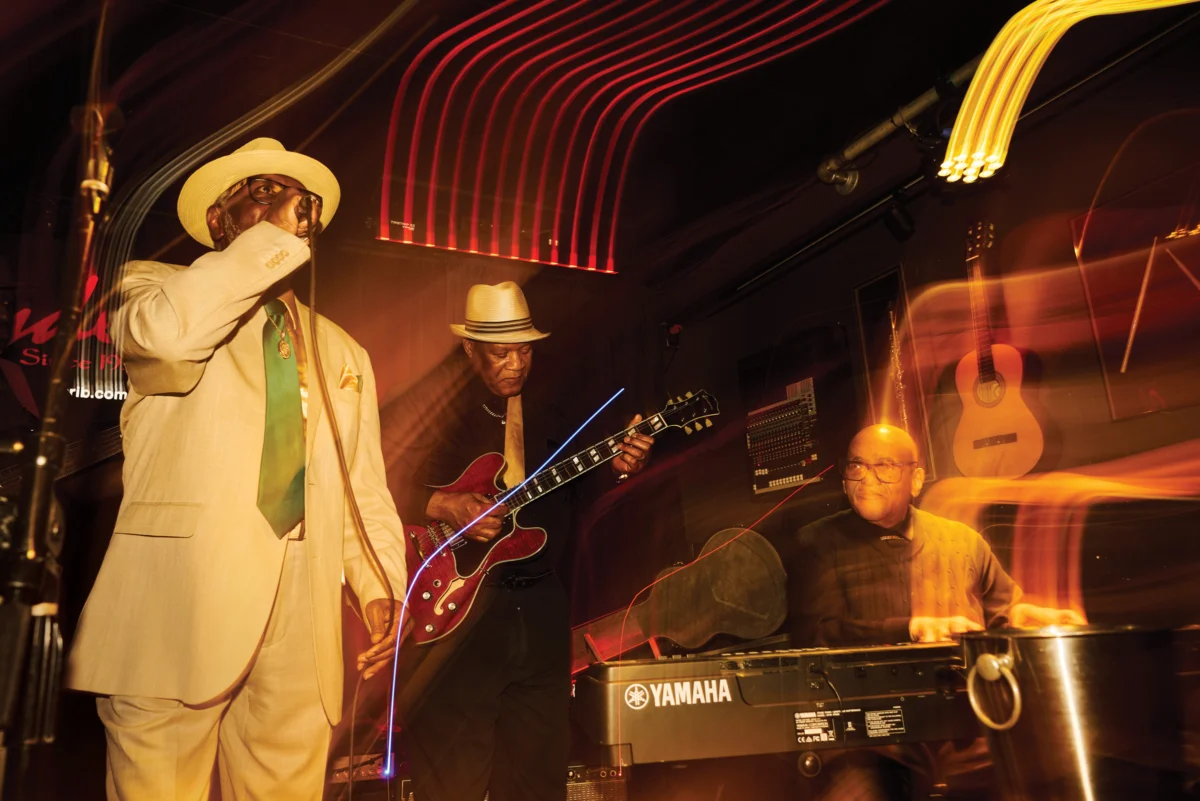
When Norman Sylvester was just 12 years old, long before he was known as "The Boogie Cat" or graced the stage with legends like B.B. King, he embarked on a transformative journey. Boarding a train in rural Louisiana, he headed west toward the distant promise of Portland, Oregon. His childhood had been steeped in the idyllic rhythms of the Southern countryside: feasting on wild muscadine grapes from his family’s farm, fishing in the bayou, and churning butter to the soulful sounds of his grandmother’s gospel hymns. When his father, who had sought better employment opportunities in Portland, sent for him, young Sylvester felt as though he were being plucked from paradise.
It was the autumn of 1957, a time when Oregon held a deeply entrenched reputation as an unwelcoming territory for Black families. From 1844 until 1926, the state enacted a series of exclusionary laws explicitly designed to prevent Black people from residing within its borders. The Oregon Donation Land Act of 1850, while offering vast tracts of free land to white settlers, cruelly prohibited Black individuals from claiming any property. Oregon notably refused to ratify the 15th Amendment, and in 1917, its Supreme Court sanctioned racial discrimination in public accommodations. By the 1920s, Oregon had become home to the largest Ku Klux Klan chapter west of the Mississippi.

Despite this inhospitable climate, Black pioneers were among Oregon’s earliest settlers, forging lives and striving for equality amidst systemic hostility. The Portland chapter of the NAACP, established in 1914, stands as the oldest continuously operating chapter west of the Mississippi River. Nevertheless, the state’s pervasive anti-Black policies acted as powerful deterrents. By the time Sylvester arrived, African Americans constituted less than one percent of Oregon’s population, and Portland’s Black community was the smallest among major West Coast cities. This stark contrast to his vibrant Southern roots plunged Sylvester into profound culture shock upon stepping out of Portland’s Union Station.
About to enter seventh grade at his first integrated school, Sylvester needed a haircut. His initial destination in his new city was a barbershop near the bustling intersection of Williams Avenue and Russell Street in North Portland. Upon reaching the corner, he was met with a lively scene. A handsome brick building topped with an onion-shaped cupola graced one corner, while homes and businesses – a cafe, a drugstore, a produce market – lined the others. Everywhere he looked, he saw a familiar sight from Louisiana: "African American people – in charge of businesses, driving nice cars up and down the street, strutting their stuff." He would later draw parallels to Harlem, but that day, it simply reminded him of the home he had left behind. Despite the thousands of miles separating him from the muscadine vines twining his grandmother’s fence, standing on that corner, Sylvester felt a sense of belonging. The very air seemed familiar, imbued with the aromas of Southern cooking and carrying the lively strains of gospel and jazz. "The place just embraced me," Sylvester recalled recently. "Everybody was singing the same song, if you know what I mean."
This vibrant intersection was, in fact, the heart of a neighborhood known as Albina. In the early 1900s, Black Portlanders, many employed as railcar attendants, began to settle in this area due to its proximity to Union Station. In the ensuing decades, discriminatory housing practices, including landlord-driven exclusion and institutional policies such as a 1919 Portland Realty Board ruling deeming it unethical to sell homes in white neighborhoods to non-white buyers, pushed Black residents into other parts of the city and further concentrated the community in Albina. By 1940, over half of Portland’s Black population, then just under 2,000 individuals, resided in Albina.

The onset of World War II brought a surge of over a hundred thousand newcomers to the city, including approximately 20,000 African Americans drawn by employment opportunities in the burgeoning shipyards. Among these migrants were Sylvester’s parents, aunt, and uncle, who settled in a defense housing development called Vanport. Constructed behind a railroad embankment in the floodplain of the Columbia River, Vanport was the largest wartime housing project in the nation. Roughly a quarter of its more than 40,000 residents were African American, making it, by far, home to Oregon’s largest Black community.
Following the war, many Vanport residents began to depart. While Sylvester’s mother returned to Louisiana, his uncle secured employment at a local hospital, and the rest of the family decided to remain in the area, continuing to live in Vanport due to racial restrictions barring them from most other neighborhoods. Tragically, on Memorial Day in 1948, the Columbia River, swollen by spring rains and snowmelt, breached its embankment and inundated the city. Within a mere 40 minutes, Vanport was submerged. At least 15 lives were lost, and more than 18,000 residents, a third of whom were Black, were left homeless.
Sylvester’s family, like the majority of African Americans displaced by the flood, found refuge in Albina, the only Portland neighborhood where they were welcomed. By the time Sylvester settled in the city, four out of every five Black Portlanders lived within the district’s boundaries. Though redlining, a lack of public investment, and negligent landlords sometimes resulted in overcrowded and dilapidated housing, the neighborhood fostered a strong sense of community and vibrance. Black-owned businesses, churches, and gathering spaces flourished. "Everything you needed in a community was right there," Sylvester told me.

Among the essential elements of this community was music. In Albina, during the decades following Sylvester’s arrival, music was abundant. Gospel choirs filled churches with song, while soul bands packed the Cotton Club, then the preeminent soul music venue in the Pacific Northwest. Nearly every night, jazz, blues, and funk bands could be heard in the neighborhood’s numerous venues, including teen clubs and all-ages spaces. Bands were formed in basements, backyards, schoolrooms, and churches, reflecting the deep musical spirit that permeated the community.
At the age of 13, Sylvester’s father, working two jobs – at the hospital by day and the foundry at night – saved enough to buy him a guitar. It wasn’t the coveted shiny red electric model he dreamed of, but an $11.95 pawnshop acoustic. His father promised that if Sylvester learned three songs, he would buy him the electric guitar. In Albina, finding music teachers was not difficult; Sylvester learned his first chords from an elderly Creole man who owned the house his family inhabited. Later, a fellow high school student mentored him in the blues. Sylvester was a quick study, and the guitar soon became a form of empowerment. As a shy country boy from the South, he often felt overwhelmed by Portland’s urban youth, and he stuttered when he spoke. "But with my guitar in front of me, I could express myself," he stated.
Now 80 years old, Sylvester has continued to express himself through music. His first band, Rated "X," was among Portland’s earliest soul ensembles. They recorded a single in 1972 and were gaining momentum from its local success when Sylvester’s trucking company assigned him to a graveyard shift, forcing him to leave the band. However, he continued to play, and before long, he established himself as a distinguished blues musician. The Norman Sylvester Blues Band has been performing for four decades. He has shared concert bills with icons like B.B. King, Buddy Guy, and Mavis Staples, and in 2011, he was inducted into the Oregon Music Hall of Fame.

Sylvester’s accomplishments are significant, yet he is far from the only remarkable musician to emerge from Albina. He is part of a broad and deeply connected community of Black musicians, educators, and arts advocates who converged in this neighborhood during the latter half of the 20th century, transforming the region into a West Coast music hub and forging a legacy that endures today. Until recently, however, the rich musical history of Albina resided primarily within the memories – and sometimes dusty closets – of those who lived it, a generation of artists now nearing the twilight of their lives.
By the time Bobby Smith moved to Albina in the early 2000s, the neighborhood bore little resemblance to the predominantly Black community of Sylvester’s youth. Smith, a young white schoolteacher who occasionally worked as a freelance music journalist, knew that a vibrant jazz scene had once thrived there in the 1940s and ’50s, an era chronicled in Robert Dietsche’s 2005 book Jumptown. Yet, he wondered what had happened to Portland’s Black music scene after 1957. As an avid record collector, Smith sought out recordings to answer this question. For years, he scoured used record stores and consignment shops, but commercial recordings by Portland’s Black musicians from the 1960s, ’70s, and ’80s were scarce. He did, however, stumble upon the 45 rpm single Sylvester recorded with Rated "X" in the early 1970s, one of the few records from those decades he could find. Concurrently, he engaged with neighbors, frequented local parks when music filled the air, and spent time at Clyde’s Prime Rib, one of the city’s few establishments that regularly featured elder Black performers.
In 2014, Smith began DJing for XRAY-FM, a nascent community radio station broadcasting from Albina. By then, he had amassed a modest collection of recordings from the region’s past and started inviting local musicians to the station to discuss them on air. One of his earliest guests was Calvin Walker. A drummer, bandleader, and self-proclaimed "child of Albina," Walker initially planned for a 30-minute interview but stayed for three hours. He shared his life story, inadvertently mapping out an entire ecosystem of musicians and educators who had both shaped and been shaped by Albina. "If you’re really curious about this, here’s a list of people you need to start talking to," he told Smith, offering his assistance.

Soon, Smith’s weekly radio show evolved into a hub where elder Black musicians shared their narratives. Despite the obstacles that had limited their access to the recording industry, Albina’s musicians had diligently documented their own work. A wealth of unreleased recordings survived in their possession: demos, reel-to-reel tapes, cassettes, and VCR tapes. This ever-growing trove of music and memorabilia pouring into the station illuminated an extraordinary legacy of Black arts and culture in Portland, revealing a largely untold chapter of Oregon’s history.
In 2015, Walker, Smith, and Ken Berry – another local musician and community leader – established the Albina Music Trust (AMT) with an ambitious goal: to preserve thousands of obsolete and decaying media items and make them accessible to everyone. Experienced engineers donated equipment and trained volunteers in the operation of archaic machinery. Each item was digitized and uploaded into a meticulously categorized database. After a decade of dedicated effort, in 2024, AMT launched the Albina Community Archive, believed to be the only community archive in the United States dedicated to the restoration of a Black community’s musical heritage.
The online repository now houses over 13,000 items sourced from 180 contributors. It features an extensive collection of music, including live recordings, out-of-circulation albums, and unreleased demos, alongside films, newsprint, posters, handbills, and oral histories. This vast collection serves as the archive’s foundation, functioning more as a seedbank of historical artifacts than a static museum. These preserved items are brought to life through projects extending far beyond the website. An art installation titled Wall to Wall Soul combines restored and recolored posters and photography, creating striking images exhibited across the city and now permanently displayed in the dining room of Clyde’s Prime Rib. Under the record label of the same name, AMT releases vinyl albums of previously unheard music from Albina’s past, as well as new works by contemporary artists from the community. An audio tour, The Albina Soul Walk, guides listeners on a mile-long, music-infused journey through Albina, visiting the sites of former venues and gathering places while featuring recordings of musicians and club owners recounting the neighborhood’s history. Listening to the tour feels akin to donning 3D glasses, bringing an unseen dimension into sharp focus. Even after removing the earbuds and re-entering the present-day sounds of the city – the rustling of maple leaves, the distant hum of cyclists – the voices from the tour lingered. Though I departed the neighborhood the same way I arrived, the experience had profoundly altered my perception.

One morning last summer, I met Smith, Walker, and Berry at AMT’s modest office in Northeast Portland. The space, barely a few hundred square feet, resembled a walk-in closet. Shelves laden with neatly labeled boxes lined one wall, while audio equipment spanning various eras – turntables, reel-to-reel machines, cassette players, CD drives – crammed the desks and floor. A grid of framed record sleeves adorned a lime-green wall, and the mellow strains of jazz filled the room.
Settling into one of the four mismatched chairs arranged in the compact space felt less like a formal meeting and more like joining a family gathered around a cozy kitchen table. That day, I experienced something akin to Smith’s initial encounter with Walker: I anticipated an hour-long conversation, but one story led to another, stretching well past lunchtime, at which point hunger compelled us to a taqueria across the street, where we continued our meal and discussion together.
Ken Berry arrived in Oregon from Kansas in 1953 at the age of four. His family settled in a house in Southeast Portland near Laurelhurst Elementary, where he became the school’s first Black student. However, two years later, following complaints from anti-integration neighbors, their landlord demolished the house, and the Berry family relocated to Albina.

There, he began playing piano during Sunday school at the New Hope Missionary Baptist Church, earning 75 cents a day. He joined the choir at Jefferson High School, and after graduating, he started playing a Hammond B3 organ at what was then Albina’s most prominent jazz club, The Upstairs Lounge. It was there he met the late Thara Memory. Memory, a trumpeter from Florida who had performed with artists like James Brown, was traveling with his band en route to Seattle when they stopped in Portland to play at The Upstairs Lounge. However, the allure of Albina – its towering trees and vibrant community – captivated him, and when his band continued north, Memory stayed. He and Berry later formed a group called Shades Of Brown, one of several collaborations that would profoundly shape Albina’s music culture for decades to come.
Around the same time and not far from The Upstairs Lounge, Walker encountered Memory at another vital community hub in Albina, the Albina Arts Center. As a teenager, Walker frequently performed there with his jazz-infused funk band, The Gangsters. "Thara comes in one night and says, ‘Can I play your trumpet?’" Walker recalled. He handed over the instrument and listened, utterly mesmerized. "I never played trumpet again!" Instead, Walker continued on drums, and Memory joined him on trumpet.
In the summer of 1970, the American Legion held its annual convention in Portland. Hoping to deter potential war protesters from disrupting the event, the city organized what is believed to be the only state-sponsored rock concert in U.S. history: Vortex 1. Although The Gangsters were not officially invited to perform, they loaded their equipment onto an Albina Arts Center truck and drove to the festival, arriving right at the stage. When the manager informed them that all performance slots were filled, Memory retorted, "But you don’t have any all-Black bands." Thirty minutes later, they were on stage. "We played for an hour and a half, and I think they even paid us!" Walker said, a grin spreading across his face.

Despite its historical significance, most retrospective coverage of this event – including a book and a television documentary – omitted this crucial detail. When AMT inquired about the omission, the answer was straightforward: the researchers were unaware of it. Like much of Albina’s history, this story was held within the community, not within institutional archives. "The public library and the Oregon Historical Society have existed for over a hundred years," Smith told me. "But in the 10 years we’ve been around, we’ve become the largest digital repository of Black arts and culture in the entire state of Oregon." Walker nodded in agreement. "People are putting their lives in our hands because they trust that their story will be told accurately," he stated.
AMT is part of a burgeoning nationwide network of community archives dedicated to preserving collective histories often overlooked by mainstream repositories. More than 300 such archives have been mapped across the country, each documenting a distinct facet of American life, from LGBTQ+ experiences in the Deep South to the activism of radical Indigenous women and the stories of communities impacted by the death penalty. As control over historical narratives becomes an increasingly potent political tool – exemplified by the Trump administration’s attacks on the National Museum of African American History and Culture – community-based archives like AMT broaden the spectrum of voices authoring history, crafting a narrative of America that resonates less as a monologue and more as a rich, multifaceted choir.
In AMT’s compact office, Walker, Smith, and Berry seamlessly wove together the Trust’s narrative with the deep rapport forged over years of shared dreams and collaborative problem-solving. Despite their differences in age and race, the mutual respect among them was palpable, evident in the fluid way their conversation flowed, with one man recounting an anecdote, another clarifying a timeline, and the third providing essential context. It was only later that I recognized what this experience reminded me of – music, of course. Listening to these three converse felt like observing a masterful band jam session: each player contributing a distinct element without overshadowing the others, creating a collective output far greater than the sum of its individual parts.

Before I departed, Berry handed me a copy of YouthSound and requested that I text him upon my safe arrival home. That evening, I placed the album on my turntable and perused the liner notes as a cascade of voices – dozens of children and adults singing in unison in a high school auditorium four decades prior – filled my living room. "It was all about listening," one student recalled. "Anybody could put out a tune. But your tune gotta match the person standing next to you. This was about teamwork. We needed to sound as one."
While their work often involves the literal preservation of the past, AMT’s ultimate focus is on the future. "In another 50 years, we don’t want a couple of guys like me and Ken sitting around talking about the good old days," Walker remarked. To that end, the Trust is actively collaborating with Portland schools and nonprofits to expand access to arts education while connecting students with the rich Black music legacy of Albina.
Last June, I drove to the school district headquarters for "Rhythms of Tomorrow," one of 38 public events AMT hosted in 2025 alone. This initiative, a collaboration between AMT and Portland Public Schools, marked the first district-wide celebration of Black Music Month. On my way, I stopped for lunch on Mississippi Avenue, in the historic Albina neighborhood. Standing in line for tacos, I found myself surrounded by throngs of lunch-goers wearing Blundstone boots and sporting fine-line tattoos – predominantly individuals in their thirties and forties, mostly white. Nearby, a cafe advertised boba tea and handcrafted donuts, and a boutique nursery offered mounted ferns for $150 each. Yoga studios and brewpubs abounded.

Decades after city bulldozers tore through Albina, another wave of displacement impacted what remained of the neighborhood. In the 1990s, the area’s affordable housing began to attract white residents priced out of other districts. The city commenced investing previously withheld resources into Albina, cracking down on predatory lending and housing abandonment. These changes primarily benefited middle-class white newcomers, and soon, gentrification drove housing prices beyond the reach of many long-term residents. By 2000, less than a third of Black Portlanders lived in Albina, and for the first time since the 1960s, the area no longer held a Black majority. "A lot of folks are out in The Numbers now," Sylvester told me, referring to the far reaches of East Portland. "I used to cruise around in my 1974 Dodge Charger – it had a sunroof and an 8-track," he reminisced. "I could wave at 50 people, stop and talk to 30. Now, I can drive from my house in Kenton, all through Albina, and never wave once."
A mile south of Mississippi Avenue, the school district headquarters occupies a sprawling 10.5-acre campus. Once a site of "urban renewal" projects in the 1960s that displaced residents, it is now a drab industrial building, brick-pink and resembling a parking garage. However, on the day of my visit, the building’s austere exterior stood in stark contrast to the vibrant scene within. Children darted about, enjoying watermelon slices and salami from a long table laden with snacks. Adults exchanged warm hugs and handshakes. A DJ commanded a setup of turntables and mixers, capturing the attention of numerous 11-year-olds and filling the room with buoyant music.
Norman Sylvester opened the event, the first in a lineup of musicians and speakers spanning genres and generations, from blues to hip-hop, high school students to elders. He stepped onto the stage, his guitar held more like an extension of his body than an object in hand. Though Sylvester has explored various genres throughout his career, he remains deeply rooted in the blues. When asked what drew him to this music, he explained, "I can only imagine a man like Muddy Waters or Son House, plowing a field, driving a tractor all day, and still being able to play a guitar and sing at that quality. Where did that come from?" Before I could offer a guess, he answered, "From the dedication they had to doing something better. Those journeys just mean something to me, so I want to keep that going."

Listening to him play that afternoon, his notes bending into riffs that were at once aching and sweet, I reflected on his words and their profound implication: a song is not merely an artifact to be archived, but a repository of history in itself. Here, preserved in melody and lyric, rhythm and pitch, a record of life is stored for future access.
Before the end of summer, I attended one more AMT event: the latest performance of TimeSound, Albina’s historic concert series, recently revived by AMT after a three-decade hiatus. It was part of the grand reopening celebration for the expanded Albina Library. Located on Russell Street, the library sits just a block east of the intersection where Norman Sylvester found himself on that autumn day in 1957, a young boy in search of a haircut. Before the show, I walked over to the crossing.
There, the afternoon sun pooled on the asphalt, broken by the shade of street trees. Cars passed by. A woman carried a toddler down the sidewalk. I imagined Sylvester standing there all those years ago. If that 12-year-old boy returned today, I wondered, would he recognize anything? Apartments occupied two corners, and a commercial complex on the third housed the Urban League of Portland, a civil rights nonprofit. On the fourth corner, where the brick building with the onion-shaped cupola once stood, a chain-link fence enclosed a rectangle of bare land.

The space had remained vacant since it was demolished in the 1970s. Now, half a century later, that is finally changing. Last February, a collaboration guided by the Black-led nonprofit Williams and Russell CDC broke ground on a residential and commercial development that will prioritize access for individuals with generational ties to the neighborhood. The city of Portland – which, last June, agreed to a settlement that will pay $8.5 million to 26 descendants of displaced Black families – is among the project’s partners. The development is funded in part by the 1803 Fund, an organization that invests in Black Portland and has supported several restorative development efforts underway in Albina. The 1803 Fund also supports AMT’s work, because, as Juma Sei, the organization’s community partnership manager, explained, "You can have a bunch of buildings, but it doesn’t matter if there isn’t a culture to put people into those buildings."
Sei first encountered AMT shortly after returning to Portland in 2024. He had grown up in the area, but his parents immigrated from Sierra Leone, leaving him without generational connections to Portland’s Black community. Seeking to deepen his understanding of local Black history, he began researching archives and discovered AMT. He was astonished. Sei had lived in Atlanta, Washington D.C., and Detroit, all cities celebrated for their Black culture. "Portland isn’t on that list," he observed. "But here was this living, breathing thing – the largest archive of its kind in the U.S. – right here in Portland. To me, it was a treasure trove."
Demographically, Sei noted, Albina is no longer the epicenter of Black life in Portland. Most Black Portlanders now reside farther east or outside the city limits. At the library celebration events held thus far – featuring puppet theater and 3D printing demonstrations – Sei couldn’t help but notice the scarcity of Black attendees. However, at the TimeSound concert, the scene was remarkably different.

In a large meeting room, a dreamy mural backlit a stage, and glass doors opened to a courtyard where attendees enjoyed complimentary horchata oat-milk popsicles in the sun. The space was bathed in light and nearly filled to capacity with predominantly Black families, though others were also present, creating a diverse crowd spanning generations: seniors, individuals in their forties, and infants in arms.
Calvin Walker was the first to approach the microphone. "Is this not a miracle?" he asked. "To have this beautiful facility, the second-largest library in Portland, right here?" The room erupted in applause. "There was a time when nobody wanted to live in Albina," he continued. "After Vanport, this is where we landed, and we made it vibrant. Now, it’s going to come back, and it’s going to come back with all of us."
The concert was directed by Arietta Ward, who, in the TimeSound tradition, led an intergenerational ensemble performing works by Albina’s Black composers. When Ken Berry invited her to direct, Ward experienced a moment of trepidation. "It’s hard not to get imposter syndrome. These musicians are my heroes, my teachers. They’ll always be legendary to me." Yet, on stage that afternoon, any trace of her worries vanished, replaced by a profound admiration for Albina’s musicians – past and present. To highlight the community’s female artists, she had selected a program composed primarily by women and began with a song by her mother. The crowd fell silent. Some, like me, had never heard this particular composition before. Others had listened to it countless times, perhaps even played it themselves. For them, the song likely unlocked a chest of cherished memories, evoking people and places from years gone by. The courtyard doors stood open, and I wondered: If a young boy were standing on the corner of Williams and Russell at that very moment, might he catch a melodic riff drifting on the wind?

Near the end of the show, Ward invited Ken Berry onstage to sing. He approached the microphone, shaking his head with a look of delighted bewilderment. "I was just having a flashback," he said, describing an evening some 35 years prior. He was on stage at another Portland library, performing in a community concert. Ward and her sister Nafisaria were there, mere children. "Arietta was right here," he said, placing a hand to his ribs to indicate her height at the time. As he looked up, his eyes welled with tears, but he was smiling. "It’s just so good to see that we are still whole when there’s been so much to break us apart." He began to speak further, then turned to the band, signaled them to begin, and allowed the music to convey the rest.