Rocky Gerung
In a quiet wing of the Georgia O’Keeffe Museum in Santa Fe, a series of paintings by Jason Garcia, a member of Santa Clara Pueblo (Kha’p’o Owingeh), offers a profound reinterpretation of Cerro Pedernal. This iconic mesa in northern New Mexico, known as "Flint Hill" in Spanish and Ts’í P’ín in Tewa, has been rendered repeatedly by Garcia from a singular vantage point, revealing its multifaceted nature through minimalist compositions and masterful plays of light and shadow, even capturing its enigmatic presence at night. This deliberate repetition is not merely an artistic exercise but a powerful act of reclamation, as Garcia, whose Tewa name is Okuu P’ín and who co-curated the exhibition, aims to showcase more of his interpretations of Ts’í P’ín within the museum walls than Georgia O’Keeffe herself did during her lifetime. Currently, nineteen of his works adorn the gallery, with plans to expand his series, collectively titled "Our Private Mountain," to over thirty depictions.

This ambitious project forms a central part of "Tewa Nangeh/Tewa Country," an exhibition that purposefully juxtaposes the works of twelve Indigenous Tewa artists, scholars, and culture bearers with those of O’Keeffe. Her evocative paintings of the region have become so deeply ingrained in the American consciousness that they often serve as the default visual representation of northern New Mexico. Throughout her prolific career, O’Keeffe captured scores of Southwest scenes, including flora, fauna, and architecture, yet it is her sweeping landscapes that have achieved the most enduring recognition. This genre, much like O’Keeffe’s own vision, frequently presented the region as pristine and devoid of human presence, fostering an impression of emptiness and isolation. Her portrayal has been distilled into the now-ubiquitous phrase "O’Keeffe Country," a label that, while artistically significant, overlooks the enduring reality of the land’s original inhabitants. As Garcia points out, "Tewa people are still living on this land. We still have our ancestral place names for pretty much all of Tewa country," underscoring the continuous human connection to this territory. He further emphasizes their deep spiritual ties, stating, "We’re still living within our four sacred mountains."
Despite these assertions of enduring Indigenous presence, O’Keeffe’s iconic New Mexico imagery continues to dominate popular perception. In a 1977 interview with Newsweek, O’Keeffe referred to Ts’í P’ín, which she simply called "the Pedernal," as "my private mountain. It belongs to me. God told me that if I painted it enough, I could have it." This possessive viewpoint proved influential, shaping how an entire region is understood. This perspective was amplified in 2021 when the New Mexico Tourism Department revived one of her quotes for an advertising campaign, featuring a voice-over in a commercial depicting horseback riders traversing the landscape: "When I got to New Mexico, that was mine."

However, the Georgia O’Keeffe Museum itself has taken a significant step to counter this narrative of exclusive ownership. In response to the tourism campaign, the museum issued a statement clarifying its stance: "We do not support the use of Georgia O’Keeffe quotes describing the New Mexico landscape as ‘her country’ or claiming ‘that was mine.’ While these quotes are from the artist, it is now clear that this is the language of possession, colonization, and erasure." This statement reflects a deliberate path of institutional introspection that the museum had embarked upon prior to the exhibition. In 2020, it hosted a pivotal panel discussion titled "This is Not O’Keeffe Country," moderated by the author of this article, which featured prominent voices such as Corrine Sanchez, executive director of Tewa Women United; Christina Castro, founder of Three Sisters Collective, an Indigenous and Pueblo-women-led organization based in Santa Fe; and Jason Garcia himself.
The "Tewa Nangeh/Tewa Country" exhibition stands as a crucial initiative to address the perceptual gaps created by O’Keeffe’s pervasive influence and the institutions that have amplified her mystique. By centering the voices and perspectives of local Indigenous artists, the exhibition offers a more expansive and accurate portrayal of Tewa presence, reminding viewers that, despite O’Keeffe’s renown, she was but one figure in the rich and complex history of Tewa Nangeh.

Among the compelling contributions is This Land Carries Us, an experimental documentary by Charine Pilar Gonzales, a 2024 Sundance Institute Native Lab Fellow and a community-based filmmaker from San Ildefonso Pueblo. Gonzales masterfully employs visual layering and stop-motion animation to create a deeply resonant experience. One scene opens with a stand of trees adorned with vibrant autumn leaves bathed in the warm glow of a setting sun, overlaid with Polaroid images of elders, children, and ceramics. In her artist statement, Gonzales eloquently articulates the film’s core message: "The visuals of this film reaffirm what has always been true. You cannot speak of Tewa land without also speaking of Tewa people."
This profound connection to place is further embodied in Coming Home, a striking mural by Eliza Naranjo-Morse of Kha’p’o Owingeh, painted directly onto the gallery walls using locally gathered clay. The artwork offers a view northward through the distinctive badlands and mesas of Tewa Country, mirroring the vista Naranjo-Morse experiences on her drives home from Santa Fe. This perspective prompted her to contemplate "the understated but significant acts that maintain relationship to land, preserve the Tewa language and the values of respect and reciprocity with all life," as she expresses in her artist statement.

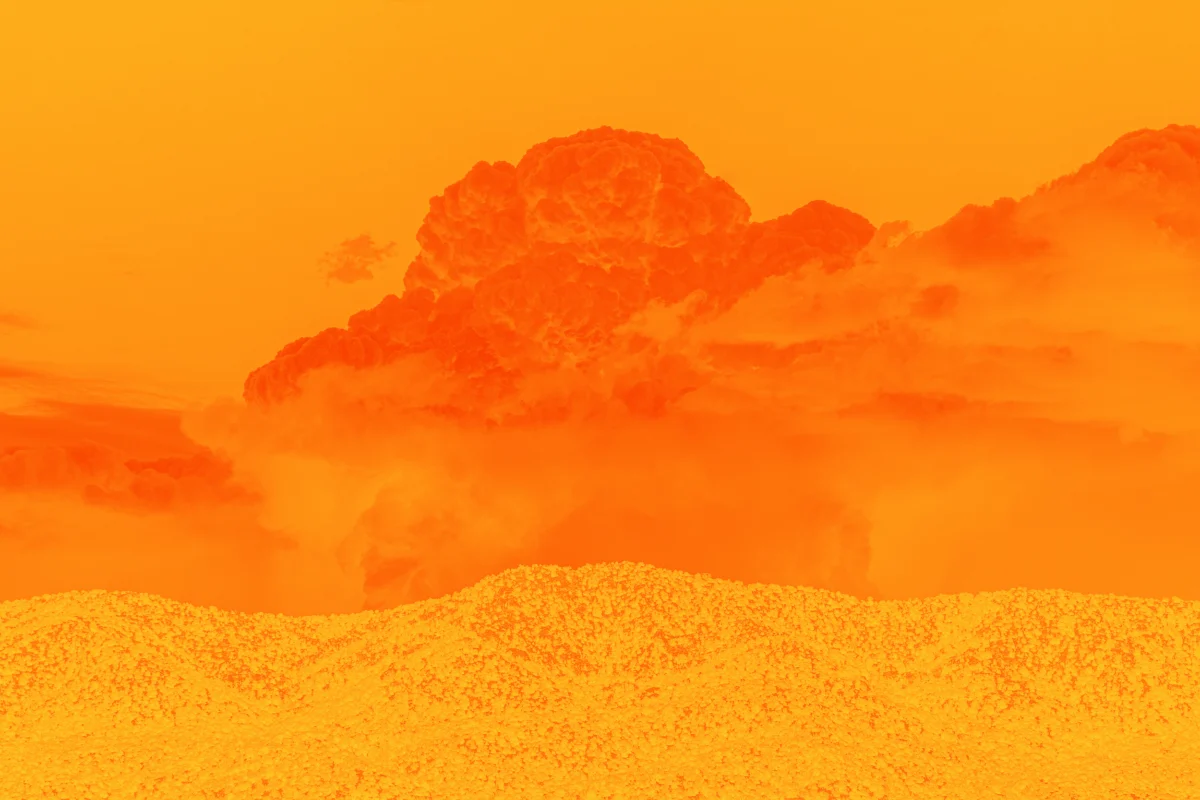
Other works within the exhibition confront issues that are acutely specific to New Mexico, including the profound impacts of climate change and the legacy of nuclear weapons. Michael Namingha, of Ohkay Owingeh and Hopi heritage, presents Disaster #8, a powerful depiction of a massive cloud of smoke looming over a mountain landscape. While directly referencing the devastating Hermits Peak/Calf Canyon Fire of 2022, the largest wildfire in New Mexico’s history, the image also evokes the chilling imagery of atomic mushroom clouds. Namingha’s work enters into a poignant dialogue with O’Keeffe’s 1945 painting, Red with Yellow. Created in the same year as the Trinity atomic bomb test in a New Mexico desert deemed unpopulated by military planners, O’Keeffe’s piece shares a fiery palette of oranges and reds with Namingha’s work. However, in Namingha’s interpretation, these vibrant colors serve to represent the Air Quality Index chart, a stark reminder of contemporary environmental anxieties.
Several pieces directly challenge O’Keeffe’s perceived appropriation of the landscape. In Garcia’s Tewa Tales of Suspense series, presented as comic book-style clay tablets roughly the size of an iPad, O’Keeffe herself appears as a character. Fired using traditional Pueblo pottery techniques and painted with natural pigments gathered from the region, these works offer sharp commentary. In one such tablet, O’Keeffe, clad in her signature black wrap dress and hat, stands before Ts’í P’ín. A sign behind her, initially reading "Welcome to O’Keeffe Country," has been defaced, with "O’Keeffe" scratched out and replaced with "TEWA," a clear assertion of Indigenous sovereignty over the land and its representation.

This exhibition emerges within a broader national context of contested narratives surrounding history and representation. Six years ago, the museum began its critical examination of O’Keeffe’s role in perpetuating Indigenous erasure. Today, however, the national discourse has shifted, often leaning towards right-wing ideologies, which increasingly impact visual culture. Last summer, the U.S. Department of Homeland Security shared John Gast’s infamous Manifest Destiny painting, American Progress, on social media, accompanied by a quote echoing white nationalist sentiments: "A Heritage to be proud of, a Homeland worth Defending." Concurrently, political administrations have proposed significant cuts to federal funding for public art institutions that champion diversity, equity, and inclusion initiatives, and Indigenous and minority-serving higher education programs, such as the Institute of American Indian Arts in Santa Fe, also face potential funding reductions.
"We can and should do better and work from a place of care instead of violence, fear or racism," stated Bess Murphy, the O’Keeffe Museum’s Luce Curator of Art and Social Practice and co-curator of the exhibition alongside Garcia. She highlighted the collaborative nature of the exhibition, emphasizing that the twelve participating artists were involved in every stage of its development, from selecting O’Keeffe’s works to be displayed to writing their own exhibition texts, which were then meticulously edited by Dr. Beverly Singer, an Indigenous anthropologist from Santa Clara Pueblo. Garcia further noted that a collaborative map, delineating the six Tewa pueblos and featuring their ancestral place names and villages, was also a product of this shared vision. Within this framework lies a powerful argument for self-representation, fostering artist and community-led exhibitions that cultivate nuanced and instructive dialogues about a region that has too long been defined by external perspectives.