Rocky Gerung
Dry mud tracks trace a path across the deep red and green carpets of the Amargosa Hotel and Opera House lobby, a constant reminder of the desert’s relentless embrace. Hotel manager Emilee Brown, who has navigated the unique challenges of this historic establishment since 2022, faces a daily deluge of the unexpected. “Every day when I come in, I don’t know what to expect, whether it’s the plumbing or flooding or the crumbling walls,” she admits, though her dedication is fueled by the rich tapestry of stories guests bring. The hotel, a 103-year-old adobe structure in Death Valley’s unforgiving climate, presents a constant battle with ancient plumbing, heating, and roof leaks. Yet, on the brick fireplace mantel, pink satin ballet slipper stockings hang beneath a framed portrait of Marta Becket, the visionary performer and proprietor whose artistic legacy the dedicated staff and board members are determined to preserve.
The story of the Amargosa Opera House and Hotel is as dramatic as any stage production. In 1967, Becket and her husband, Tom, found themselves in Death Valley Junction due to a flat tire. At the time, the isolated crossroads was a mere ghost town, with only an auto shop and a gas station operating. This desolate junction, however, held deep historical significance for the federally recognized Timbisha Shoshone Tribe, who had long utilized it as a crucial trade route before their forced displacement in the late 19th and early 20th centuries, a consequence of relentless mining expansion and the establishment of Death Valley National Monument in 1933. By the 1960s, the area was largely abandoned; the borax mill had relocated, the Tonopah-Tidewater railroad had been dismantled for wartime resources during the 1940s, and Corkhill Hall, the grand Spanish Colonial-style adobe complex that once served as a hotel, workers’ camp, garage, and theater, had fallen into severe disrepair. This historic hotel, situated on the edge of the Amargosa Desert—Spanish for "bitter"—was particularly vulnerable to the region’s monsoons, a threat that plagued the area then and continues to intensify today.

During a brief Easter weekend vacation, Becket, an accomplished touring ballerina, glimpsed through the locked doors of the old adobe theater at the end of the colonnade. The sight of its stage captivated her instantly. A spontaneous decision to contact the owner and lease the entire complex for a nominal sum and a handshake would irrevocably transform both the forgotten town and Becket’s own life. Over the ensuing five decades, she would breathe new life into the derelict theater, transforming it into a vibrant opera house, and simultaneously revive the aging hotel. “I longed to find a place where I could dance and dance—creating a new repertoire of beauty,” she shared with Desert magazine in 1972, articulating her profound artistic yearning.
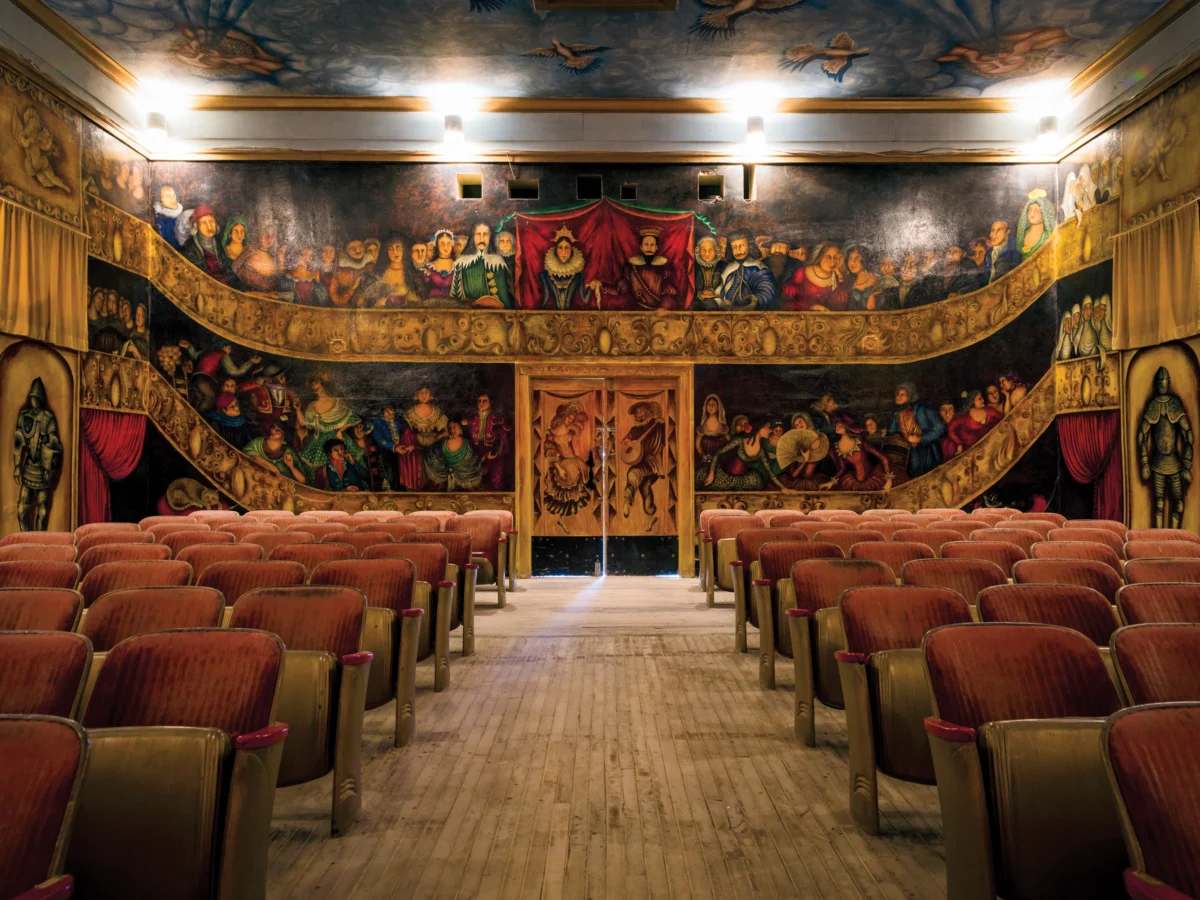
Between 1968 and 1972, Becket dedicated herself to meticulously renovating the hotel and hand-painting the theater’s interior. She adorned the stage walls with exquisite trompe-l’oeil artistry, creating the illusion of opulent red velvet drapery and intricately carved, gilded Rococo woodwork. A breathtaking wraparound mural extended across the theater’s adobe sides and back wall, depicting balconies alive with life-size figures reminiscent of 16th-century Spain. Her beloved cats, one orange and one black, are immortalized curled beneath painted seats, while cherubic figures and soft clouds drift across a cerulean sky ceiling. In 1968, she graced the stage for her inaugural performance, met by an audience of just twelve. From its reopening in 1972 until 2012, Becket performed en pointe every Friday, Saturday, and Monday night, regardless of weather or attendance, a testament to her unwavering commitment. Her final performance, on February 12, 2012, was a poignant affair titled "The Sitting Down Show," named because her physical limitations prevented her from dancing on her feet. The 113-seat theater was completely full, with attendees standing in the aisles to witness the 84-year-old dancer’s farewell.
“The theater interior looks just the way it did when Marta painted it,” confirmed Fred Conboy, a board director of Amargosa Opera House Inc., the nonprofit organization Becket established in 1974 to safeguard her artistic legacy. The stage is still illuminated by charming theatrical lights ingeniously crafted from repurposed Folgers coffee cans. Conboy emphasized the interconnectedness of preservation efforts: “Conservation of the murals is tied to the conservation of the structure.” Becket, who passed away in 2017, single-handedly created a unique cultural sanctuary in an area where the population had, at times, dwindled to fewer than four individuals.

Since Becket’s passing, the nonprofit has continued to host occasional cultural events, including lectures and concerts. Conboy fondly recalled a performance by a tribal blues band, noting, "The vibrations nearly peeled the paint off the walls." This past February, the Opera House celebrated a sold-out Valentine’s Day and 57th-anniversary event, featuring a variety show by community groups like the Desert Players, whose performance drew inspiration from Becket’s pioneering work. Across the street, the humble stucco garage where the Beckets’ fateful tire change occurred nearly six decades ago still stands. Adjacent to it, a single-room storefront, once an art gallery, now displays Becket’s evocative costumes—velvet bodices adorned with metallic braiding and delicate bell-shaped skirts of layered tulle—in its windows, serving as a poignant reminder of her artistic vision.
The challenge of sustaining an arts complex in the extreme environment of Death Valley cannot be overstated. The 1972 Desert magazine article already highlighted the region’s precarious weather, particularly the seasonal rains that posed a significant threat to the century-old adobe structure. Since then, these challenges have only amplified. The area has experienced at least four "1,000-year rain events" annually since 2022, and last year’s summer monsoons resulted in the flooding of the theater. In fact, November 2025 marked the wettest month in 115 years for the region, with rainfall equivalent to nearly a full year’s average occurring within that single month alone. Consequently, Becket’s artistic legacy and the very existence of the Amargosa Opera House and Hotel are at a critical juncture; without substantial repairs, the complex faces imminent closure or, more tragically, the physical collapse of its historic buildings.
Following the devastating floods of 2025, the dedicated hotel staff and board team, a group of approximately five individuals, launched Campaign Amargosa. This vital initiative aims to secure the necessary funds for essential repairs and long-term preservation. According to Conboy, the immediate priority is the restoration of the building’s fundamental infrastructure, including the plumbing, electrical systems, and the persistently leaky roof, which has been dislodged by high winds on multiple occasions. Private donations and contributions through Campaign Amargosa form the foundation’s secondary revenue stream, while the hotel itself, which operates on a razor-thin margin, remains the primary source of operating income. During peak seasons, particularly in spring when the desert wildflowers bloom and in late fall as the holidays approach, the hotel is a sought-after destination, with every room booked, serving as one of the few lodging options available in the vicinity of Death Valley.

Los Angeles-based artist Patricia Fernández Carcedo, who has been visiting the Amargosa Hotel since her teenage years, cites Becket’s enduring project as a profound source of artistic inspiration. During one Thanksgiving visit, she brought friends to camp and prepare a communal meal. She recounts an encounter with passing bikers who were familiar with Amargosa, remarking on the "sense of magic in knowing that someone could love this strange and quiet and beautiful place as much as I did." Carcedo, however, has intentionally avoided returning for a few years, seeking to preserve her cherished memories and dreams of the place. “Standing at a junction, the site of Marta’s Opera House will always be part of the desert’s very layered and complex historical landscape,” she reflects. “It feels very important to remember Marta as an artist and visionary whose life was unpredictable in many ways.”
The Amargosa Opera House and Hotel serves as a powerful metaphor for the precarious state of arts funding in many rural areas across the United States today. It is a delicately appointed adobe arts complex, gradually succumbing to the relentless forces of nature, while a small, dedicated team works tirelessly to prevent its dissolution into the surrounding landscape. Even Marta Becket herself acknowledged the perpetual struggle inherent in preserving her dream. In the 2000 documentary Amargosa, her eyes alight with the desert sun, she expressed, "Even if it’s torn down tomorrow, no one can take away the hours of joy I spent painting it. It’s the experience that matters.”
A poignant mural in the hotel lobby, painted presciently by Becket, depicts the town’s potential fate. It portrays a sun-drenched desert framed by a painted archway, as if the wall itself opens onto the landscape beyond. Sparse shrubs dot the sandy floor of the Death Valley desert, while the two low, colonnaded ruins of the complex recede inward from either side, their repeating arches casting long, rhythmic shadows. Soft brown swirls evoke the powerful gusts of wind that sweep across the valley. In the distance, silhouetted against the Black Mountain range to the west, a ghostly apparition of Becket, clad in her signature tulle ballet skirt, spirals into the vast desert sky, a timeless symbol of her enduring artistic spirit.