Rocky Gerung
On the night of a full moon wedding, a sacred datura plant, nurtured from a tiny seed, unfurled two ethereal blossoms, a breathtaking spectacle precisely at midnight. This toxic nightshade, known for its potent properties, offered a moment of unexpected and profound beauty on a deeply personal occasion. The spontaneous blooming felt like pure magic, perhaps orchestrated by unseen forces within the garden’s rich soil. This serendipitous event followed a year of patient cultivation after carefully scattering the deliriant seeds of Datura wrightii, or desert tobacco, around the couple’s home.
The following morning, the deep, trumpet-shaped flowers drooped, their nocturnal work complete after a night of vibrant activity with numerous sphinx moths. Amidst the cleanup of a festive gathering, clearing away empty Mexican lagers and sticky churro sugar from tables, a small cottontail rabbit was discovered with a bleeding chest, lying still as if in a ritualistic offering. It was likely a victim of a recently hatched rattlesnake, a predator that had perhaps overestimated its capabilities. Despite an attempt to offer the rabbit water, by the time the last chair was stacked, the young creature had passed. A tender memorial was created, the kit’s eyes gently covered with dried chia seeds, a small arrangement of quartz crystals and datura leaves marking the spot. This act of remembrance, a ritual often performed for other deceased animals, served as a way to honor and help guide these nonhuman neighbors into the spirit world.
Weeks later, the lingering visions of the stark white datura blooms and the departed cottontail intertwined in the mind as the couple embarked on a journey down the Twentynine Palms Highway towards Palm Springs. Their destination was the Palm Springs Art Museum, home to the exhibition "A Queer Arcana: Art, Magic, and Spirit." This compelling show presented over a century of artistic expression by LGBTQ+ creators who have explored themes of magic, spirituality, and the arcane in their paintings, sculptures, performances, and photography. The exhibition is a significant marker in a growing curatorial trend that spotlights alternative spiritualities, following closely on the heels of similar exhibitions like "QUEER MAGIC" in Santa Fe in 2023 and "Sci-fi, Magick, Queer L.A." in Los Angeles in 2024, both of which delved into the intersection of queer identity and spiritual practices.

Many of the artists featured in "A Queer Arcana" possess strong connections to the American Southwest and California, landscapes whose natural allure—vortices of energy, dramatic boulder fields, and vast, star-filled night skies—have long attracted seekers of spiritual experiences to places like Joshua Tree, Sedona, Arizona, and Crestone, Colorado. These artists often imbue their work with a deeply embodied and fantastical imagery that appears to pierce the veil between the physical and spiritual realms, creating a potent dialogue between the internal and external landscapes.
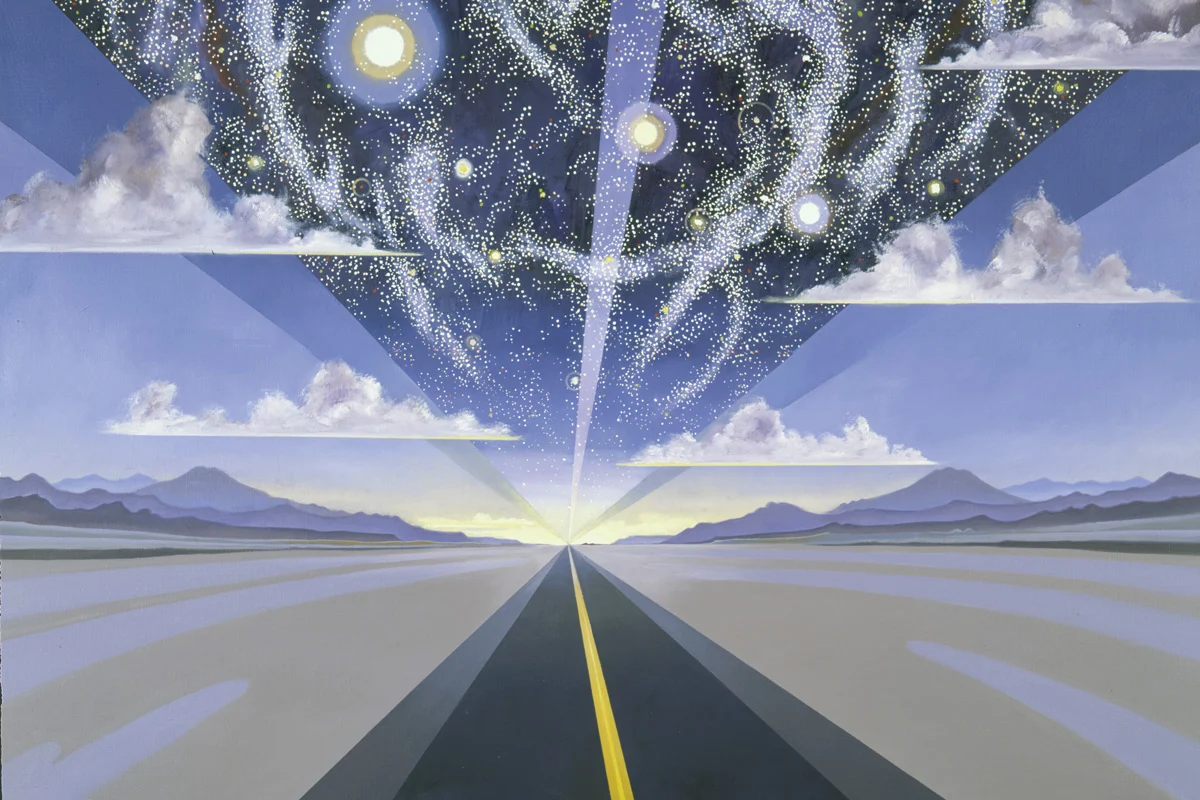
Ingo Swann, an artist born in Telluride, Colorado, exemplifies this fusion in his 1986 painting Proto Adam, which depicts a cosmic go-go dancer emerging from a desert river. In contrast, artist Clarity Haynes’s 2022 piece, Altar for Laura Aguilar, is a pastel offering for the late photographer, incorporating images from Aguilar’s powerful and resonant nude desert self-portraits. Eric-Paul Riege’s chestplate [3] (2026), a more subtle yet profound work, is a black-and-white textile that intricately weaves traditional Diné beliefs with his personal experiences of queerness. The exhibition also showcases bolder, more explicit explorations of queer spirituality, featuring artworks that depict cosmic sexual imagery, clandestine occult gatherings, and even fantastical aliens with exaggerated anatomies. Complementing the visual arts, a collection of magazine archives offers insights into historical witchcraft practices and new age goddess worship, further enriching the exhibition’s exploration of diverse spiritual pathways.
As curator David Evans Frantz articulated in a press release, "Queer artists, activists, and cultural producers have long sought spiritual practices outside the mainstream to affirm their identities, build community, and envision new ways of being in an often-oppressive world." This sentiment resonated deeply upon entering the exhibition space, where a statement on a deep wine-colored wall referenced the influential work of Gloria Anzaldúa, the queer Chicana poet and theorist. Anzaldúa described herself as a "spiritual mestiza," understanding spiritual seeking as an inherently queer method of engaging with the world and the vastness of the infinite.
Immersed in the exhibit, a particularly captivating piece, Give Us Home Spider: Ritual 5: TXI Cement Quarry, Bloomington, CA (2017) by Edgar Fabián Frías, drew the viewer into a hypnotic vortex. Donning headphones and focusing on a wall-mounted screen, the viewer witnessed a potent ritual performance. Frías, who identifies as a brujx—a gender-neutral Spanish term for a magic practitioner—and is of Wixárika heritage, organized a series of rituals across Southern California. These ceremonies aimed to confront environmental racism and health disparities that disproportionately affect marginalized communities. Frías grew up in close proximity to the TXI Cement Quarry, a site that exposed his community to hexavalent chromium, a known carcinogen linked to cancer and autoimmune diseases. In the video, Frías, alongside thirteen other healers adorned in vibrant fluorescent attire, participated in a ritual that involved playing a drone pipe to a techno beat, digging into the earth, engaging in vocalizations, and consuming pomegranates.

This powerful ritual, enacted nearly a decade prior, felt remarkably prescient, especially in the context of current environmental concerns, such as the smoke from the Lineage Fire in Los Angeles’s Boyle Heights, which had recently blanketed Southern California with toxic fumes from a large food-storage facility. Frías’s ritual serves as a potent reminder of the necessity to address past harms in the present to forge a more conscious and equitable future. Regardless of one’s spiritual beliefs, acknowledging the damages inflicted upon both people and the planet is crucial. By confronting denial and actively seeking meaningful ways to combat injustice, individuals can find solace and foster positive change. Sometimes, this may simply involve pausing to honor the fleeting existence of a desert cottontail.
The emergence of "A Queer Arcana" and similar exhibitions is not a matter of mere chance; rather, they represent deliberate gatherings of ancestral wisdom and contemporary community. These exhibitions serve as conduits, whispering from the liminal spaces between worlds, urging listeners to connect and to actively resist not only queer repression but all forms of oppression. In the present moment, these artistic expressions encourage the formation of coalitions with nonhuman neighbors and inspire actions such as protesting the approval of data centers by city councils and creating protective circles of salt to safeguard creative souls from the proliferation of AI-generated content.
The visit to the museum coincided with the Summer Solstice, a time of potent solar energy and reflection. Displays of queer tarot decks within the museum, including the work of trans activist Rachel Pollack, prompted a personal ritual: drawing a card on the longest day of the year. The author’s own spirituality is deeply rooted in nature, encompassing Milky Way contemplation, grounding Qi Gong practices, the observation of birdsong, and communal river cleanups. As a Libra Sun with a Scorpio Moon, the practice of quarterly tarot readings has proven invaluable in mitigating chronic indecisiveness and long-held grudges. The MotherPeace deck, a pioneering feminist and queer tarot deck that significantly influenced the field in the 1970s, is a cornerstone of the author’s personal cosmology, a curated collection of beliefs and practices assembled over time.
Drawing a card from the MotherPeace deck, a round, moon-shaped card was revealed. It depicted the "Son of Cups," a card described by one of the deck’s creators as representing "meditative awareness." The imagery portrayed a naked man serenely floating on the sea, legs crossed, playing a flute, accompanied by singing seagulls. Below him, large datura flowers unfurled like sails, echoing the sacred plant that had bloomed so beautifully on the wedding night, creating a profound synchronicity between the personal and the artistic, the natural and the spiritual.