Roger Danuarta
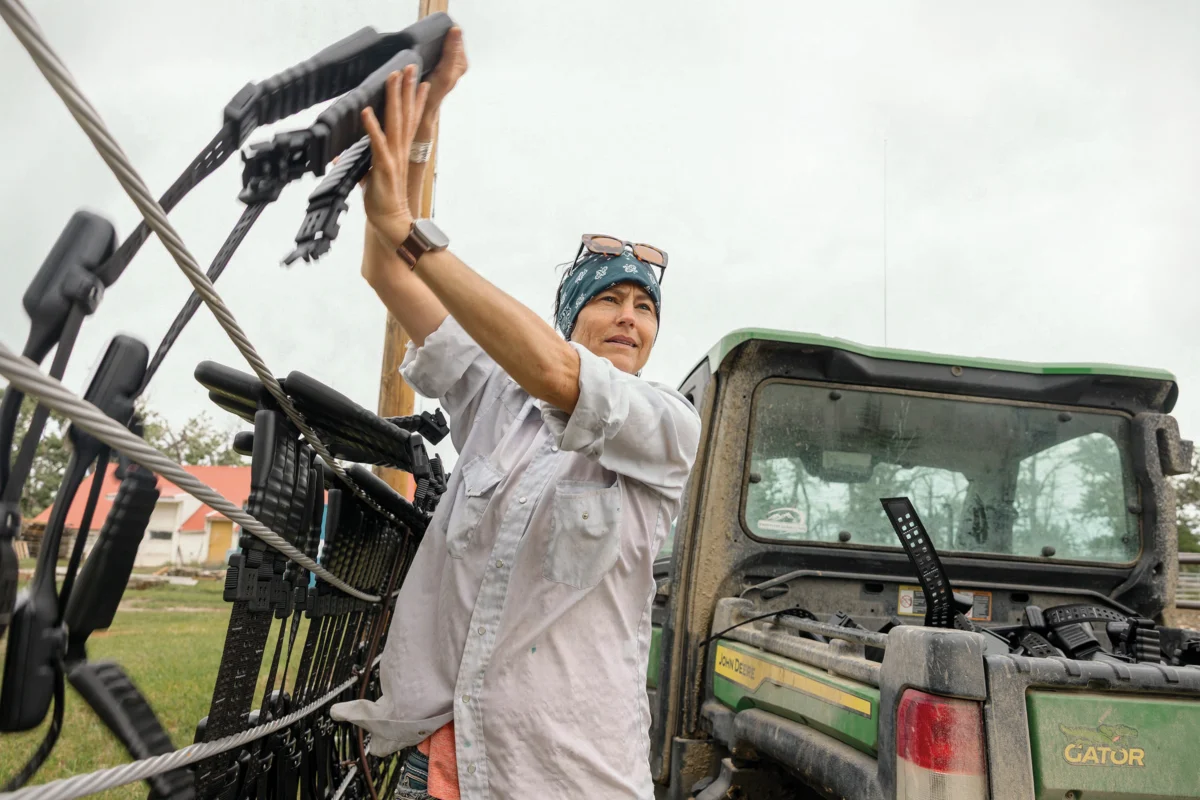
On a sun-drenched July morning, the rhythmic clang of steel echoed across the McFarland White Ranch as cattle, their breath misting in the crisp Montana air, were guided into a chute for a fitting session unlike any other. Harrison White, a rancher whose family has worked these lands for generations, approached each animal, securing a thick, black polymer collar around its neck – a high-tech piece of "jewelry" equipped with GPS tracking capabilities. These devices connect via nearby base stations and satellite to a digital application, allowing White and his sister, Lanie, to monitor each collared animal’s precise location and, with a few clicks, draw invisible fences across their sprawling property. Should a cow stray too close to these digital boundaries, its collar emits a warning sound, followed by a mild electric shock, gently guiding it back into the designated grazing area. After receiving its new collar, a cow might buck briefly, adjusting to the unfamiliar weight, but soon settles back into the familiar rhythm of nibbling grass in the forested foothills where the Crazy Mountains meet the Musselshell River Valley.

This pioneering approach challenges the very foundation of Western land management, where an estimated 620,000 miles of barbed wire and other physical fences crisscross the landscape, dictating grazing patterns and often impeding wildlife migration. Lanie White articulates a growing sentiment among progressive ranchers: "Real fence is bullshit. It’s expensive, it’s damaging, and it fragments ecosystems." The adoption of virtual fencing has surged dramatically across the American West since its commercial availability in 2021, offering a compelling solution to a host of contemporary ranching and environmental challenges. Ranchers are now employing this technology to rapidly replace physical fences obliterated by devastating wildfires, to protect sensitive ecological zones like spawning fish habitats or nesting bird sites, and to strategically direct cattle grazing to create vital fire breaks in vulnerable areas. The White family, among the first in Montana to embrace this innovation, initially trialed Vence technology before transitioning to Halter, both companies with roots in New Zealand’s intensive dairy industry, where the need for frequent pasture rotation necessitated efficient fencing solutions. Vence, notably, received strategic funding from a division of Shell, interested in its potential to mitigate overgrazing and enhance carbon sequestration in soil for carbon offset initiatives, before its acquisition by Merck Animal Health in 2022. For Lanie White, this technological leap represents nothing less than "the biggest ranching revolution that will occur in my lifetime."

The history of physical fencing in the United States is deeply intertwined with the nation’s expansionist past. In the early 1800s, European colonists, fueled by the promise of "free" land appropriated from Native American tribes and the doctrine of "manifest destiny," pushed westward. The vast Great Plains, however, lacked the abundant timber and stone used for traditional fencing in the East, and early attempts with smooth wire proved ineffective against livestock. This scarcity sparked a fierce competition in the late 1860s and early 1870s to develop "spiked" wire fencing. Joseph Glidden, an Illinois farmer, revolutionized this effort in 1873 with his patented design for attaching barbs to double-stranded wire and the machinery to mass-produce it. Glidden’s inexpensive and easily deployed "metallic thorny hedge" quickly facilitated the rapid partitioning of the landscape. David Augustine, a landscape ecologist with the Department of Agriculture’s Agricultural Research Service, notes that much of this fencing arbitrarily followed surveyed section lines rather than natural ecological boundaries, creating an artificial grid across the continent.

Fencing, particularly barbed wire, quickly became a potent symbol and tool of control, not just for animals but also for human populations. Scott Abbott, a professor at Utah Valley University and co-author of The Perfect Fence: Untangling the Meanings of Barbed Wire, observes, "Control through violence and force, I think that’s the underlying basic meaning." Historians and scholars argue that barbed wire, alongside railroads, plows, and the telegraph, served as a critical mechanism for the colonization of the West. Dina Gilio-Whitaker of the Confederated Tribes of the Colville Reservation emphasizes that these were "mechanisms of containment in a paradigm of domination," reinforcing a private-property ethos that encouraged individualism and facilitated the assimilation of tribal lands under policies like the Dawes Act of 1887, which fractured communal reservation territories into individual plots. The environmental consequences soon became apparent, though not immediately recognized. Early 20th-century fencing along Yellowstone National Park’s northern boundary, intended to exclude livestock and protect pronghorn from poaching, ironically led to a decline in the pronghorn population. By the 1960s, scientific literature began documenting pronghorn entanglements and deaths, prompting public outcry. Images of dying pronghorn in Wyoming in 1965 spurred Rep. Henry Reuss of Wisconsin to propose legislation to prohibit fencing that impeded wildlife movement on public lands, a stark recognition of the ecological toll. The evolving sentiment was captured in popular culture, with Edward Abbey’s 1975 novel The Monkey Wrench Gang featuring the iconic line, "Always cut fence. That’s the law west of the 100th meridian."

For decades, Abbey’s rebellious call remained an ideal, lacking a practical alternative to the omnipresent barbed wire—until the recent commercialization of virtual fencing. The fundamental concept of remotely controlling animal movement is not entirely novel; "invisible fences" for domestic dogs, relying on buried wires and shock collars, were patented as early as 1973, with researchers exploring radio-wave activation by 1987. Scientists within the U.S. Department of Agriculture began developing virtual fencing for cattle in the early 2000s, but it took the concerted efforts of overseas companies, particularly those serving the New Zealand dairy industry, to refine the technology for the expansive grazing requirements of the West’s beef cattle. This new era of livestock management has ignited enthusiasm among conservationists, who envision a future where wildlife can move freely across landscapes. Organizations like The Nature Conservancy (TNC), in partnership with initiatives such as the Southwest Montana Sagebrush Partnership, are actively providing financial support to ranchers adopting virtual fencing. Jim Berkey, TNC’s High Divide Headwaters program director, sees in this technology the potential for "vast potential changes across the landscape," promising a harmonious coexistence between agricultural practices and ecological integrity.

The economic impetus for virtual fencing adoption is particularly stark in the wake of escalating wildfires across the West. Fast-moving rangeland fires can decimate thousands of miles of physical fencing, with replacement costs often exceeding $15,000 per mile—an astronomically expensive and labor-intensive undertaking. Virtual fencing, by contrast, offers a significantly more cost-effective and flexible solution. While collar rentals and batteries typically cost around $50 per animal annually, and base stations requiring cellular coverage can be $10,000 each (though often relocatable), these expenses pale in comparison to rebuilding miles of traditional fence. This economic advantage particularly benefits larger ranches with extensive herds and vast acreages. Funding from non-profits such as TNC, the National Wildlife Federation, and the Rocky Mountain Elk Foundation, alongside state departments of wildlife and even federal agencies, often helps bridge the initial investment gap, especially for ranchers recovering from fire damage. For example, the 2020 East Troublesome Fire near Granby, Colorado, led to one of the first known uses of virtual fencing on a Forest Service allotment, with a Natural Resources Conservation Service grant funding a Vence trial for nearly 3,000 cattle. Similarly, eastern Oregon rancher Dan Probert faced the destruction of 20 miles of fencing on his 20,000-acre Saddle Creek Forest Service allotment during the 2022 Double Creek Fire. The estimated replacement cost of $20,000 to $25,000 per mile in remote Hells Canyon National Recreation Area made virtual fencing an appealing alternative for all stakeholders, including the Forest Service and wildlife groups. Beyond disaster recovery, the technology also supports strategic conservation efforts, such as when Mike and Joy Wilson in north-central Washington adopted virtual fencing on 9,000 acres leased from the Confederated Tribes of the Colville Reservation. This allowed them to manage cattle without disrupting the newly reacquired parcel, which tribal leaders hoped would serve as a crucial wildlife corridor connecting the Rocky Mountains and the Cascade Range.

In Salmon, Idaho, the 2022 Moose Fire presented another opportunity for innovation on the 70,000-acre Diamond Moose allotment within the Salmon-Challis National Forest. Permittees Chyenne and Jay Smith observed that while some forage had burned, significant areas remained untouched. They envisioned using virtual fencing to temporarily cordon off unburned sections, allowing continued grazing while the scorched land recovered, thereby preventing the Forest Service from closing the entire allotment for years. Melinda Ellison, an associate professor of range livestock research at the University of Idaho, seized this chance to test the technology in the region’s challenging, steep terrain. Collaborating with the Smiths, Ellison secured funding and partnerships with the Bureau of Land Management, Forest Service, and Idaho Department of Agriculture, launching a research project that now spans nine ranches, over 2,000 collars, and 20 base stations. For Chyenne Smith, her laptop map, displaying her herd’s real-time locations, has become an indispensable part of her morning routine, allowing her to remotely check water sources, identify areas needing salt licks, or detect unusual movements indicative of injury or predators. This precision management means she and Jay can allocate their time on the allotments more efficiently, ensuring even grazing, preventing premature movement to higher ground, and allowing strategic resting of pastures, ultimately making them "better range managers."

Despite the clear benefits, the path to widespread virtual fencing adoption has not been without its hurdles. The McFarland White Ranch’s initial trial with 1,800 Vence collars in 2022 encountered significant issues, with hundreds of collars breaking or falling off, scattering quarter-pound lithium batteries across their property. Lanie White expressed grave concerns about these batteries potentially leaching heavy metals into the headwaters of the American Fork River and Big Elk Creek. Moreover, the remaining collars required battery changes every six months, far more frequently than expected. While Vence (Merck Animal Health) attributed performance variations to terrain, weather, and grazing practices, the Whites ultimately removed the problematic collars in February 2023. Early adopters across the West faced similar hardware snafus, from cows damaging loose collars to bulls getting entangled when their carabiners interlocked, leading USDA researcher David Augustine to conclude that the initial product "was just not quite right." However, rapid innovation is addressing these early deficiencies. The Whites’ subsequent trial with Halter collars in late 2024 showed immediate improvements, with a snugger fit leading to faster cow acclimation. Halter’s solar-powered collars boast a five-to-seven-year lifespan, a significant upgrade from earlier battery-dependent models, and their newest iterations can transmit data directly to the Starlink satellite network, potentially eliminating the need for expensive local base stations entirely.

The institutional support for virtual fencing is also expanding, with funding from organizations like the National Fish and Wildlife Foundation and the Property and Environment Research Center (PERC), complementing federal and state contributions. While the Forest Service, as Dwayne Rice, Region 2 rangeland program manager, clarifies, "We’re not in the livestock business, and we don’t want to be in the livestock management business," they are investing in base stations and permitting virtual fencing as a temporary range improvement. As of spring 2026, 270,000 acres of allotments within the Salmon-Challis National Forest are managed with virtual fencing, a testament to its growing acceptance. The pace of adoption continues to accelerate, particularly in areas ravaged by wildfires. In eastern Oregon, the 2024 Lone Rock Fire destroyed an estimated 1,100 miles of fencing, costing $25 million to replace. This disaster spurred Sustainable Northwest, a Portland-based nonprofit, to lead a project to install virtual fencing across 177,000 acres of private land in the Upper Rock Creek watershed, poised to become the largest such system in the Pacific Northwest. Dallas Hall Defrees, the program director, articulates the goal: "What we’re trying to do with virtual fencing is to have working lands and to do them better, to have rural economies, rural communities and ecosystems all function alongside each other." The burgeoning market, with new players like Gallagher eShepherd and Norway’s Nofence joining Vence and Halter, is driving rapid technological advancements, with experts like Allegra Waterman-Snow of the Eagle County Conservation District predicting significant changes in the technology within five years. Joshua Morrison, a Halter territory manager, confirms this boom, reporting 65,000 collars sold in his eastern Montana to western North Dakota territory by July 2026, with trials expanding into western Montana and Idaho.

Despite this undeniable momentum, virtual fencing remains a developing technology with inherent limitations. Dallas Hall Defrees aptly describes it as "a steak knife, not a scalpel," acknowledging that it cannot prevent drought, invasive species, or wildfires, nor is it a panacea for poor land management. In the arid West, where thirsty cows may override warning shocks to reach water, ranchers must meticulously ensure virtual boundaries encompass sufficient water sources and maintain a safe distance from appealing, sensitive riparian areas. Moreover, the human element presents its own challenges. Tony Vorster, a researcher at Colorado State University, observes that "the learning curve is steeper for the humans than it is for the livestock," particularly for older ranchers less accustomed to smartphone interfaces and complex digital platforms.

While the promise of a truly wire-free West inspires many, a meaningful reduction in physical fencing has yet to materialize. The technology is still too nascent for ranchers or land managers to confidently dismantle existing barriers, especially given the prohibitive cost of their initial installation. Ranchers like Koy Holland in Montana’s Grasshopper Valley, whose physical fences cost $17,000 to $20,000 per mile, humorously states, "it’s pretty hard to rip a fence down when it costs that much. What we’re doing is throwing gates open." Even in the more advanced Salmon-Challis National Forest, Kyle Nelson confirms that while they "continue to use it," widespread physical fence removal is "definitely a discussion that we’re all kind of curious about, but I don’t think we’re quite there yet." In mountainous regions like Eagle County, where virtual fencing reliability hovers around 70% to 80%, this lack of absolute assurance means perimeter fencing, crucial for containing livestock and delineating property lines, will almost certainly remain in place. As the landscape continues its slow, incremental transition, the enduring legacy of barbed wire stands as a stark reminder. Driving away from the McFarland White Ranch, the sight of a woven-wire fence topped with barbed wire, a century-old design impassable to many species, with a "Private Property, No Trespassing" sign, serves as a poignant counterpoint to the technological revolution. Just beyond it, a pronghorn with two fawns grazed, encapsulating the complex interplay of past, present, and the still-evolving future of land management in the American West.