Rocky Gerung
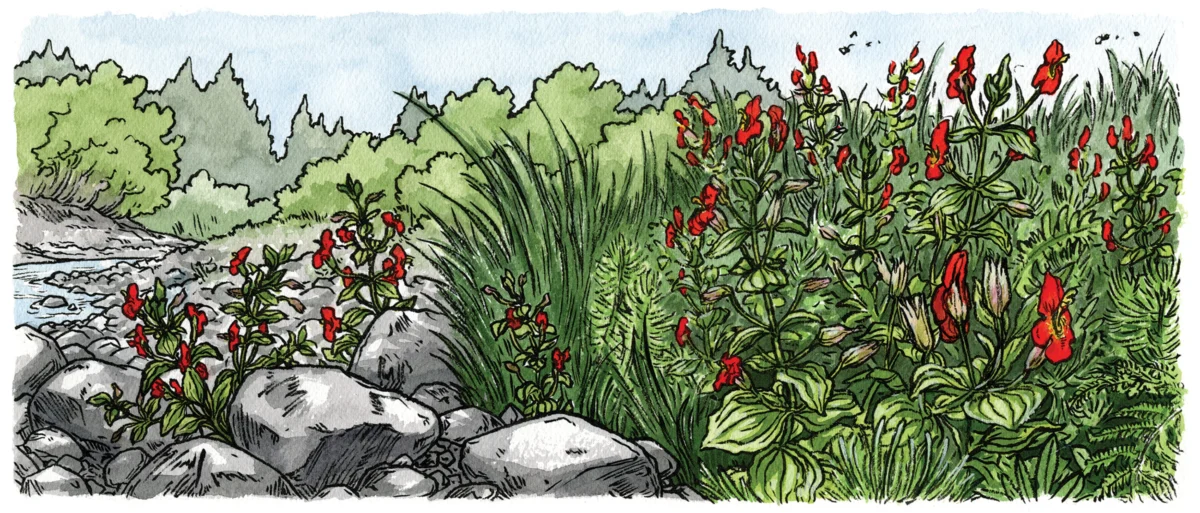
Throughout the summer, along the streambanks stretching from Washington to Northern Mexico, a vibrant spectacle unfolds as hummingbirds flit between scarlet, face-shaped blossoms meticulously evolved to suit their specific needs. As autumn approaches, these striking flowers transform into elongated brown capsules, each holding a treasure trove of thousands of microscopic seeds. It is then that scientists, much like the hummingbirds they observe, diligently collect genetic material from these pods. This material, though not intended for human study, has become an indispensable tool for unraveling the complexities of evolutionary biology and predicting how changing global climates will reshape Western ecosystems.
In a significant breakthrough published earlier this year, a team of researchers, spearheaded by Amy Angert, an ecologist at the University of British Columbia, utilized the scarlet monkeyflower (Mimulus cardinalis) to provide the first empirical evidence that certain plant species can indeed evolve rapidly enough in natural settings to overcome the detrimental impacts of climate change. This latest discovery adds to a growing body of research centered on this small, trumpet-shaped bloom, illuminating how pollinators influence speciation, how plant adaptive capacities can vary geographically, and how a unique form of intergenerational learning, akin to "floral trauma," enables plants to adjust to climatic shifts even in the absence of novel genetic mutations.

The scarlet monkeyflower is poised to remain a pivotal species for scientific inquiry, and Angert’s laboratory continues to develop sophisticated models based on its evolutionary responses. These models hold the potential to forecast the adaptability of other species to escalating threats such as drought, extreme heat, and wildfires, all driven by climate change. Angert aims to equip conservationists with a clearer understanding of which species and populations warrant immediate attention, while identifying those that, like many of her beloved monkeyflowers, possess the inherent ability to adapt and persevere through self-reliance.
From Streambank to Laboratory: A Decade of Dedicated Research
Since 2010, Angert and her team have undertaken annual expeditions, visiting dozens, and often hundreds, of monkeyflower habitats. During these field excursions, they meticulously record observations and gather seeds, transporting them back to their laboratory for in-depth study. Through several pivotal experiments, her team has successfully "resurrected" multiple generations of seeds within controlled greenhouse environments. These studies have consistently demonstrated that over time, lineages exposed to drought conditions have evolved demonstrable drought-tolerant traits, including modifications in leaf thickness and adjustments in their blooming cycles.

The scarlet monkeyflower possesses fuzzy leaves that secrete a sticky resin, emitting a distinctive aroma described by Angert as "a little sweet, a little pungent." She notes, "I’ve never been able to hit on the right word, but I smell that scent and I’m immediately transported." These perennial plants typically establish themselves between rocks along streambanks and creeks, thriving in locations where the water flow is neither too swift to dislodge them nor so sluggish that it allows competing meadow grasses to dominate. The scarlet monkeyflower blooms in delicate sprays atop stems that can range in height from a mere six inches in arid, challenging environments to a robust three feet in more verdant locales.
A Supermodel for Scientific Discovery
Monkeyflowers have emerged as exemplary "model species" within the field of evolutionary biology, offering profound insights that extend far beyond the plant kingdom and hold relevance for a vast array of organisms. Their utility in scientific research stems from a confluence of advantageous characteristics. Firstly, they have been the subject of scientific study for an extended period, dating back to the early 19th century. Secondly, they exhibit a short life cycle and flourish readily under laboratory conditions, facilitating controlled experiments. Furthermore, each flower pod produces an abundant yield of seeds—exceeding 2,000 per capsule—making seed collection an efficient and practical undertaking. Historically, their relatively small genome size also contributed to their suitability for genetic research, although this factor has become less critical with the precipitous decline in gene-sequencing costs and the concurrent advancement of sophisticated computational tools.

A Climate Toolkit for Conservation
Research emanating from Angert’s laboratory has revealed a significant geographical disparity in the adaptive genetic variation within scarlet monkeyflower populations. Specifically, populations found in the southern reaches of their range exhibit greater genetic diversity than those in the northern regions, enabling them to evolve more rapidly in response to identical environmental stressors. This finding underscores a crucial caveat for researchers and conservationists: generalizations about species-level adaptive capacity cannot be reliably extrapolated from studies focused on only a limited number of populations.
Many plant species possess a phenomenon known as "stress memory," where epigenetic markers—compounds or modifications that alter gene expression without changing the underlying DNA sequence—are passed down through generations. These markers can be transmitted from grandparents to parents and then to offspring. This capacity for epigenetic inheritance, much like adaptive genetic variation, can also fluctuate across a species’ geographic distribution. Angert’s team posits that even those populations that may lack the genetic toolkit to evolve at a pace sufficient to outrun climate change might still leverage this "stress memory" to adapt to a rapidly altering environment.

The House Special: Pollinator Specialization and Evolutionary Speed
The scarlet monkeyflower has evolved a sophisticated suite of adaptations designed to attract hummingbirds. Its vibrant red hue, tubular shape, generous nectar production, and strategically positioned long stamen work in concert to ensure that pollen is efficiently deposited onto the forehead of each visiting hummingbird. In contrast, a closely related species, Lewis’s monkeyflower (Mimulus lewisii), has specialized in attracting bumblebees. Its pink blossoms yield less nectar, and its broader petals provide a convenient landing platform for bumblebees engaged in pollen collection. These two species, whose ranges overlap considerably, possess the capacity for hybridization. However, their distinct pollinator preferences act as a significant reproductive barrier, leading to rare instances of interbreeding. Evolutionary biologists have elucidated that the divergence in floral morphology between these two species can be attributed to alterations in just a few key genomic regions, suggesting that the evolution of specialized traits, such as adapting to a new pollinator, can occur relatively rapidly on evolutionary timescales, measured in millennia.
Illustrations by Emily Poole.