Rocky Georgio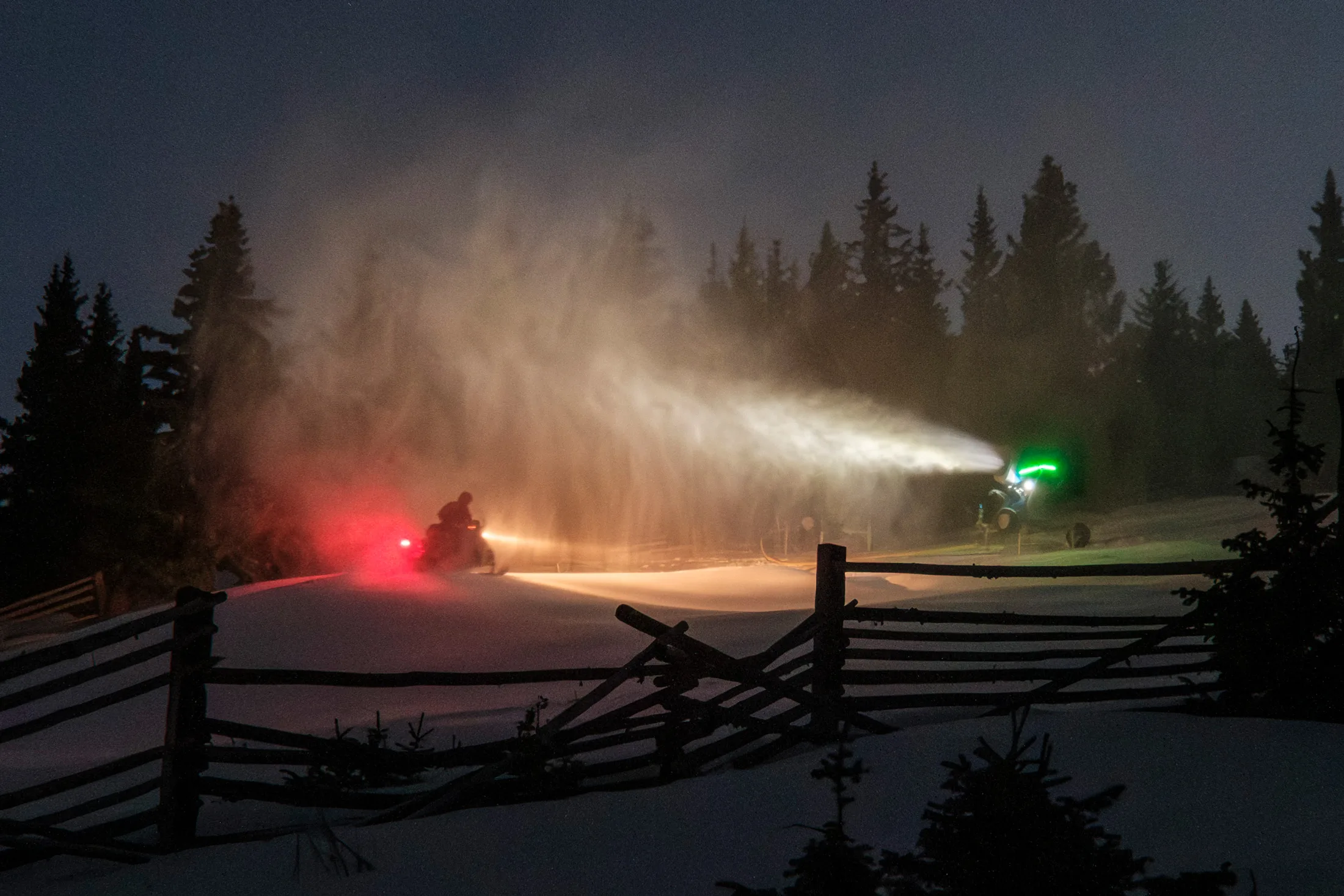
This winter has brought the lowest snow cover on record to the Western United States, a stark reality that, while potentially heralding a torrent of challenges come spring—including increased wildfire risks and diminished water resources for agriculture and aquatic ecosystems—currently occupies many Westerners’ minds primarily through the lens of recreational skiing. Resorts across the region are experiencing unprecedented conditions: in Colorado, Arapahoe Basin has seen less than a third of its runs open, while Washington’s Mt. Baker Ski Area was forced to cancel its annual snowboard race due to an unworkable snowpack. Oregon’s Hoodoo and Mt. Ashland Ski Areas endured temporary closures lasting weeks due to the dearth of snowfall, and even college ski championships were relocated from Bozeman, Montana, to Utah, highlighting the widespread nature of the warm winter.
In the face of these challenges, ski resorts are turning to snowmaking, though specific details about their capabilities and operations remain largely undisclosed. Major ski resort conglomerates like Alterra and POWDR did not respond to inquiries regarding their snowmaking strategies. Vail Resorts, a global operator of 42 ski areas, acknowledged that while detailed snowmaking data is proprietary, "weather conditions, particularly temperature, influence how much and how long we make snow."
However, the feasibility of significantly expanding snowmaking in the West is constrained by practical and legal hurdles. Steven Fassnacht, a professor of snow hydrology at Colorado State University, explained that any major ramp-up in snowmaking capacity would necessitate resorts acquiring additional water rights, a process that is both financially burdensome and legally intricate. Historically, Western ski resorts have relied far less on artificial snow compared to their counterparts in other regions of the United States. Nationally, fewer than 10% of skiable acres are typically covered by man-made snow, a stark contrast to the more than 50% in the Northeast and approximately 80% in the Southeast and Midwest.

As climate change increasingly contributes to warmer and more unpredictable winters, snowmaking is poised to become a more critical, albeit complex, element for the Western ski industry. This shift brings with it a host of environmental considerations and other challenges.
The origins of snowmaking technology can be traced back to 1949, when a Connecticut ski resort owner experimented with spreading 700 pounds of ice on a single run, a rudimentary effort that lasted only about two weeks but sparked an idea among a group of engineers and failed ski entrepreneurs. John Fry, a ski historian, described how they connected a compressor to a garden hose and a spray-gun nozzle, laying the groundwork for modern snowmaking. Today, the fundamental technology remains the same: atomizing highly pressurized water into the air, allowing it to freeze. The primary environmental concerns revolve around the substantial energy and water consumption involved. Potential impacts extend to soil degradation and even chemical exposure, alongside opposition from Indigenous communities who view the use of wastewater for snowmaking as a desecration of sacred sites.
The process of snowmaking is energy-intensive, requiring significant power to pressurize water and air, and to pump water uphill. One study encompassing ten ski areas nationwide estimated that snowmaking accounts for an average of 18% of a resort’s total energy consumption. Water usage is also considerable; Palisades Tahoe, for instance, utilizes between 50 and 70 million gallons of water annually for snowmaking, enough to cover approximately 60 acres with 1.5 feet of snow, according to the San Francisco Chronicle. While 70 million gallons is a substantial volume, equivalent to the annual use of about 50 American families, Professor Fassnacht noted that an estimated 80% of this water is returned to streams and rivers through melt, with the remainder lost to evaporation.
Although this water is drawn from the same sources as those supplying cities and farms, the timing of demand differs. Ski resorts typically engage in snowmaking during the late fall and early winter, a period when agricultural and municipal water needs are generally lower, ramping up in the late spring and summer. Furthermore, in situations of water scarcity, ski resorts hold junior water rights, meaning they would be secondary to senior rights holders. In Colorado, snowmaking accounts for a minuscule 0.05% of the state’s annual water consumption, with agriculture being the dominant user at around 85%.

Despite the volume of water used, Professor Fassnacht views snowmaking as a form of "temporary storage on the mountain, instead of in a reservoir." He emphasizes that the water is not permanently removed from the system but rather relocated, and crucially, it does not substitute for naturally falling snow.
A significant concern for Fassnacht is the timing of water withdrawal from streams. If water is taken during periods of low flow, it could have detrimental effects on aquatic ecosystems. To mitigate freshwater consumption, some resorts, such as Big Sky in Montana, have begun producing snow from treated wastewater. While conservation groups have lauded this practice as beneficial for both river health and resort economies, it remains a contentious issue. Flagstaff’s ski area, for example, began using treated wastewater for snowmaking in 2013, a move that sparked significant protests from local Indigenous peoples and members of 13 Native American tribes due to the proximity to sacred lands, with protests continuing to this day.
Ultimately, while snowmaking can be viewed as an adaptation strategy to a changing climate, researchers are questioning whether it constitutes a maladaptation—a response that inadvertently exacerbates climate change. A 2022 study published in the Journal of Sustainable Tourism highlighted that the environmental impacts of snowmaking are highly dependent on a resort’s geographical location. Resorts situated in areas with cleaner electricity grids and greater water security, like Washington, experience a lesser environmental footprint compared to states such as New Mexico, Colorado, Nevada, and Wyoming, where grids are more carbon-intensive and water scarcity is more pronounced. While many of these states have plans for grid decarbonization, projections indicate an increase in water stress over the coming decades.
The researchers also pointed out that the impact of travel associated with snowmaking cannot be overlooked. On average, skiers drive approximately 36 miles before their transit emissions exceed those generated at a ski area. Consequently, if snowmaking encourages skiers to frequent local mountains rather than undertaking long-distance travel, it could potentially represent a net positive for the environment.

The outlook for skiing, particularly at coastal resorts and lower elevations, appears increasingly challenging. Jesse Ritner, an assistant professor of history at Georgia College & State University and author of a forthcoming book on snowmaking, stated bluntly, "There’s a level to which, to put it bluntly, the ski industry is screwed." He added, however, that "snowmaking is only going to become more and more important." The industry itself appears to recognize this trend; in 2019, Vail Ski Resort invested in 421 new snow guns for its Colorado mountain, a move described as the "largest snowmaking expansion in North American history." Other resorts, like Bogus Basin in Idaho, are exploring "snowfarming," a technique involving the collection and storage of snow for use in subsequent winters.
Despite these adaptive measures, the industry remains vulnerable to unfavorable weather patterns. Earlier this year, Vail Resorts reported to investors that a significant decline in snowfall across Western states had resulted in a 20% decrease in visitation across its North American properties. Michael Pidwirny, an associate professor at the University of British Columbia specializing in climate change and skiing, observed that years with poor snowfall, once a rarity, are becoming more common and are projected to increase further. He raised a critical question: "if it’s too warm, how do you make snow?"
Snowmaking is contingent on sufficiently cold temperatures; the "wet bulb temperature," a measure combining humidity and air temperature, must be below 28 degrees Fahrenheit for effective snow production. Pidwirny predicts that Whistler Blackcomb, a prominent Vail-owned resort, could face a situation where one out of every two years is too warm to support good skiing by 2050 or 2060. He suggests that resorts will need to adapt by acknowledging that "it’s not guaranteed that they’re going to have a ski season every year," a reality that even advanced snowmaking technology may not be able to alter.