Rocky Georgio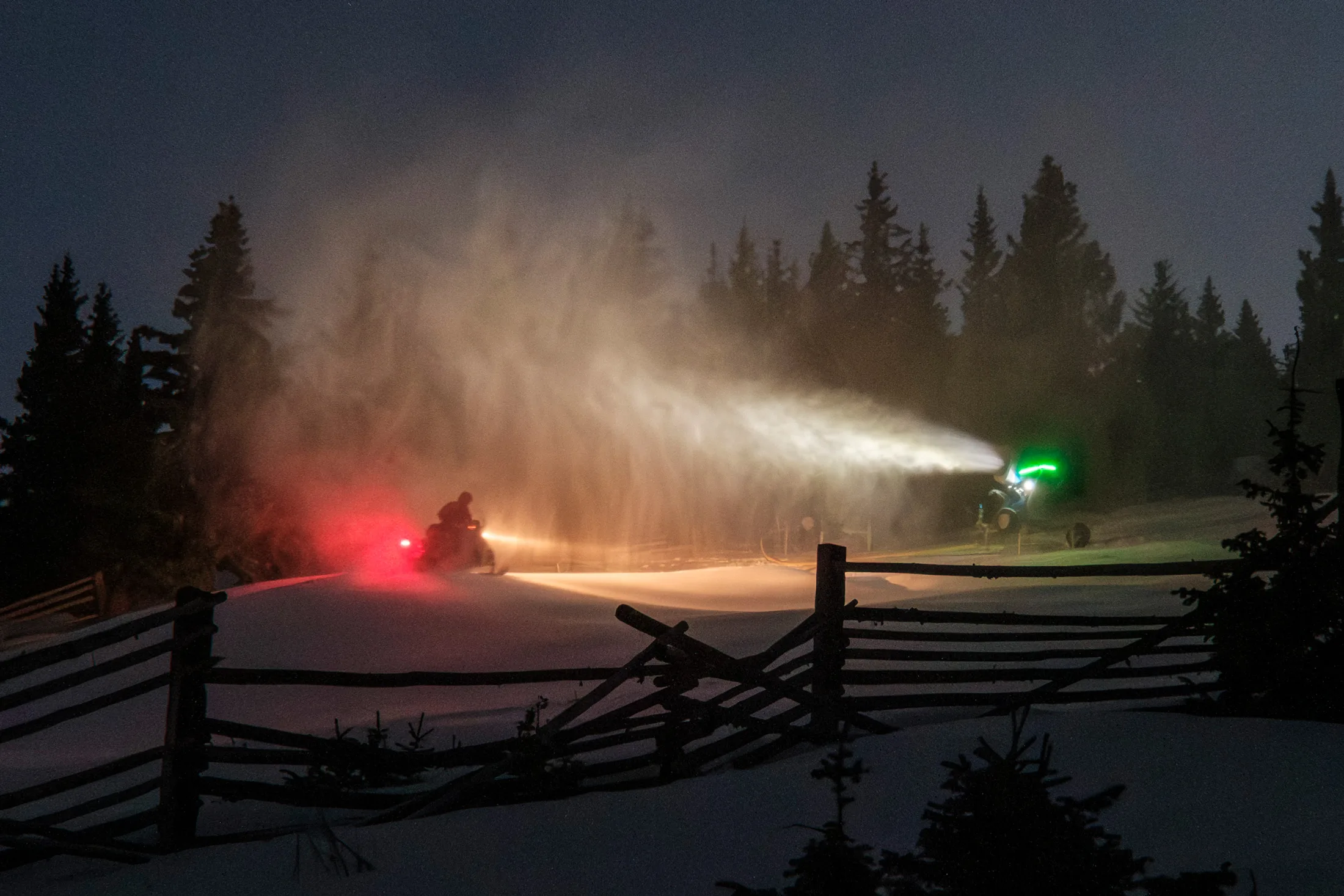
In Colorado, the Arapahoe Basin ski area currently has less than a third of its runs open, a telling statistic for a region accustomed to robust winter conditions. Similarly, Washington’s Mt. Baker Ski Area was compelled to cancel its annual snowboard race due to an "unworkable snowpack," highlighting the severity of the situation. Across Oregon, Hoodoo Ski Area and Mt. Bachelor Ski Area faced temporary closures lasting weeks, directly attributable to the lack of natural snowfall. The ripple effects extend to collegiate athletics, with the NCAA Ski Championships being relocated from Bozeman, Montana, to Utah, underscoring the widespread geographical impact of the warm winter.
Faced with these challenging conditions, ski resorts are increasingly turning to artificial snowmaking, though comprehensive data on their operational capacities remains elusive. Major resort conglomerates like Alterra and POWDR did not respond to inquiries regarding their snowmaking efforts. Vail Resorts, a global operator of 42 ski areas, acknowledged that "weather conditions, particularly temperature, influence how much and how long we make snow," but declined to share specific snowmaking data, citing proprietary concerns.
Steven Fassnacht, a professor of snow hydrology at Colorado State University, points out the significant hurdles to drastically increasing snowmaking in the Western U.S. Acquiring the necessary water rights for such an expansion would involve a costly and legally intricate process. Historically, Western ski resorts have operated with a far lower capacity for artificial snow production compared to their counterparts in other regions of the country. Nationally, fewer than 10% of skiable acres are covered by man-made snow on average, a stark contrast to the over 50% in the Northeast and approximately 80% in the Southeast and Midwest.

However, as climate change progressively ushers in warmer and more unpredictable winters, the necessity of snowmaking in the West is poised to escalate, bringing with it a host of environmental considerations and other challenges. The very technology that sustains the winter sports industry is itself a product of human ingenuity, with its origins tracing back to 1949. It was then that a Connecticut ski resort owner experimented with spreading 700 pounds of ice onto a single slope, a rudimentary effort that lasted only about two weeks but sparked an idea among a group of engineers and former ski entrepreneurs. As ski historian John Fry documented, outside their defunct ski factory, they connected a 10-horsepower compressor via a garden hose to a spray-gun nozzle previously used for painting skis, laying the groundwork for modern snowmaking.
The core technology of snowmaking, while advanced, fundamentally remains the same: spraying highly pressurized water into the atmosphere, where it freezes into ice crystals. The primary environmental concerns revolve around the substantial energy and water consumption required for this process. Beyond that, potential impacts range from soil degradation to chemical exposure, and crucially, Indigenous communities have raised objections concerning the desecration of sacred sites through wastewater discharge.
The energy demands of snowmaking are considerable, necessitating the pumping of water uphill and the pressurization of air. A comprehensive study encompassing 10 ski areas across the United States estimated that snowmaking accounts for an average of 18% of a resort’s total energy consumption. The volume of water utilized is also significant. For instance, Palisades Tahoe reportedly uses between 50 to 70 million gallons of water annually for snowmaking, sufficient to cover approximately 60 acres of terrain with 1.5 feet of snow, according to the San Francisco Chronicle.
While 70 million gallons represents a substantial quantity—equivalent to the annual water usage of about 50 American families—Professor Fassnacht emphasizes that an estimated 80% of this water ultimately returns to streams and rivers through melt and runoff, with the remainder lost to evaporation. Although this water is drawn from the same sources that supply cities and farms, the critical difference lies in the timing of demand. Ski resorts typically engage in snowmaking during the late fall and early winter, a period when agricultural and municipal water needs have not yet reached their peak, which typically occurs in the late spring and summer. Furthermore, in scenarios of water scarcity, ski resorts are considered junior water rights holders, meaning they would be secondary in line to users with senior water rights. In Colorado, for example, snowmaking constitutes a mere estimated 0.05% of the state’s annual water consumption, a minuscule fraction compared to agriculture’s approximately 85% share.

Crucially, machine-made snow differs from natural snow in a vital aspect: it does not contribute to the region’s water supply at scale. Researchers at the University of California, Berkeley, have noted that approximately 75% of the water relied upon by Western communities originates from mountain snowpack. Consequently, even if snowmaking provides a solution for skiers facing dry conditions, it does not compensate for the broader deficit in water resources during dry winters when that water is most needed for downstream users. Professor Fassnacht articulates this by stating, "Snowmaking should be considered a temporary storage on the mountain, instead of in a reservoir. The water is not really taken out of the system, just stored somewhere else. It does not replace snow that falls from the sky."
Fassnacht’s primary concern regarding snowmaking centers on its timing—specifically, when resorts draw water from streams. If water is extracted during periods of low flow, he warns, it could have detrimental consequences for aquatic life. To mitigate their reliance on fresh water, some resorts, such as Big Sky in Montana, have begun producing snow from treated wastewater. While conservation groups have lauded this practice as "a win-win for the health of our rivers and the resort economy," it remains a contentious issue.
Flagstaff’s Arizona Snowbowl, for example, commenced using treated wastewater for snowmaking in 2013. This practice involved spraying sewage-treated water onto a mountain considered sacred by local Indigenous peoples and members of 13 Native American tribes. The controversial implementation and subsequent protests persist to this day.
On a broader level, snowmaking can be viewed as an adaptation strategy to climate change. However, researchers are increasingly questioning whether it represents a maladaptation—a solution that inadvertently exacerbates the problem. A 2022 study published in the Journal of Sustainable Tourism concluded that the environmental footprint of snowmaking is heavily influenced by a resort’s geographical location. In regions with relatively clean electricity grids and high water security, such as Washington, snowmaking has a considerably lower impact compared to states like New Mexico, Colorado, Nevada, and Wyoming, where electricity generation is more carbon-intensive and water stress is more pronounced. Although many of these states have outlined plans to decarbonize their grids in the coming decades, projections indicate a simultaneous increase in water scarcity over the same period.

The researchers also highlighted the significant impact of travel associated with snowmaking. On average, they found that skiers emit more carbon dioxide through their travel than they do at the ski area after driving just 36 miles. Therefore, if snowmaking encourages skiers to opt for local mountains rather than undertaking long-distance travel, it could potentially represent a net positive for the environment.
The prognosis for skiing, particularly at coastal resorts and lower elevations, appears increasingly grim. Jesse Ritner, an assistant professor of history at Georgia College & State University and an author on snowmaking, frankly states, "There’s a level to which, to put it bluntly, the ski industry is screwed. That said, snowmaking is only going to become more and more important." The industry itself recognizes this trend. In 2019, Vail Ski Resort invested in 421 new snow guns for its Colorado mountain, a move hailed as the "largest snowmaking expansion in North American history." Other resorts, like Bogus Basin in Idaho, are experimenting with snowfarming, a technique involving the collection and storage of snow for use in the following winter.
However, even these proactive measures cannot entirely insulate companies from the vagaries of adverse weather. Earlier this year, Vail Resorts informed investors that diminished snowfall in Western states had resulted in a 20% decline in visitation across its North American properties. Michael Pidwirny, an associate professor at the University of British Columbia specializing in climate change and skiing, observes, "Bad years were a real rarity, now they’re becoming more common. They’re going to even increase more in the future, and if it’s too warm, how do you make snow?" Snowmaking is contingent upon sufficiently cold temperatures; the "wet bulb temperature," a metric combining humidity and air temperature, must fall below 28 degrees Fahrenheit for effective snow production. Pidwirny predicts that Whistler Blackcomb, a prominent Vail-owned resort, may face a situation where one out of every two years is too poor to support quality skiing by approximately 2050 or 2060. Resorts will need to adapt, Pidwirny suggests, by acknowledging that "it’s not guaranteed that they’re going to have a ski season every year." Ultimately, even the most advanced snowmaking technology may not be enough to alter this fundamental shift.